
Pulp Fiction, 1919 · page 182 of 196
Argosy, Vol. 112, No. 2 — page 182: what you’re looking at
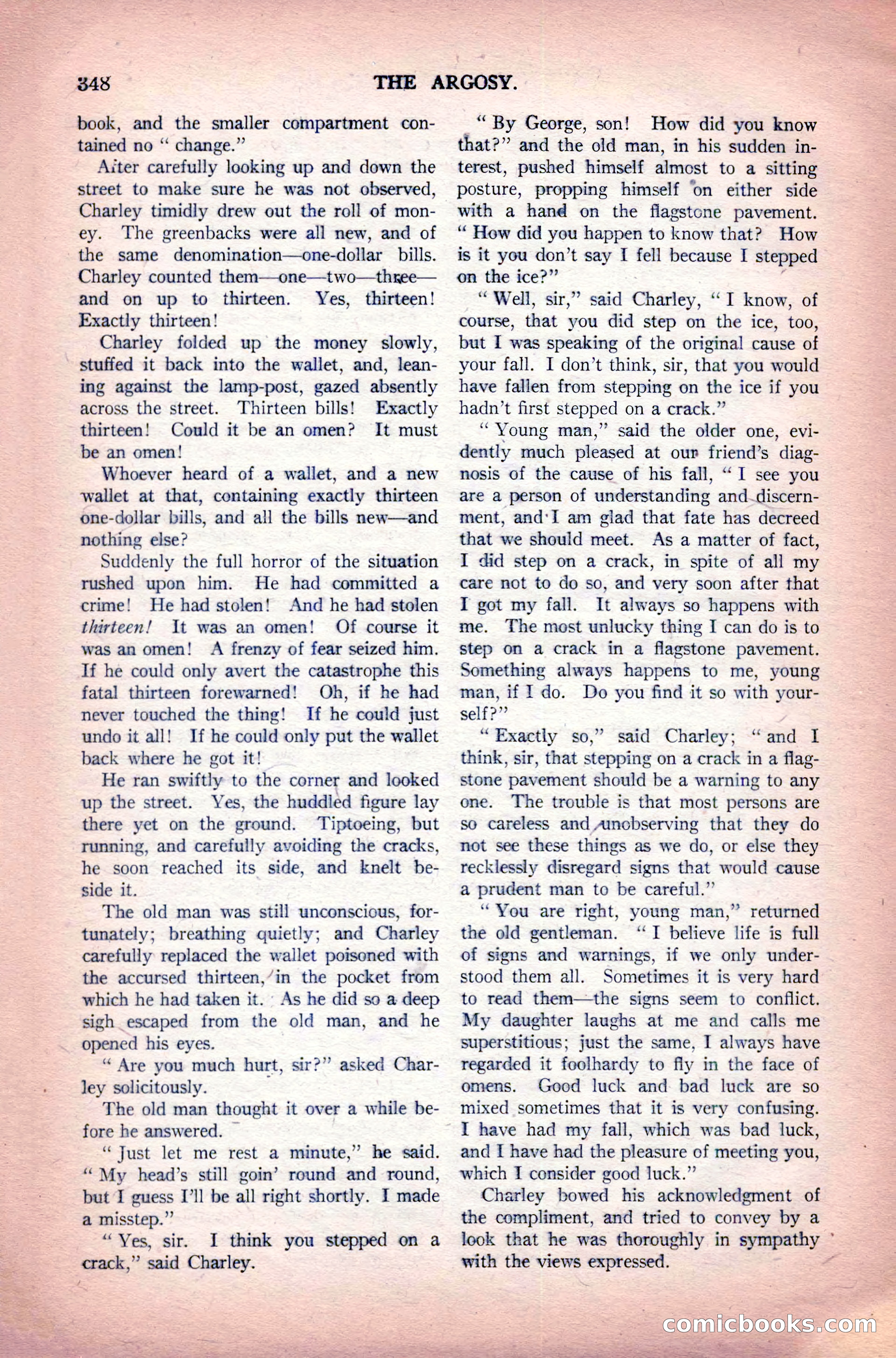
A restored page from Pulp Fiction, 1919. Page through the whole issue in the reader above.
📄 Transcribed text from this page (OCR, searchable)
Machine-transcribed from the original scan — historical spelling and the odd misread are preserved.
3438 book, and the smaller compartment con- tained no “ change.” Aiter carefully looking up and down the street to make sure he was not observed, Charley timidly drew out the roll of mon- ey. The greenbacks were all new, and of the same denomination—one-dollar bills. Charley counted them—one—two—three— and on up to thirteen. Yes, thirteen! Exactly thirteen! Charley folded up the money slowly, stuffed it back into the wallet, and, lean- ing against the lamp-post, gazed absently across the street. Thirteen bills! Exactly thirteen! Could it be an omen? It must be an omen! Whoever heard of a wallet, and a new wallet at that, containing exactly thirteen one-dollar bills, and all the bills new—and nothing else? Suddenly the full horror of the situation rushed upon him. He had committed a crime! He had stolen! And he had stolen thirteen! It was an omen! Of course it was an omen! A frenzy of fear seized him. If he could only avert the catastrophe this fatal thirteen forewarned! Oh, if he had never touched the thing! If he could just undo it all! If he could only put the wallet back where he got it! He ran swiftly to the corner and looked up the street. Yes, the huddled figure lay there yet on the ground. Tiptoeing, but running, and carefully avoiding the cracks, he soon reached its side, and knelt be- side it. The old man was still unconscious, for- tunately; breathing quietly; and Charley carefully replaced the wallet poisoned with the accursed thirteen,’in the pocket from which he had taken it. As he did so a deep sigh escaped from the old man, and he opened his eyes. “ Are you much hurt, sir?” asked Char- ley solicitously. The old man thought it over a while be- fore he answered. | ‘Just let me rest a minute,” he said. “My head’s still goin’ round and round, but I guess I’ll be all right shortly. I made a misstep.” “Ves, sir. I think you stepped on a crack,” said Charley. THE ARGOSY. “By George, son! How did you know that?” and the old man, in his sudden in- terest, pushed himself almost to a sitting posture, propping himself ‘on either side with a hand on the flagstone pavement. “How did you happen to know that? How is it you don’t say I fell because I stepped on the ice?” “Well, sir,” said Charley, “I know, of course, that you did step on the ice, too, but I was speaking of the original cause of your fall. I don’t think, sir, that you would have fallen from stepping on the ice if you hadn’t first stepped on a crack.” “ Young man,” said the older one, evi- dently much pleased at our friend’s diag- nosis of the cause of his fall, “I see you are a person of understanding and-discern- ment, and'I am glad that fate has decreed that we should meet. As a matter of fact, I did step on a crack, in spite of all my care not to do so, and very soon after that I got my fall. It always so happens with me. The most unlucky thing I can do is to step on a crack in a flagstone pavement. Something always happens to me, young man, if 1 do. Do you find it so with your- self?” “Exactly so,” said Charley; “and I think, sir, that stepping on a crack in a flag- stone pavement should be a warning to any one. The trouble is that most persons are so careless and Amobserving that they do not see these things as we do, or else they recklessly disregard signs that would cause a prudent man to be careful.” “You are right, young man,” returned the old gentleman. “I believe life is full of signs and warnings, if we only under- stood them all. Sometimes it is very hard to read them—the signs seem to conflict. My daughter laughs at me and calls me superstitious; just the same, I always have regarded it foolhardy to fly in the face of omens. Good luck and bad luck are so mixed sometimes that it is very confusing. I have had my fall, which was bad luck, and { have had the pleasure of meeting you, which I consider good luck.” Charley bowed his acknowledgment of the compliment, and tried to convey by a look that he was thoroughly in sympathy ° with the views expressed. Eomicbooks = te — ag eee — SS a oe ee eee ee ee (E©) < { we