
Pulp Fiction, 1919 · page 181 of 196
Argosy, Vol. 112, No. 2 — page 181: what you’re looking at
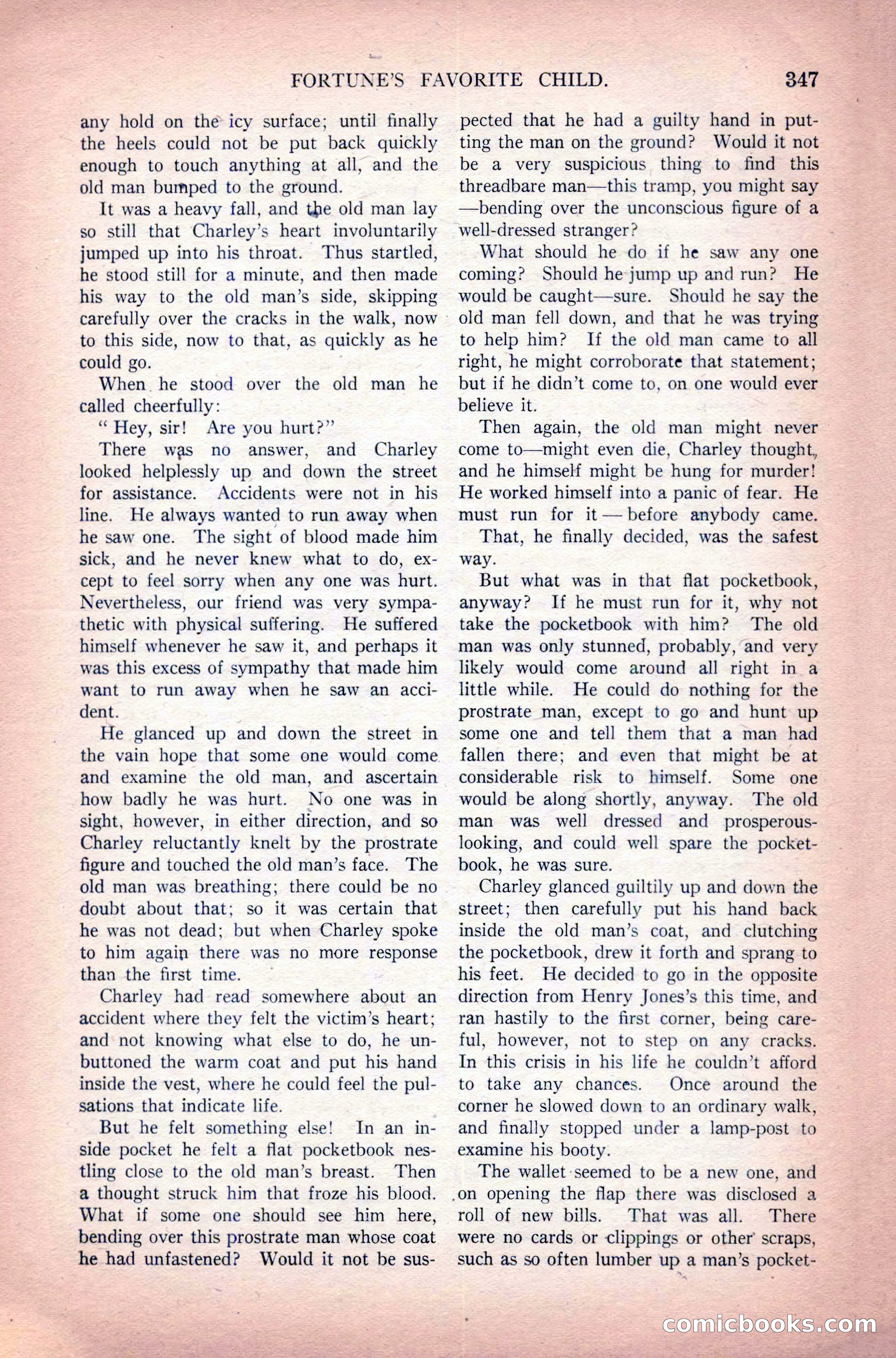
A restored page from Pulp Fiction, 1919. Page through the whole issue in the reader above.
📄 Transcribed text from this page (OCR, searchable)
Machine-transcribed from the original scan — historical spelling and the odd misread are preserved.
FORTUNE’S FAVORITE CHILD. any hold on the icy surface; until finally the heels could not be put back quickly enough to touch anything at all, and the old man bumped to the ground. It was a heavy fall, and the old man lay so still that Charley’s heart involuntarily jumped up into his throat. Thus startled, he stood still for a minute, and then made his way to the old man’s side, skipping carefully over the cracks in the walk, now to this side, now to that, as quickly as he could go. When he stood over the old man he called cheerfully: ‘“ Hey, sir! Are you hurt?” There was no answer, and Charley looked helplessly up and down the street for assistance. Accidents were not in his line. He always wanted to run away when he saw one. The sight of blood made him sick, and he never knew what to do, ex- cept to feel sorry when any one was hurt. Nevertheless, our friend was very sympa- thetic with physical suffering. He suffered himself whenever he saw it, and perhaps it was this excess of sympathy that made him want to run away when he saw an accli- dent. He glanced up and down the street in the vain hope that some one would come and examine the old man, and ascertain how badly he was hurt. No one was in sight, however, in either direction, and so Charley reluctantly knelt by the prostrate figure and touched the old man’s face. The old man was breathing; there could be no doubt about that; so it was certain that he was not dead; but when Charley spoke to him again there was no more response than the first time. Charley had read somewhere about an accident where they felt the victim’s heart; and not knowing what else to do, he un- buttoned the warm coat and put his hand inside the vest, where he could feel the pul- sations that indicate life. But he felt something else! In an in- side pocket he felt a flat pocketbook nes- tling close to the old man’s breast. Then a thought struck him that froze his blood. What if some one should see him here, bending over this prostrate man whose coat he had unfastened? Would it not be sus- 347 pected that he had a guilty hand in put- ting the man on the ground? Would it not be a very suspicious thing to find this threadbare man—this tramp, you might say —hbending over the unconscious figure of a well-dressed stranger? What should he do if he saw any one coming? Should he jump up and run? He would be caught—sure. Should he say the old man fell down, and that he was trying to help him? If the old man came to all right, he might corroborate that statement; but if he didn’t come to, on one would ever believe it. Then again, the old man might never come to—might even die, Charley thought, and he himself might be hung for murder! He worked himself into a panic of fear. He must run for it— before anybody came. That, he finally decided, was the safest way. But what was in that flat pocketbook, anyway? If he must run for it, why not take the pocketbook with him? The old man was only stunned, probably, and very likely would come around all right in a little while. He could do nothing for the prostrate man, except to go and hunt up some one and tell them that a man had fallen there; and even that might be at considerable risk to himself. Some one would be along shortly, anyway. The old man was well dressed and _ prosperous- looking, and could well spare the pocket- book, he was sure. Charley glanced guiltily up and down the street; then carefully put his hand back inside the old man’s coat, and clutching the pocketbook, drew it forth and sprang to his feet. He decided to go in the opposite direction from Henry Jones’s this time, and ran hastily to the first corner, being care- ful, however, not to step on any cracks. In this crisis in his life he couldn’t afford to take any chances. Once around the corner he slowed down to an ordinary walk, and finally stopped under a lamp-post to examine his booty. The wallet:seemed to be a new one, and .on opening the flap there was disclosed a roll of new bills. That was all. There were no cards or clippings or other’ scraps, such as so often lumber up a man’s pocket- Eomicbook