
Pulp Fiction, 1919 · page 159 of 196
Argosy, Vol. 112, No. 2 — page 159: what you’re looking at
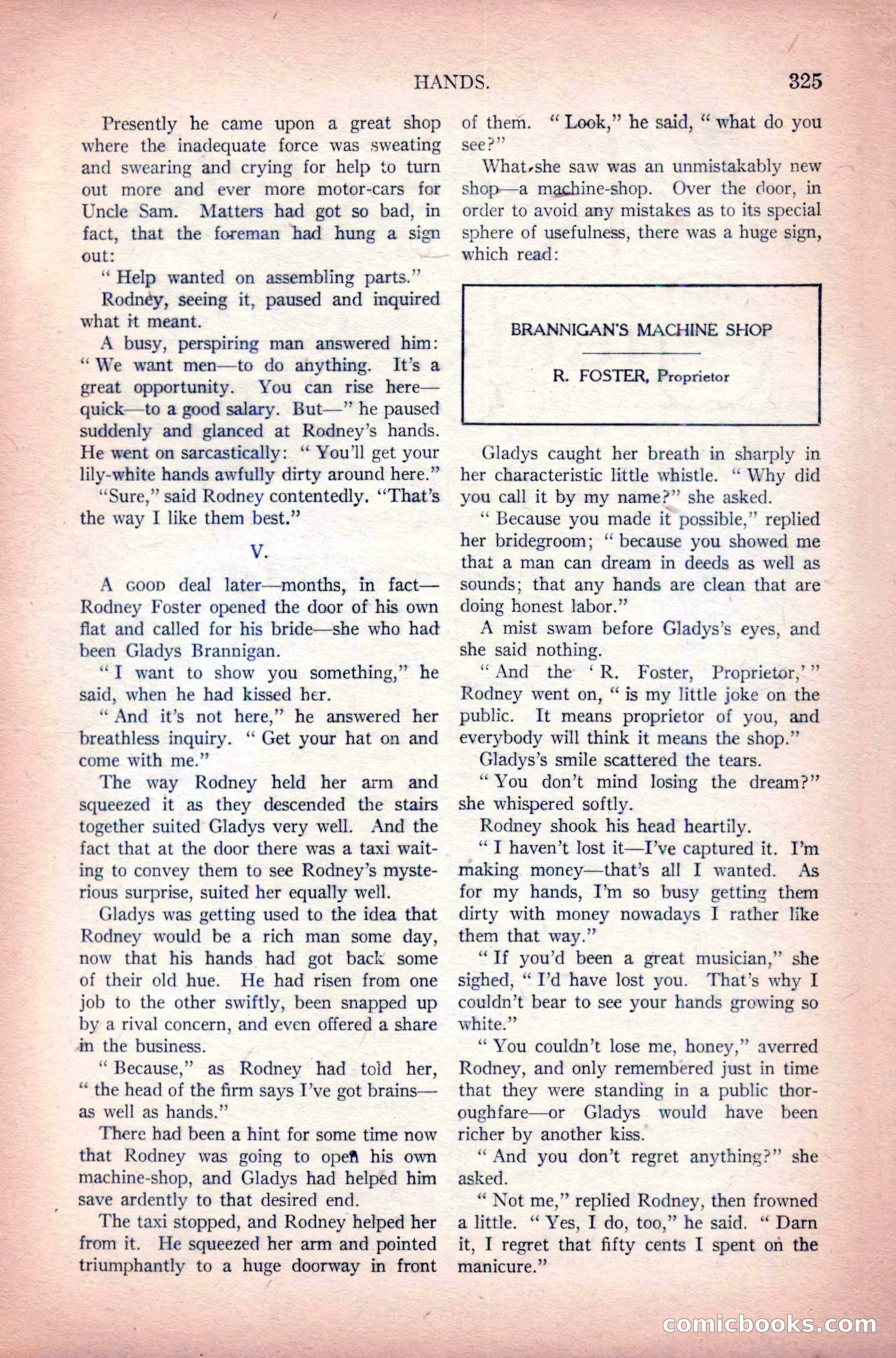
A restored page from Pulp Fiction, 1919. Page through the whole issue in the reader above.
📄 Transcribed text from this page (OCR, searchable)
Machine-transcribed from the original scan — historical spelling and the odd misread are preserved.
HANDS. Presently he came upon a great shop where the inadequate force was sweating and swearing and crying for help to turn out more and ever more motor-cars for Uncle Sam. Matters had got so bad, in fact, that the foreman had hung a sign out: ‘“Help wanted on assembling parts.” Rodnéy, seeing it, paused and mquired what it meant. A busy, perspiring man answered him: ‘We want men—to do anything. It’s a great opportunity. You can rise here— quick—to a good salary. But—”’ he paused suddenly and glanced at Rodney’s hands. He went on sarcastically: ‘ You’ll get your lily-white hands awfully dirty around here.” “Sure,” said Rodney contentedly. ‘“That’s the way I like them best.” V. A coop deal later—months, in fact— Rodney Foster opened the door of his own flat and called for his bride—she who had been Gladys Brannigan. “T want to show you something,” he said, when he had kissed her. “And it’s not here,” he answered her breathless inquiry. “ Get your hat on and come with me.” The way Rodney held her arm and squeezed it as they descended the stairs together suited Gladys very well. And the fact that at the door there was a taxi wait- ing to convey them to see Rodney’s myste- rious surprise, suited her equally well. Gladys was getting used to the idea that Rodney would be a rich man some day, now that his hands had got back some of their old hue. He had risen from one job to the other swiftly, been snapped up by a rival concern, and even offered a share im the business. ‘“ Because,” as Rodney had toid her, “ the head of the firm says I’ve got brains— as well as hands.” There had been a hint for some time now that Rodney was going to ope his own machine-shop, and Gladys had helped him save ardently to that desired end. The taxi stopped, and Rodney helped her from it. He squeezed her arm and pointed triumphantly to a huge doorway in front 325 of them. ‘“ Look,” he said, “ what do you see?” What-she saw was an unmistakably new shop—a magchine-shop. Over the door, in order to avoid any mistakes as to its special sphere of usefulness, there was a huge sign, which read: BRANNIGAN'S MACHINE SHOP R. FOSTER, Proprietor Gladys caught her breath in sharply in her characteristic little whistle. “ Why did you call it by my name?” she asked. ‘“ Because you made it possible,” replied her bridegroom; ‘‘ because you showed me that a man can dream in deeds as well as sounds; that any hands are clean that are doing honest labor.” A mist swam before Gladys’s eyes, and she said nothing. “And the ‘R. Foster, Proprietor, Rodney went on, “ is my little joke on the public. It means proprietor of you, and everybody will think it means the shop.” Gladys’s smile scattered the tears. “You don’t mind losing the dream?” she whispered softly. Rodney shook his head heartily. “I haven’t lost it—I’ve captured it. I’m making money—that’s all I wanted. As for my hands, I’m so busy getting them dirty with money nowadays I rather like them that way.” “If you’d been a great musician,” she sighed, “ I’d have lost you. That’s why I couldn’t bear to see your hands growing so white.” “You couldn’t lose me, honey,” averred Rodney, and only remembered just in time that they were standing in a public thor- oughfare—or Gladys would have been richer by another kiss. ‘““And you don’t regret anything?” she asked. “Not me,” replied Rodney, then frowned a little. ‘“‘ Yes, I do, too,” he said. “ Darn it, I regret that fifty cents I spent on the manicure.” » 9») , comicbooks (E(0) OO