
Pulp Fiction, 1919 · page 158 of 196
Argosy, Vol. 112, No. 2 — page 158: what you’re looking at
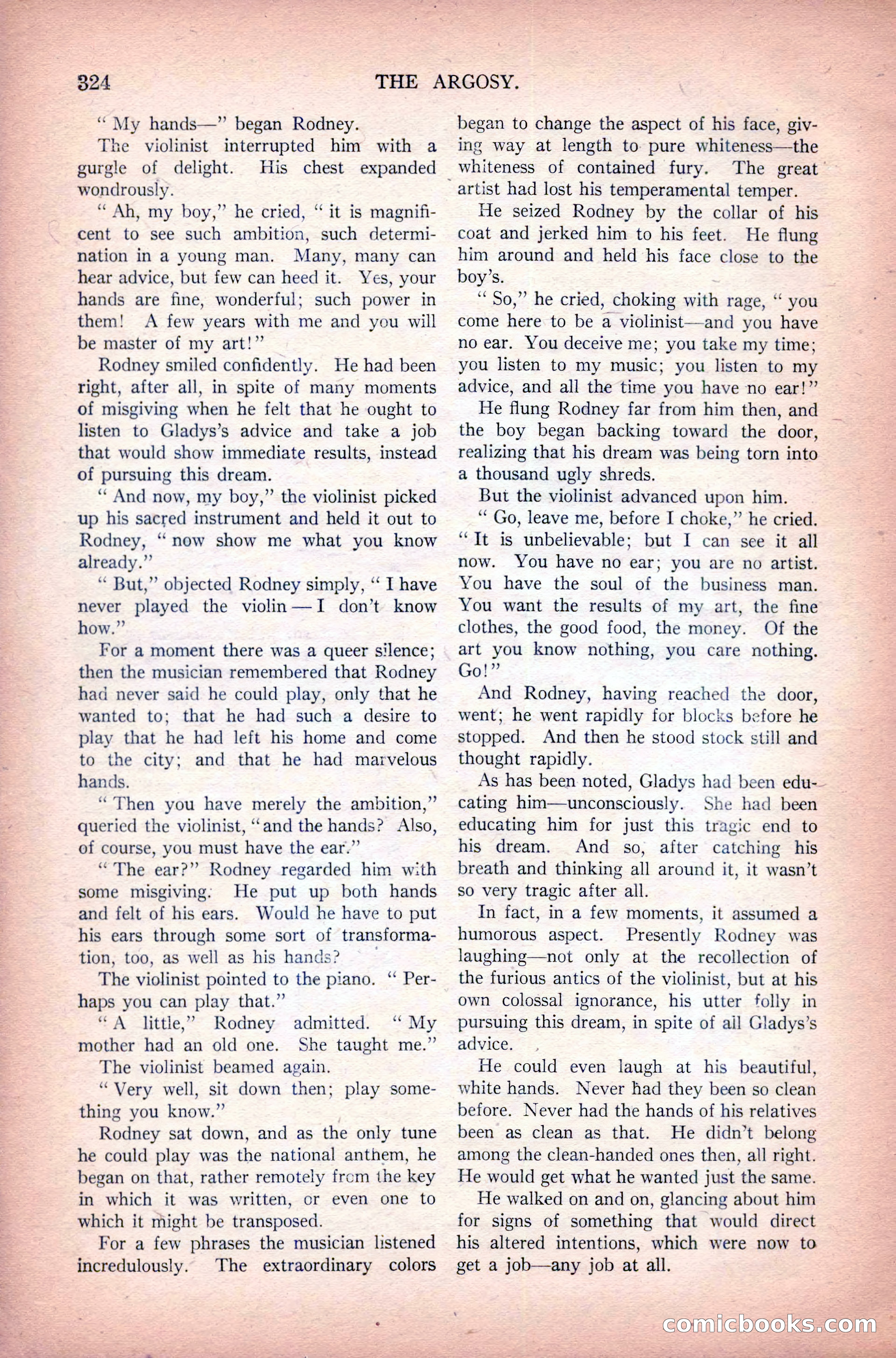
A restored page from Pulp Fiction, 1919. Page through the whole issue in the reader above.
📄 Transcribed text from this page (OCR, searchable)
Machine-transcribed from the original scan — historical spelling and the odd misread are preserved.
O24 THE ARGOSY. “ My hands—” began Rodney. The violinist interrupted him with a gurgle of delight. His chest expanded wondrously. “Ah, my boy,” he cried, “ it is magnifi- cent to see such ambition, such determi- nation in a young man. Many, many can hear advice, but few can heed it. Yes, your hands are fine, wonderful; such power in them! A few years with me and you will be master of my art!”’ Rodney smiled confidently. He had been right, after all, in spite of many moments of misgiving when he felt that he ought to listen to Gladys’s advice and take a job that would show immediate results, instead of pursuing this dream. ‘And now, my boy,” the violinist picked up his sacred instrument and held it out to Rodney, “now show me what you know already.” * But,” objected Rodney simply, “‘ I have never played the violin—I don’t know how.” For a moment there was a queer silence; then the musician remembered that Rodney had never said he could play, only that he wanted to; that he had such a desire to play that he had left his home and come to the city; and that he had marvelous hands. “Then you have merely the ambition,” queried the violinist, ‘““and the hands? Also, of course, you must have the ear.” “The ear?” Rodney regarded him with some misgiving: He put up both hands and felt of his ears. Would he have to put his ears through some sort of transforma- tion, too, as well as his hands? ~~ The violinist pointed to the piano. “ Per- haps you can play that.” “A little,’ Rodney admitted. ‘“‘ My mother had an old one. She taught me.” The violinist beamed again. “Very well, sit down then; play some- thing you know.”’ Rodney sat down, and as the only tune he could play was the national anthem, he began on that, rather remotely from the key in which it was written, or even one to which it might be transposed. For a few phrases the musician listened incredulously. The extraordinary colors Z comicbook began to change the aspect of his face, giv- ing way at length to pure whiteness—the whiteness of contained fury. The great’ artist had lost his temperamental temper. He seized Rodney by the collar of his coat and jerked him to his feet. He flung him around and held his face close to the boy’s. “So,” he cried, choking with rage, “ you come here to be a violinist—and you have no ear. You deceive me; you take my time; you listen to my music; you listen to my advice, and all the time you have no ear!” He flung Rodney far from him then, and the boy began backing toward the door, realizing that his dream was being torn into a thousand ugly shreds. But the violinist advanced upon him. ‘Go, leave me, before I choke,” he cried. “It is unbelievable; but I can see it all now. You have no ear; you are no artist. You have the soul of the business man. You want the results of my art, the fine clothes, the good food, the money. Of the art you know nothing, you care nothing. Go!” And Rodney, having reached the door, went; he went rapidly for blocks before he stopped. And then he stood stock still and thought rapidly. As has been noted, Gladys had been edu-- cating him—unconsciously. She had been educating him for just this tragic end to his dream. And so, after catching his breath and thinking all around it, it wasn’t so very tragic after all. In fact, in a few moments, it assumed a humorous aspect. Presently Rodney was laughing—not only at the recollection of the furious antics of the violinist, but at his own colossal ignorance, his utter folly in pursuing this dream, in spite of ail Gladys’s advice. He could even laugh at his beautiful, white hands. Never had they been so clean before. Never had the hands of his relatives been as clean as that. He didn’t belong among the clean-handed ones then, all right. He would get what he wanted just the same. He walked on and on, glancing about him for signs of something that would direct his altered intentions, which were now to get a job—any job at all.