
Pulp Fiction, 1919 · page 93 of 188
Argosy, Vol. 111, No. 1 — page 93: what you’re looking at
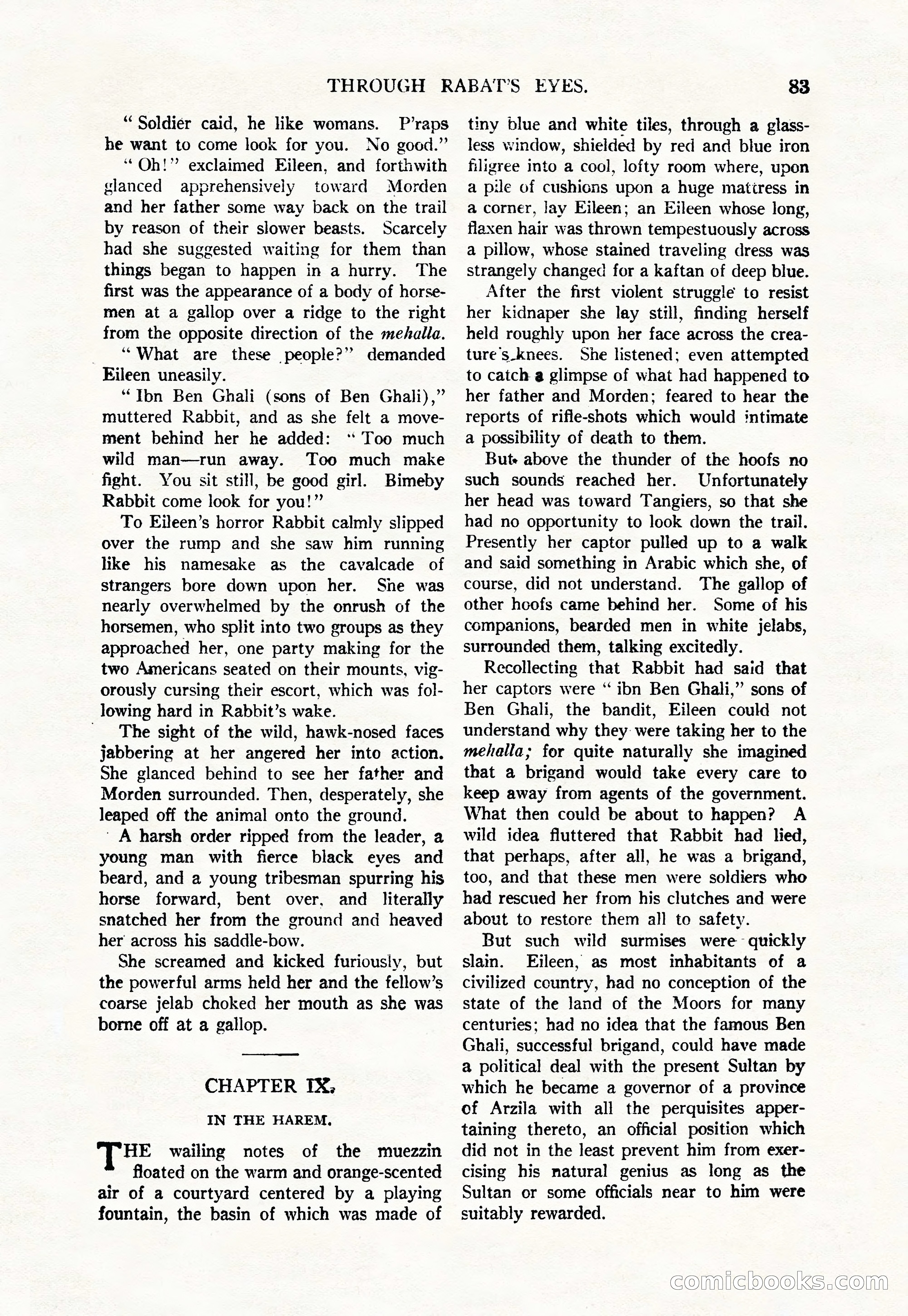
A restored page from Pulp Fiction, 1919. Page through the whole issue in the reader above.
📄 Transcribed text from this page (OCR, searchable)
Machine-transcribed from the original scan — historical spelling and the odd misread are preserved.
THROUGH RABAT’S EYES. “‘ Soldier caid, he like womans. P’raps he want to come look for you. No good.” “Qh!” exclaimed Eileen, and forthwith glanced apprehensively toward Morden and her father some way back on the trail by reason of their slower beasts. Scarcely had she suggested waiting for them than things began to happen in a hurry. The first was the appearance of a body of horse- men at a gallop over a ridge to the right from the opposite direction of the mehalla. “What are these people?” demanded Eileen uneasily. “Ibn Ben Ghali (sons of Ben Ghali),” muttered Rabbit, and as she felt a move- ment behind her he added: ‘ Too much wild man—run away. ‘Too much make fight. You sit still, be good girl. Bimeby Rabbit come look for you!” To Eileen’s horror Rabbit calmly slipped over the rump and she saw him running like his namesake as the cavalcade of strangers bore down upon her. She was nearly overwhelmed by the onrush of the horsemen, who split into two groups as they approached her, one party making for the two Americans seated on their mounts, vig- orously cursing their escort, which was fol- lowing hard in Rabbit’s wake. The sight of the wild, hawk-nosed faces jJabbering at her angered her into action. She glanced behind to see her father and Morden surrounded. Then, desperately, she leaped off the animal onto the ground. ' A harsh order ripped from the leader, a young man with fierce black eyes and beard, and a young tribesman spurring his horse forward, bent over, and _ literally snatched her from the ground and heaved her across his saddle-bow. She screamed and kicked furiously, but the powerful arms held her and the fellow’s coarse jelab choked her mouth as she was borne off at a gallop. CHAPTER IX, IN THE HAREM. THE wailing notes of the muezzin floated on the warm and orange-scented air of a courtyard centered by a playing fountain, the basin of which was made of 83 tiny blue and white tiles, through a glass- less window, shielded by red and blue iron filigree into a cool, lofty room where, upon a pile of cushions upon a huge matiress in a corner, lay Eileen; an Eileen whose long, flaxen hair was thrown tempestuously across a pillow, whose stained traveling dress was strangely changed for a kaftan of deep blue. After the first violent struggle to resist her kidnaper she lay still, finding herself held roughly upon her face across the crea- ture s_knees. She listened; even attempted to catch a glimpse of what had happened to her father and Morden; feared to hear the reports of rifle-shots which would intimate a possibility of death to them. Bute above the thunder of the hoofs no such sounds reached her. Unfortunately her head was toward Tangiers, so that she had no opportunity to look down the trail. Presently her captor pulled up to a walk and said something in Arabic which she, of course, did not understand. The gallop of other hoofs came behind her. Some of his companions, bearded men in white jelabs, surrounded them, talking excitedly. Recollecting that Rabbit had said that her captors were ‘“ ibn Ben Ghali,” sons of Ben Ghali, the bandit, Eileen could not understand why they were taking her to the mehalla; for quite naturally she imagined that a brigand would take every care to keep away from agents of the government. What then could be about to happen? A wild idea fluttered that Rabbit had lied, that perhaps, after all, he was a brigand, too, and that these men were soldiers who had rescued her from his clutches and were about to restore them all to safety. But such wild surmises were quickly slain. Eileen, as most mhabitants of a civilized country, had no conception of the state of the land of the Moors for many centuries; had no idea that the famous Ben Ghali, successful brigand, could have made a political deal with the present Sultan by which he became a governor of a province of Arzila with all the perquisites apper- taining thereto, an official position which did not in the least prevent him from exer- cising his natural genius as long as the Sultan or some officials near to him were suitably rewarded. GOMIIGIOO