
Pulp Fiction, 1919 · page 90 of 188
Argosy, Vol. 111, No. 1 — page 90: what you’re looking at
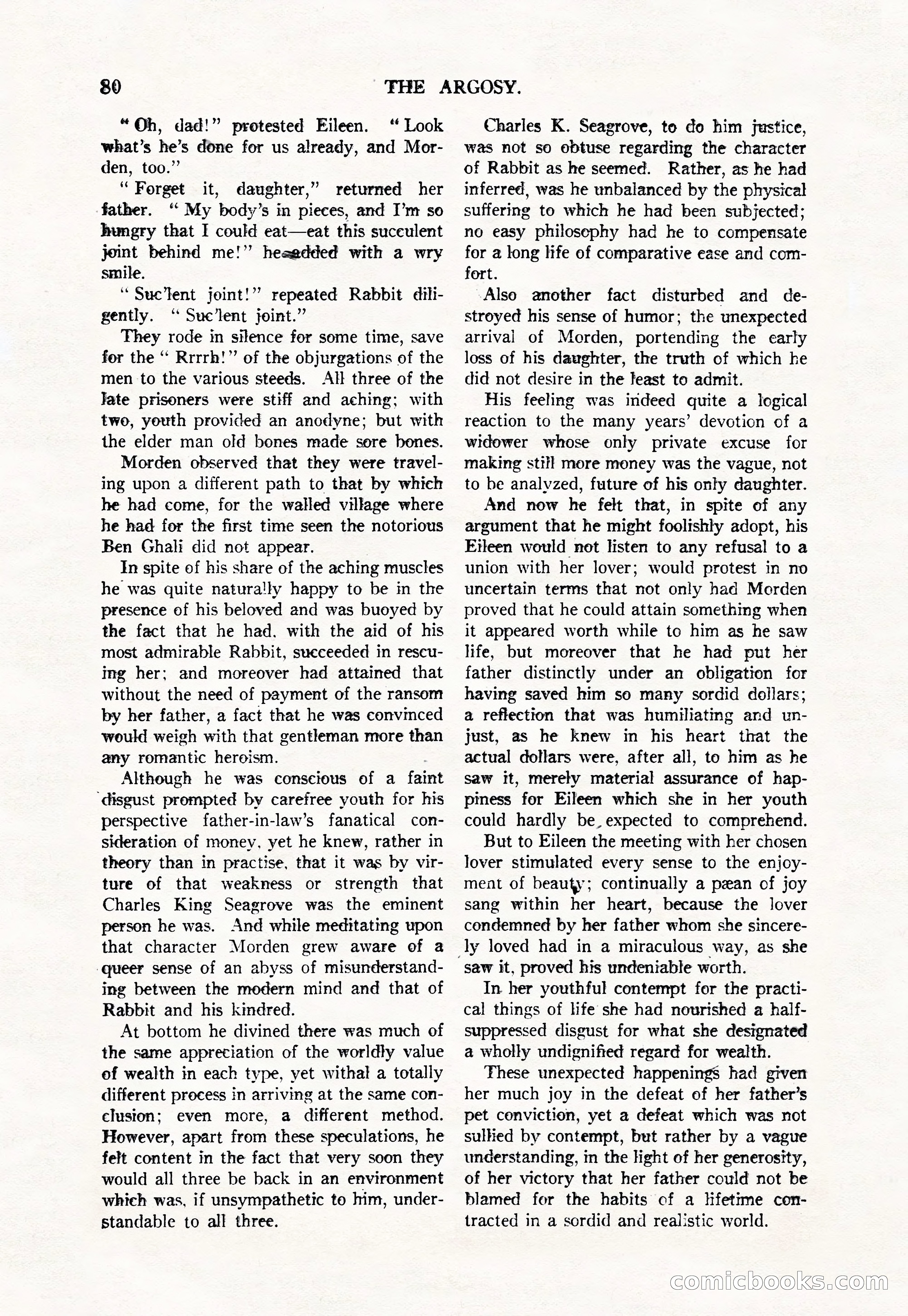
A restored page from Pulp Fiction, 1919. Page through the whole issue in the reader above.
📄 Transcribed text from this page (OCR, searchable)
Machine-transcribed from the original scan — historical spelling and the odd misread are preserved.
80 “Oh, dad!” protested Eileen. ‘ Look what’s he’s done for us already, and Mor- den, too.” “Forget it, daughter,” returned her father. ‘‘ My body’s in pieces, and I’m so hungry that I could eat—eat this succulent joint behind me!” heaedded with a wry smile. ‘“ Sucent joint!” repeated Rabbit dili- gently. ‘“ Suc’lent joint.” They rode im silence for some time, save for the ‘‘ Rrrrh!”’ of the objurgations of the men to the various steeds. All three of the Jate prisoners were stiff and aching; with two, youth provided an anodyne; but with the elder man old bones made sore bones. Morden observed that they were travel- ing upon a different path to that by which he had come, for the walled village where he had for the first time seen the notorious Ben Ghali did not appear. In spite of his share of the aching muscles he was quite natura!ly happy to be in the presence of his beloved and was buoyed by the fact that he had. with the aid of his most admirable Rabbit, succeeded in reseu- ing her; and moreover had attained that without the need of payment of the ransom by her father, a fact that he was convinced would weigh with that gentleman more than any romantic heroism. . Although he was conscious of a faint ‘disgust prompted by carefree youth for his perspective father-in-law’s fanatical con- sideration of money, yet he knew, rather in theory than in practise, that it was by vir- ture of that weakness or strength that Charles King Seagrove was the eminent person he was. And while meditating upon that character Morden grew aware of a ‘queer sense of an abyss of misunderstand- ing between the modern mind and that of Rabbit and his kmdred. At bottom he divined there was much of the same appreciation of the worldly value of wealth in each type, yet withal a totally different process in arriving at the same con- clusion; even more, a different method. However, apart from these speculations, he felt content in the fact that very soon they would all three be back in an environment which was, if unsympathetic to him, under- standable to all three. THE ARGOSY. Charles K. Seagrove, to do him justice, was not so obtuse regarding the character of Rabbit as he seemed. Rather, as he had inferred, was he unbalanced by the physical suffering to which he had been subjected; no easy philosephy had he to compensate for a long life of comparative ease and com- fort. -Also another fact disturbed and de- stroyed his sense of humor; the unexpected arrival of Morden, portending the early loss of his daughter, the truth of which he did not desire in the least to admit. His feeling was indeed quite a logical reaction to the many years’ devotion of a widower whose only private excuse for making stri} more money was the vague, not to be analvzed, future of his only daughter. And now he felt that, in spite of any argument that he might foolishly adopt, his Eileen would not listen to any refusal to a union with her lover; would protest in no uncertain terms that not only had Morden proved that he could attain somethmg when it appeared worth while to him as he saw life, but moreover that he had put her father distinctly under an obligation for having saved him so many sordid dollars; a reftection that was humiliatmg and un- just, as he knew in his heart that the actual dollars were, after all, to him as he Saw it, merely material assurance of hap- piness for Eileen which she in her youth could hardly be. expected to comprehend. But to Eileen the meeting with her chosen lover stimulated every sense to the enjoy- ment of beauty; continually a pean of joy sang within her heart, because the lover condemned by her father whom she sincere- ly loved had in a miraculous way, as she “saw it, proved his undeniable worth. In her youthful contempt for the practi- cal things of hfe she had nourished a half- suppressed disgust for what she designated a wholly undignified regard for wealth. Fhese unexpected happenings had given her much joy in the defeat of her father’s pet conviction, yet a defeat which was not sulted by contempt, but rather by a vague understanding, in the light of her generosity, of her victory that her father could not be blamed for the habits of a hfetime con- tracted in a sordid and realistic world. Conn SIOOKS (CO)