
Pulp Fiction, 1919 · page 81 of 188
Argosy, Vol. 111, No. 1 — page 81: what you’re looking at
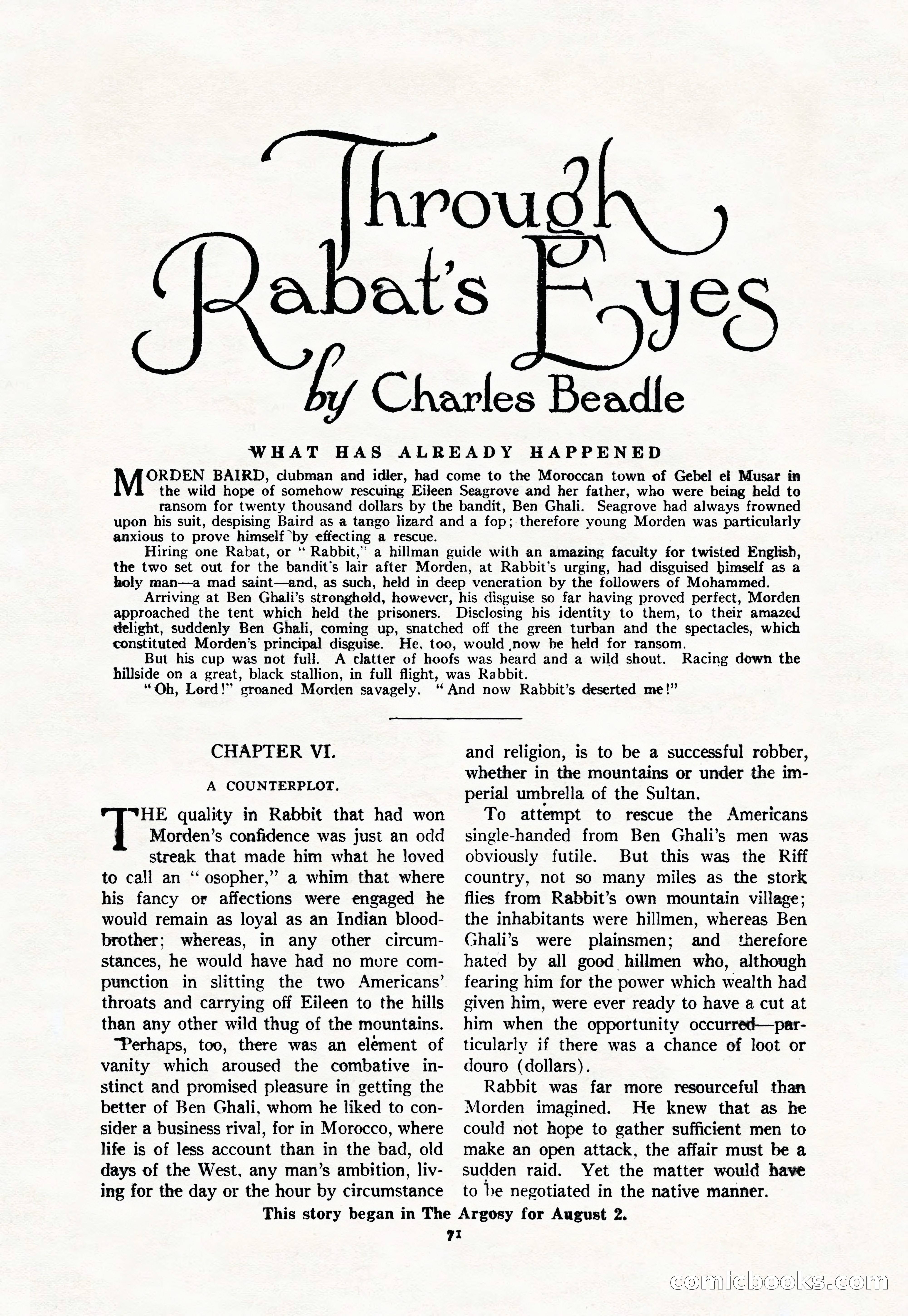
A restored page from Pulp Fiction, 1919. Page through the whole issue in the reader above.
📄 Transcribed text from this page (OCR, searchable)
Machine-transcribed from the original scan — historical spelling and the odd misread are preserved.
hroug abat’s hy Charles Bea IO ec WHAT HAS ALREADY HAPPENED ORDEN BAIRD, clubman and idler, had come to the Moroccan town of Gebel el Musar in the wild hope of somehow rescuing Eileen Seagrove and her father, who were being held to ransom for twenty thousand dollars by the bandit, Ben Ghali. Seagrove had always frowned upon his suit, despising Baird as a tango lizard and a fop; therefore young Morden was particularly anxious to prove himself ‘by effecting a rescue. Hiring one Rabat, or “ Rabbit,” a hillman guide with an amazing faculty for twisted English, the two set out for the bandit’s lair after Morden, at Rabbit’s urging, had disguised himself as a holy man—a mad saint—and, as such, held in deep veneration by the followers of Mohammed. Arriving at Ben Ghali’s strongheld, however, his disguise so far having proved perfect, Morden i Disclosing his identity to them, to their amazed delight, suddenly Ben Ghali, coming up, snatched off the green turban and the spectacles, which constituted Morden’s principal disguise. He, too, would .now be held for ransom. approached the tent which held the prisoners. But his cup was not full. A clatter of hoofs was heard and a wild shout. Racing down the hillside on a great, black stallion, in full flight, was Rabbit. “Oh, Lerd!” groaned Morden savagely. CHAPTER VI. A COUNTERPLOT. “SHE quality in Rabbit that had won Morden’s confidence was Just an odd streak that made him what he loved to call an ‘‘ osopher,” a whim that where his fancy or affections were engaged he would remain as loyal as an Indian blood- brother; whereas, in any other circum- stances, he would have had no more com- punction in slitting the two Americans’ throats and carrying off Eileen to the hills than any other wild thug of the mountains. “Perhaps, too, there was an element of vanity which aroused the combative in- stinct and promised pleasure in getting the better of Ben Ghali, whom he liked to con- sider a business rival, for in Morocco, where life is of less account than in the bad, old days of the West, any man’s ambition, liv- ing for the day or the hour by circumstance “And now Rabbit’s deserted me!” and religion, is to be a successful robber, whether in the mountains or under the im- perial umbrella of the Sultan. To attempt to rescue the Americans single-handed from Ben Ghali’s men was obviously futile. But this was the Riff country, not so many miles as the stork flies from Rabbit’s own mountain village; the inhabitants were hillmen, whereas Ben (shali’s were plainsmen; and _ therefore hated by all good hillmen who, although fearing him for the power which wealth had given him, were ever ready to have a cut at him when the opportunity occurred—par- ticularly if there was a chance of loot or douro (dollars). Rabbit was far more resourceful than Morden imagined. He knew that as he could not hope to gather sufficient men to make an open attack, the affair must be a sudden raid. Yet the matter would have to be negotiated in the native manner. This story began in The Argosy for August 2. 71 CO DOOK CO