
Pulp Fiction, 1919 · page 66 of 188
Argosy, Vol. 111, No. 1 — page 66: what you’re looking at
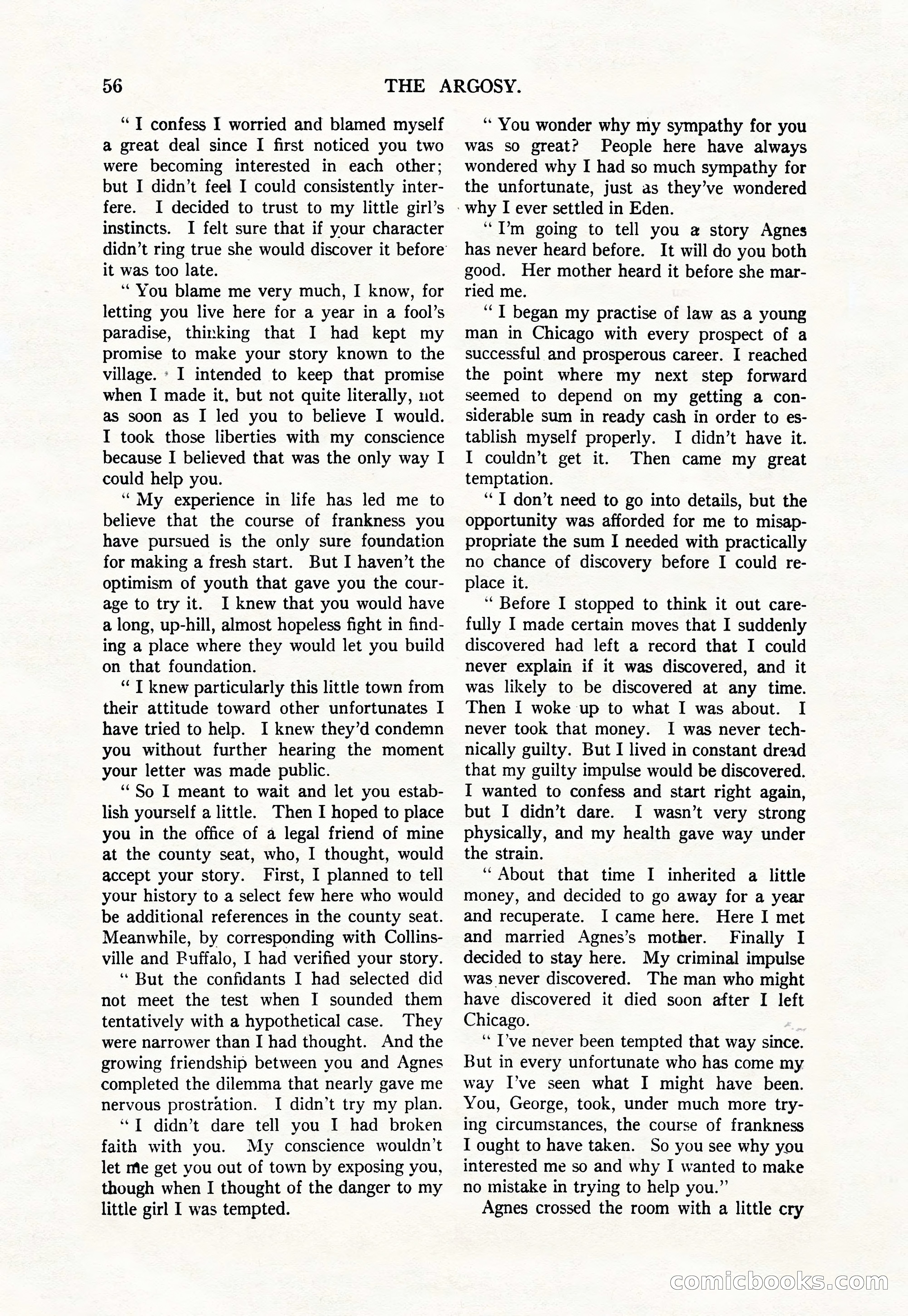
A restored page from Pulp Fiction, 1919. Page through the whole issue in the reader above.
📄 Transcribed text from this page (OCR, searchable)
Machine-transcribed from the original scan — historical spelling and the odd misread are preserved.
56 “TI confess I worried and blamed myself a great deal since I first noticed you two were becoming interested in each other; but I didn’t feel I could consistently inter- fere. I decided to trust to my little girl’s instincts. I felt sure that if your character didn’t ring true she would discover it before it was too late. ‘You blame me very much, I know, for letting you live here for a year in a fool’s paradise, thinking that I had kept my promise to make your story known to the village. » I intended to keep that promise when I made it. but not quite literally, not as soon as I led you to believe I would. I took those liberties with my conscience because I believed that was the only way I could help you. ‘“My experience in life has led me to believe that the course of frankness you have pursued is the only sure foundation for making a fresh start. But I haven’t the optimism of youth that gave you the cour- age to try it. I knew that you would have a long, up-hill, almost hopeless fight in find- ing a place where they would let you build on that foundation. “ T knew particularly this little town from their attitude toward other unfortunates I have tried to help. I knew they’d condemn you without further hearing the moment your letter was made public. ‘So I meant to wait and let you estab- lish yourself a little. Then I hoped to place you in the office of a legal friend of mine at the county seat, who, I thought, would accept your story. First, I planned to tell your history to a select few here who would be additional references in the county seat. Meanwhile, by corresponding with Collins- ville and Ruffalo, I had verified your story. ‘But the confidants I had selected did not meet the test when I sounded them tentatively with a hypothetical case. They were narrower than I had thought. And the growing friendship between you and Agnes completed the dilemma that nearly gave me nervous prostration. I didn’t try my plan. ‘““[ didn’t dare tell you I had broken faith with you. My conscience wouldn’t let me get you out of town by exposing you, though when I thought of the danger to my little girl I was tempted. THE ARGOSY. ‘You wonder why my sympathy for you was so great? People here have always wondered why I had so much sympathy for the unfortunate, just as they’ve wondered -why I ever settled in Eden. ‘I’m going to tell you a@ story Agnes has never heard before. It will do you both good. Her mother heard it before she mar- ried me. ‘I began my practise of law as a young man in Chicago with every prospect of a successful and prosperous career. I reached the point where my next step forward seemed to depend on my getting a con- siderable sum in ready cash in order to es- tablish myself properly. I didn’t have it. I couldn’t get it. Then came my great temptation. ‘“] don’t need to go into details, but the Opportunity was afforded for me to misap- propriate the sum I needed with practically no chance of discovery before I could re- place it. ‘“ Before I stopped to think it out care- fully I made certain moves that I suddenly discovered had left a record that I could never explain if it was discovered, and it was likely to be discovered at any time. Then I woke up to what I was about. I never took that money. I was never tech- nically guilty. But I lived in constant dread that my guilty impulse would be discovered. I wanted to confess and start right again, but I didn’t dare. I wasn’t very strong physically, and my health gave way under the strain. ‘About that time I inherited a little money, and decided to go away for a year and recuperate. I came here. Here I met and married Agnes’s mother. Finally I decided to stay here. My criminal impulse was never discovered. The man who might have discovered it died soon after I left Chicago. ‘ I’ve never been tempted that way since. But in every unfortunate who has come my way I’ve seen what I might have been. You, George, took, under much more try- ing circumstances, the course of frankness I ought to have taken. So you see why you interested me so and why I wanted to make no mistake in trying to help you.”’ Agnes crossed the room with a little cry COMmiic|ooo S (CO