
Pulp Fiction, 1919 · page 64 of 188
Argosy, Vol. 111, No. 1 — page 64: what you’re looking at
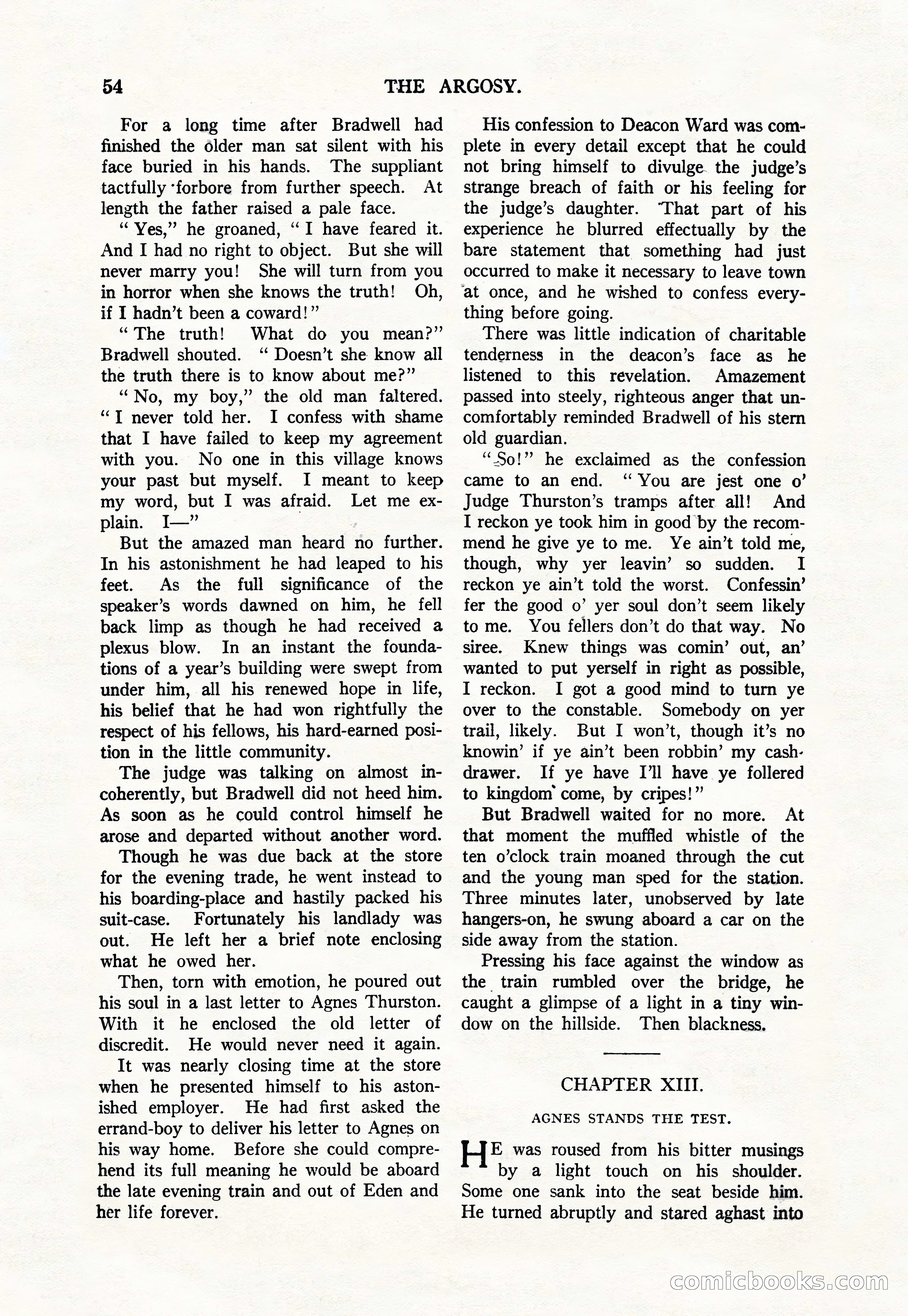
A restored page from Pulp Fiction, 1919. Page through the whole issue in the reader above.
📄 Transcribed text from this page (OCR, searchable)
Machine-transcribed from the original scan — historical spelling and the odd misread are preserved.
54 For a long time after Bradwell had finished the older man sat silent with his face buried in his hands. The suppliant tactfully ‘forbore from further speech. At length the father raised a pale face. “Yes,” he groaned, “‘I have feared it. And I had no right to object. But she will never marry you! She will turn from you in horror when she knows the truth! Oh, if I hadn’t been a coward!” “The truth! What do you mean?” Bradwell shouted. ‘‘ Doesn’t she know all the truth there is to know about me?” ‘““No, my boy,” the old man faltered. ‘““T never told her. I confess with shame that I have failed to keep my agreement with you. No one in this village knows your past but myself. I meant to keep my word, but I was afraid. Let me ex- plain. I—” But the amazed man heard no further. In his astonishment he had leaped to his feet. As the full significance of the speaker’s words dawned on him, he fell back limp as though he had received a plexus blow. In an instant the founda- tions of a year’s building were swept from under him, all his renewed hope in life, his belief that he had won rightfully the respect of his fellows, his hard-earned posi- tion in the little community. The judge was talking on almost in- coherently, but Bradwell did not heed him. As soon as he could control himself he arose and departed without another word. Though he was due back at the store for the evening trade, he went instead to his boarding-place and hastily packed his suit-case. Fortunately his landlady was out. He left her a brief note enclosing what he owed her. Then, torn with emotion, he poured out his soul in a last letter to Agnes Thurston. With it he enclosed the old letter of discredit. He would never need it again. It was nearly closing time at the store when he presented himself to his aston- ished employer. He had first asked the errand-boy to deliver his letter to Agnes on his way home. Before she could compre- hend its full meaning he would be aboard the late evening train and out of Eden and her life forever. THE ARGOSY. His confession to Deacon Ward was com- plete in every detail except that he could not bring himself to divulge. the judge’s strange breach of faith or his feeling for the judge’s daughter. “That part of his experience he blurred effectually by the bare statement that something had just occurred to make it necessary to leave town at once, and he wished to confess every- thing before going. There was little indication of charitable tenderness in the deacon’s face as he listened to this revelation. Amazement passed into steely, righteous anger that un- comfortably reminded Bradwell of his stern old guardian. “So!” he exclaimed as the confession came to an end. ‘“ You are jest one o’ Judge Thurston’s tramps after all! And I reckon ye took him in good by the recom- mend he give ye to me. Ye ain’t told me, though, why yer leavin’ so sudden. I reckon ye ain’t told the worst. Confessin’ fer the good o’ yer soul don’t seem likely to me. You fellers don’t do that way. No siree. Knew things was comin’ out, an’ wanted to put yerself in right as possible, I reckon. I got a good mind to turn ye over to the constable. Somebody on yer trail, likely. But I won’t, though it’s no knowin’ if ye ain’t been robbin’ my cash- drawer. If ye have I’ll have ye follered to kingdom come, by cripes!”’ But Bradwell waited for no more. At that moment the muffled whistle of the ten o’clock train moaned through the cut and the young man sped for the station. Three minutes later, unobserved by late hangers-on, he swung aboard a car on the side away from the station. Pressing his face against the window as the train rumbled over the bridge, he caught a glimpse of a light in a tiny win- dow on the hillside. Then blackness. CHAPTER XIII. AGNES STANDS THE TEST. HE was roused from his bitter musings by a light touch on his shoulder. Some one sank into the seat beside him. He turned abruptly and stared aghast into GomiGcboo <S (CO