
Pulp Fiction, 1919 · page 60 of 188
Argosy, Vol. 111, No. 1 — page 60: what you’re looking at
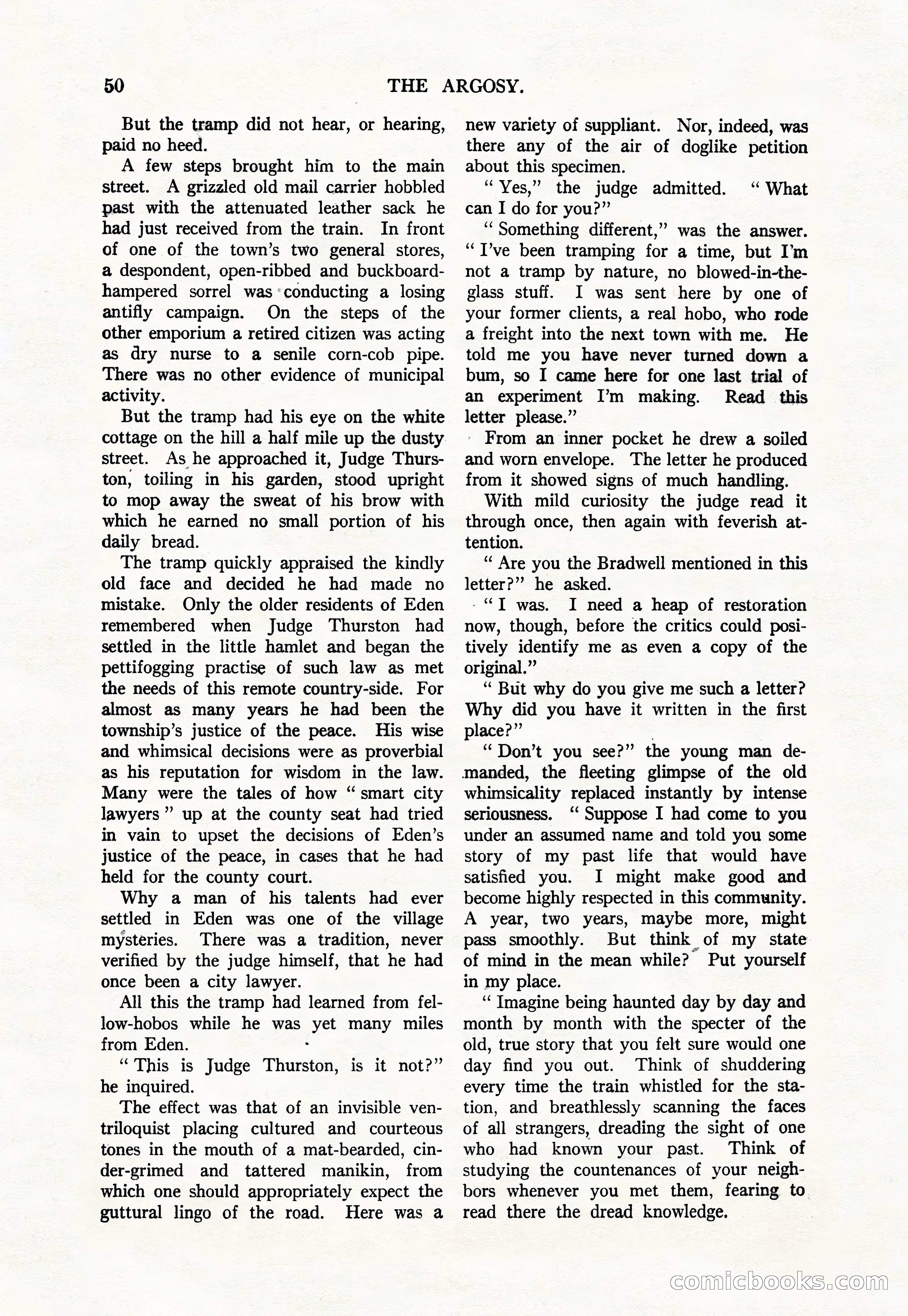
A restored page from Pulp Fiction, 1919. Page through the whole issue in the reader above.
📄 Transcribed text from this page (OCR, searchable)
Machine-transcribed from the original scan — historical spelling and the odd misread are preserved.
50 But the tramp did not hear, or hearing, paid no heed. A few steps brought him to the main street. A grizzled old mail carrier hobbled past with the attenuated leather sack he had just received from the train. In front of one of the town’s two general stores, a despondent, open-ribbed and buckboard- hampered sorrel was ‘conducting a losing antifly campaign. On the steps of the other emporium a retired citizen was acting as dry nurse to a senile corn-cob pipe. There was no other evidence of municipal activity. But the tramp had his eye on the white cottage on the hill a half mile up the dusty street. As he approached it, Judge Thurs- ton, toiling in his garden, stood upright to mop away the sweat of his brow with which he earned no small portion of his daily bread. The tramp quickly appraised the kindly old face and decided he had made no mistake. Only the older residents of Eden remembered when Judge Thurston had settled in the little hamlet and began the pettifogging practise of such law as met the needs of this remote country-side. For almost as many years he had been the township’s justice of the peace. His wise and whimsical decisions were as proverbial as his reputation for wisdom in the law. Many were the tales of how “ smart city lawyers ” up at the county seat had tried in vain to upset the decisions of Eden’s justice of the peace, in cases that he had held for the county court. Why a man of his talents had ever settled in Eden was one of the village mysteries. There was a tradition, never verified by the judge himself, that he had once been a city lawyer. All this the tramp had learned from fel- low-hobos while he was yet many miles from Eden. : “This is Judge Thurston, is it not?” he inquired. The effect was that of an invisible ven- triloquist placing cultured and courteous tones in the mouth of a mat-bearded, cin- der-grimed and tattered manikin, from which one should appropriately expect the guttural lingo of the road. Here was a THE ARGOSY. new variety of suppliant. Nor, indeed, was there any of the air of doglike petition about this specimen. “Yes,” the judge admitted. can I do for you?” ‘‘ Something different,” was the answer. ‘““Tve been tramping for a time, but I’m not a tramp by nature, no blowed-in-the- glass stuff. I was sent here by one of your former clients, a real hobo, who rode a freight into the next town with me. He told me you have never turned down a bum, so I came here for one last trial of an experiment I’m making. Read this letter please.” From an inner pocket he drew a soiled and worn envelope. The letter he produced from it showed signs of much handling. With mild curiosity the judge read it through once, then again with feverish at- tention. ‘“‘ Are you the Bradwell mentioned in this letter?” he asked. -“T was. I need a heap of restoration now, though, before the critics could posi- tively identify me as even a copy of the original.”’ ‘But why do you give me such a letter? Why did you have it written in the first place?” ‘““Don’t you see?” the young man de- ‘“ What manded, the fleeting glimpse of the old whimsicality replaced instantly by intense seriousness. ‘‘ Suppose I had come to you under an assumed name and told you some story of my past life that would have satisfied you. I might make good and become highly respected in this community. A year, two years, maybe more, might pass smoothly. But think of my state of mind in the mean while? Put yourself in my place. ‘‘ Imagine being haunted day by day and month by month with the specter of the old, true story that you felt sure would one day find you out. Think of shuddering every time the train whistled for the sta- tion, and breathlessly scanning the faces of all strangers, dreading the sight of one who had known your past. Think of studying the countenances of your neigh- bors whenever you met them, fearing to read there the dread knowledge. GOMIIGIOO CS (CO