
Pulp Fiction, 1919 · page 53 of 188
Argosy, Vol. 111, No. 1 — page 53: what you’re looking at
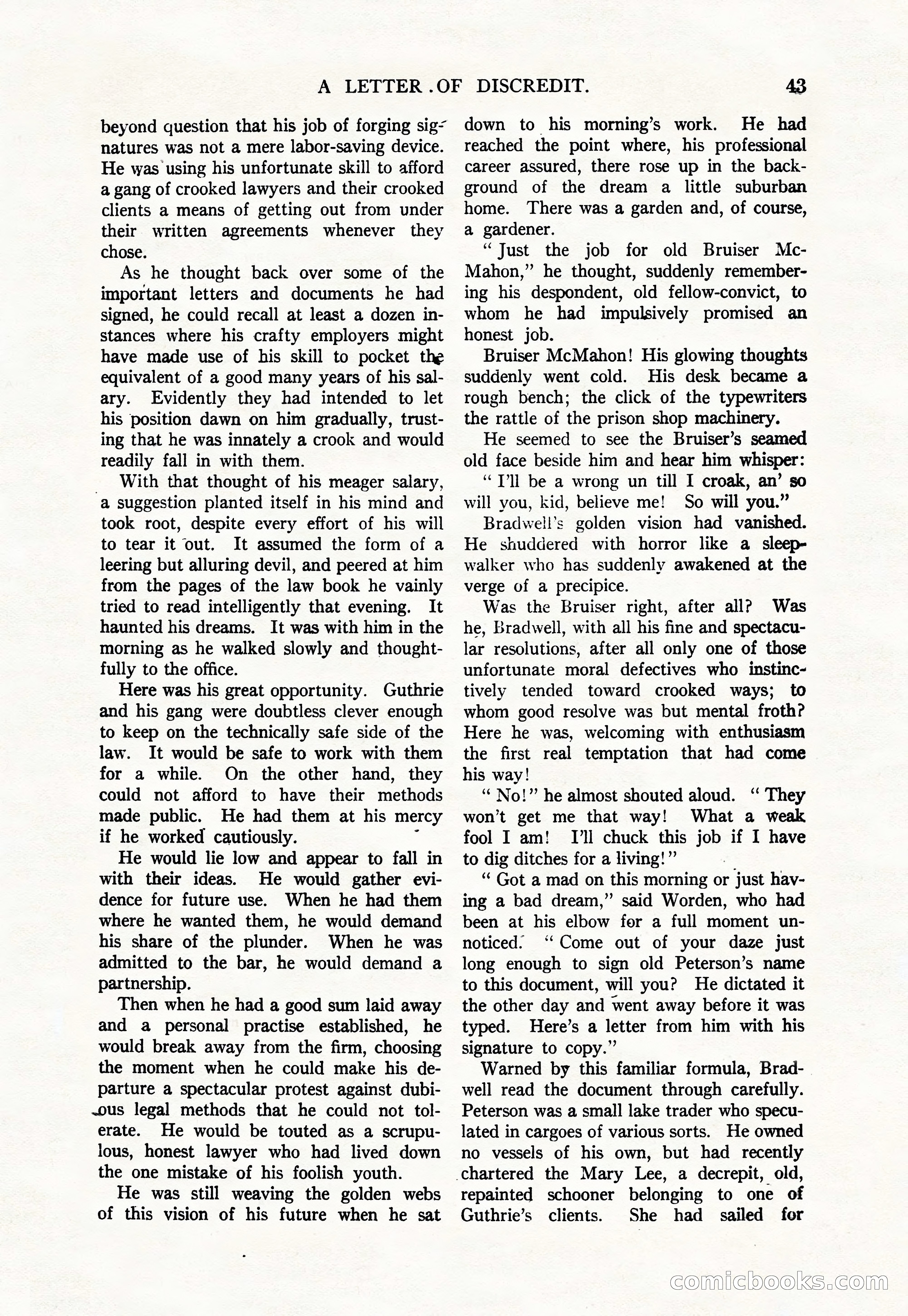
A restored page from Pulp Fiction, 1919. Page through the whole issue in the reader above.
📄 Transcribed text from this page (OCR, searchable)
Machine-transcribed from the original scan — historical spelling and the odd misread are preserved.
A LETTER .OF DISCREDIT. a beyond question that his job of forging sig- natures was not a mere labor-saving device. He was using his unfortunate skill to afford a gang of crooked lawyers and their crooked clients a means of getting out from under their written agreements whenever they chose. As he thought back over some of the important letters and documents he had signed, he could recall at least a dozen in- stances where his crafty employers might have made use of his skill to pocket the equivalent of a good many years of his sal- ary. Evidently they had intended to let his position dawn on him gradually, trust- ing that he was innately a crook and would readily fall in with them. _ With that thought of his meager salary, a suggestion planted itself in his mind and took root, despite every effort of his will to tear it out. It assumed the form of a leering but alluring devil, and peered at him from the pages of the law book he vainly tried to read intelligently that evening. It haunted his dreams. It was with him in the morning as he walked slowly and thought- fully to the office. Here was his great opportunity. Guthrie and his gang were doubtless clever enough to keep on the technically safe side of the law. It would be safe to work with them for a while. On the other hand, they could not afford to have their methods made public. He had them at his mercy if he worked cautiously. ; He would lie low and appear to fall in with their ideas. He would gather evi- dence for future use. When he had them where he wanted them, he would demand his share of the plunder. When he was admitted to the bar, he would demand a partnership. Then when he had a good sum laid away and a personal practise established, he would break away from the firm, choosing the moment when he could make his de- parture a spectacular protest against dubi- ~ous legal methods that he could not tol- erate. He would be touted as a scrupu- lous, honest lawyer who had lived down the one mistake of his foolish youth. He was still weaving the golden webs of this vision of his future when he sat down to his morning’s work. He had reached the point where, his professional career assured, there rose up in the back- ground of the dream a little suburban home. There was a garden and, of course, a gardener. “Just the job for old Bruiser Mc- Mahon,” he thought, suddenly remember- ing his despondent, old fellow-convict, to whom he had impulsively promised an honest job. Bruiser McMahon! His glowing thoughts suddenly went cold. His desk became a rough bench; the click of the typewriters the rattle of the prison shop machinery. He seemed to see the Bruiser’s seamed old face beside him and hear him whisper: ‘“T’ll be a wrong un till I croak, an’ so will you, kid, believe me! So will you.” Bradwell’s golden vision had vanished. He shuddered with horror like a sleep- walker who has suddenly awakened at the verge of a precipice. Was the Bruiser right, after all? Was he, Bradwell, with all his fine and spectacu- lar resolutions, after all only one of those unfortunate moral defectives who instinc- tively tended toward crooked ways; to whom good resolve was but mental frothe Here he was, welcoming with enthusiasm the first real temptation that had come his way! “No!” he almost shouted aloud. ‘“ They won't get me that way! What a weak fool I am! I’ll chuck this job if I have to dig ditches for a living!” “Got a mad on this morning or just hav- ing a bad dream,” said Worden, who had been at his elbow for a full moment un- noticed. ‘“‘ Come out of your daze just long enough to sign old Peterson’s name to this document, will you? He dictated it the other day and went away before it was typed. Here’s a letter from him with his signature to copy.” Warned by this familiar formula, Brad- well read the document through carefully. Peterson was a small lake trader who specu- lated in cargoes of various sorts. He owned no vessels of his own, but had recently chartered the Mary Lee, a decrepit, old, repainted schooner belonging to one of Guthrie’s clients. She had sailed for CONMUC NOOK CO