
Pulp Fiction, 1919 · page 51 of 188
Argosy, Vol. 111, No. 1 — page 51: what you’re looking at
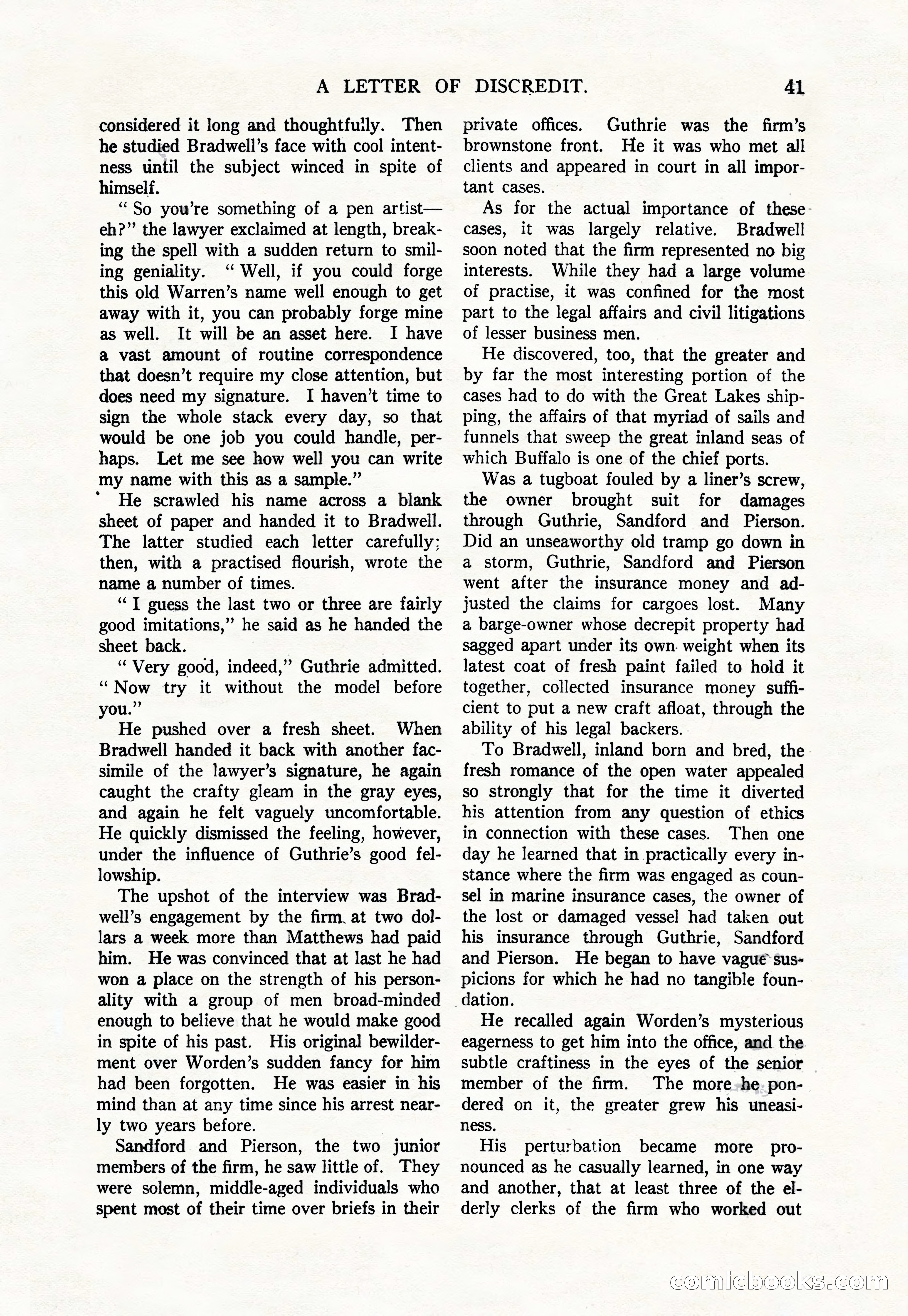
A restored page from Pulp Fiction, 1919. Page through the whole issue in the reader above.
📄 Transcribed text from this page (OCR, searchable)
Machine-transcribed from the original scan — historical spelling and the odd misread are preserved.
A LETTER OF DISCREDIT. considered it long and thoughtfully. Then he studied Bradwell’s face with cool intent- ness until the subject winced in spite of himself. ‘“So you’re something of a pen artist— eh?” the lawyer exclaimed at length, break- ing the spell with a sudden return to smil- ing geniality. ‘‘ Well, if you could forge this old Warren’s name well enough to get away with it, you can probably forge mine as well. It will be an asset here. I have a vast amount of routine correspondence that doesn’t require my close attention, but does need my signature. I haven’t time to sign the whole stack every day, so that would be one job you could handle, per- haps. Let me see how well you can write my name with this as a sample.” He scrawled his name across a blank sheet of paper and handed it to Bradwell. The latter studied each letter carefully; then, with a practised flourish, wrote the name a number of times. ‘“‘T guess the last two or three are fairly good imitations,” he said as he handed the sheet back. | “Very good, indeed,” Guthrie admitted. ‘““Now try it without the model before you.”’ He pushed over a fresh sheet. When Bradwell handed it back with another fac- simile of the lawyer’s signature, he again caught the crafty gleam in the gray eyes, and again he felt vaguely uncomfortable. He quickly dismissed the feeling, however, under the influence of Guthrie’s good fel- lowship. The upshot of the interview was Brad- well’s engagement by the firm. at two dol- lars a week more than Matthews had paid him. He was convinced that at last he had won a place on the strength of his person- ality with a group of men broad-minded enough to believe that he would make good in spite of his past. His original bewilder- ment over Worden’s sudden fancy for him had been forgotten. He was easier in his mind than at any time since his arrest near- ly two years before. : Sandford and Pierson, the two junior members of the firm, he saw little of. They were solemn, middle-aged individuals who spent most of their time over briefs in their 41 private offices. Guthrie was the firm’s brownstone front. He it was who met all clients and appeared in court in all impor- tant cases. ~ As for the actual importance of these- cases, it was largely relative. Bradwell soon noted that the firm represented no big interests. While they had a large volume of practise, it was confined for the most part to the legal affairs and civil litigations of lesser business men. He discovered, too, that the greater and by far the most interesting portion of the cases had to do with the Great Lakes ship- ping, the affairs of that myriad of sails and funnels that sweep the great inland seas of which Buffalo is one of the chief ports. Was a tugboat fouled by a liner’s screw, the owner brought suit for damages through Guthrie, Sandford and Pierson. Did an unseaworthy old tramp go down in a storm, Guthrie, Sandford and Pierson went after the insurance money and ad- justed the claims for cargoes lost. Many a barge-owner whose decrepit property had sagged apart under its own. weight when its latest coat of fresh paint failed to hold it together, collected insurance money suffi- cient to put a new craft afloat, through the ability of his legal backers. To Bradwell, inland born and bred, the fresh romance of the open water appealed so strongly that for the time it diverted his attention from any question of ethics in connection with these cases. Then one day he learned that in practically every in- stance where the firm was engaged as coun- sel in marine insurance cases, the owner of the lost or damaged vessel had taken out his insurance through Guthrie, Sandford and Pierson. He began to have vague sus- picions for which he had no tangible foun- dation. He recalled again Worden’s mysterious eagerness to get him into the office, and the subtle craftiness in the eyes of the senior member of the firm. The more-he. pon- dered on it, the greater grew his uneasi- ness. His perturbation became more _pro- nounced as he casually learned, in one way and another, that at least three of the el- derly clerks of the firm who worked out CONMUC NOOLK CO