
Pulp Fiction, 1919 · page 42 of 188
Argosy, Vol. 111, No. 1 — page 42: what you’re looking at
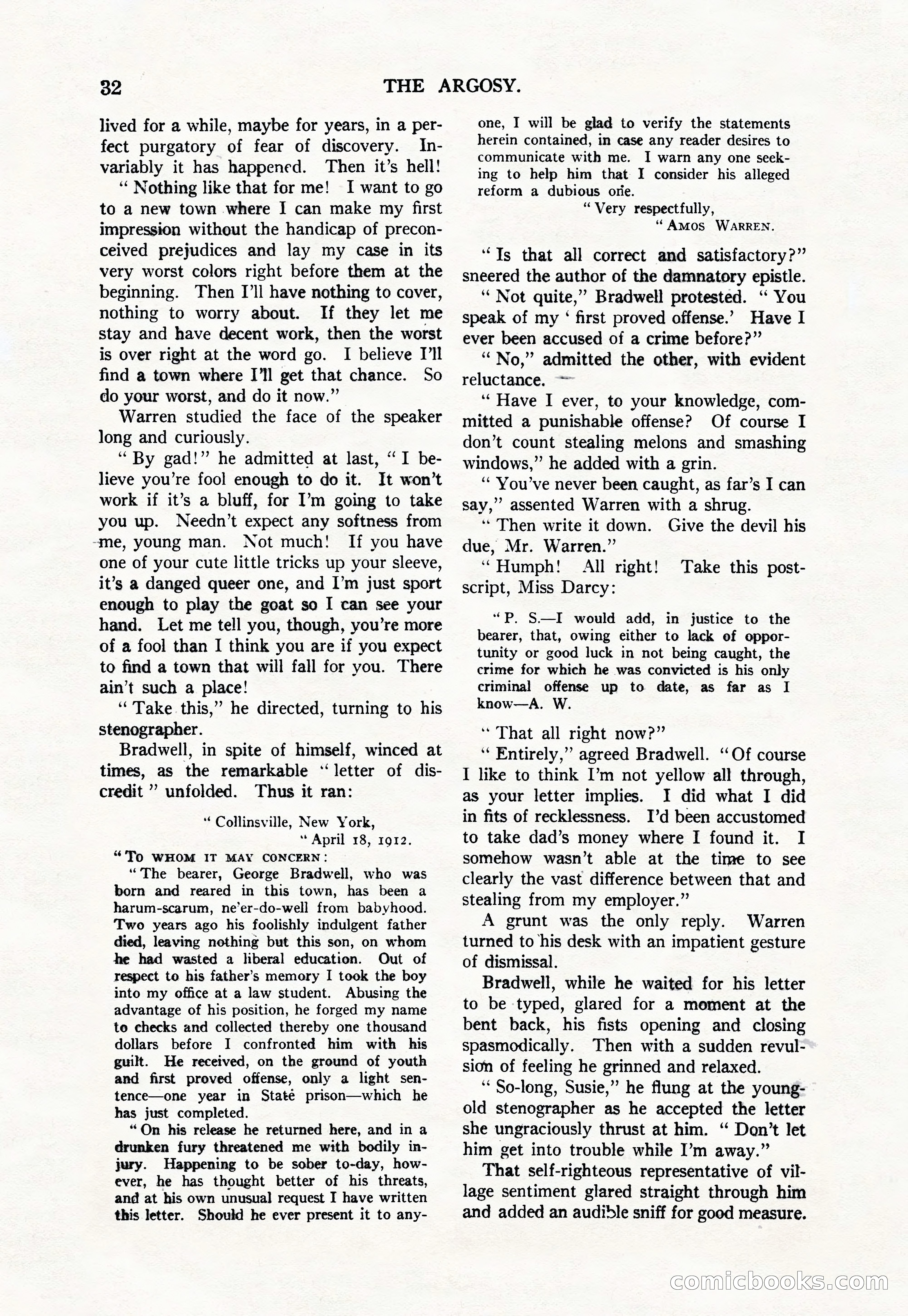
A restored page from Pulp Fiction, 1919. Page through the whole issue in the reader above.
📄 Transcribed text from this page (OCR, searchable)
Machine-transcribed from the original scan — historical spelling and the odd misread are preserved.
32 lived for a while, maybe for years, in a per- fect purgatory of fear of discovery. In- variably it has happened. Then it’s hell! ‘‘ Nothing like that for me! I want to go to a new town where I can make my first impression without the handicap of precon- ceived prejudices and lay my case in its very worst colors right before them at the beginning. Then I’ll have nothing to cover, nothing to worry about. If they let me stay and have decent work, then the worst is over right at the word go. I believe I'll find a town where I'll get that chance. So do your worst, and do it now.” Warren studied the face of the speaker long and curiously. ‘By gad!” he admitted at last, “I be- lieve you’re fool enough to do it. It won't work if it’s a bluff, for I’m going to take you up. Needn’t expect any softness from -‘me, young man. Not much! If you have one of your cute little tricks up your sleeve, it’s a danged queer one, and I’m just sport enough to play the goat so I can see your hand. Let me tell you, though, you’re more of a fool than I think you are if you expect to find a town that will fall for you. There ain’t such a place! ‘Take this,” he directed, turning to his stenographer. Bradwell, in spite of himself, winced at times, as the remarkable “letter of dis- credit” unfolded. Thus it ran: ‘‘ Collinsville, New York, ‘ April 18, 1912. “To WHOM IT MAY CONCERN: “The bearer, George Bradwell, who was born and reared in this town, has been a harum-scarum, ne’er-do-well from babvhood. Two years ago his foolishly indulgent father died, leaving nothing but this son, on whom he had wasted a liberal education. Out of respect to his father’s memory I took the boy into my office at a law student. Abusing the advantage of his position, he forged my name to checks and collected thereby one thousand dollars before I confronted him with his guilt. He received, on the ground of youth and first proved offense, only a light sen- tence—one year in State prison—which he has just completed. “On his release he returned here, and in a drunken fury threatened me with bodily in- jury. Happening to be sober to-day, how- ever, he has thought better of his threats, and at his own unusual request I have written this letter. Should he ever present it to any- THE ARGOSY. one, I will be glad to verify the statements herein contained, in case any reader desires to communicate with me. I warn any one seek- ing to help him that I consider his alleged reform a dubious orie. “Very respectfully, ‘AMOS WARREN. ‘Ts that all correct and satisfactory?” sneered the author of the damnatory epistle. ‘“ Not quite,” Bradwell protested. ‘“ You speak of my ‘ first proved offense.’ Have I ever been accused of a crime before?” ‘““ No,” admitted the other, with evident reluctance. ~ ‘‘ Have I ever, to your knowledge, com- mitted a punishable offense? Of course I don’t count stealing melons and smashing windows,” he added with a grin. ‘* ‘You’ve never been caught, as far’s I can say,’ assented Warren with a shrug. ‘Then write it down. Give the devil his due, Mr. Warren.” ‘“Humph! All right! script, Miss Darcy: Take this post- “PP. S—I would add, in justice to the bearer, that, owing either to lack of oppor- tunity or good luck in not being caught, the crime for which he was convicted is his only criminal offense up to date, as far as I know—A. W. ‘That all right now?” “Entirely,” agreed Bradwell. ‘Of course I hike to think I’m not yellow all through, as your letter implies. I did what I did in fits of recklessness. I’d been accustomed to take dad’s money where [I found it. I somehow wasn’t able at the time to see clearly the vast difference between that and stealing from my employer.” A grunt was the only reply. Warren turned to his desk with an impatient gesture of dismissal. Bradwell, while he waited for his letter to be typed, glared for a moment at the bent back, his fists opening and closing spasmodically. Then with a sudden revul- sion of feeling he grinned and relaxed. ‘‘ So-long, Susie,” he flung at the young- old stenographer as he accepted the letter she ungraciously thrust at him. ‘“ Don’t let him get into trouble while I’m away.” That self-righteous representative of vil- lage sentiment glared straight through him and added an audible sniff for good measure. GOMIIGIOO <S (CO