
Pulp Fiction, 1919 · page 186 of 188
Argosy, Vol. 111, No. 1 — page 186: what you’re looking at
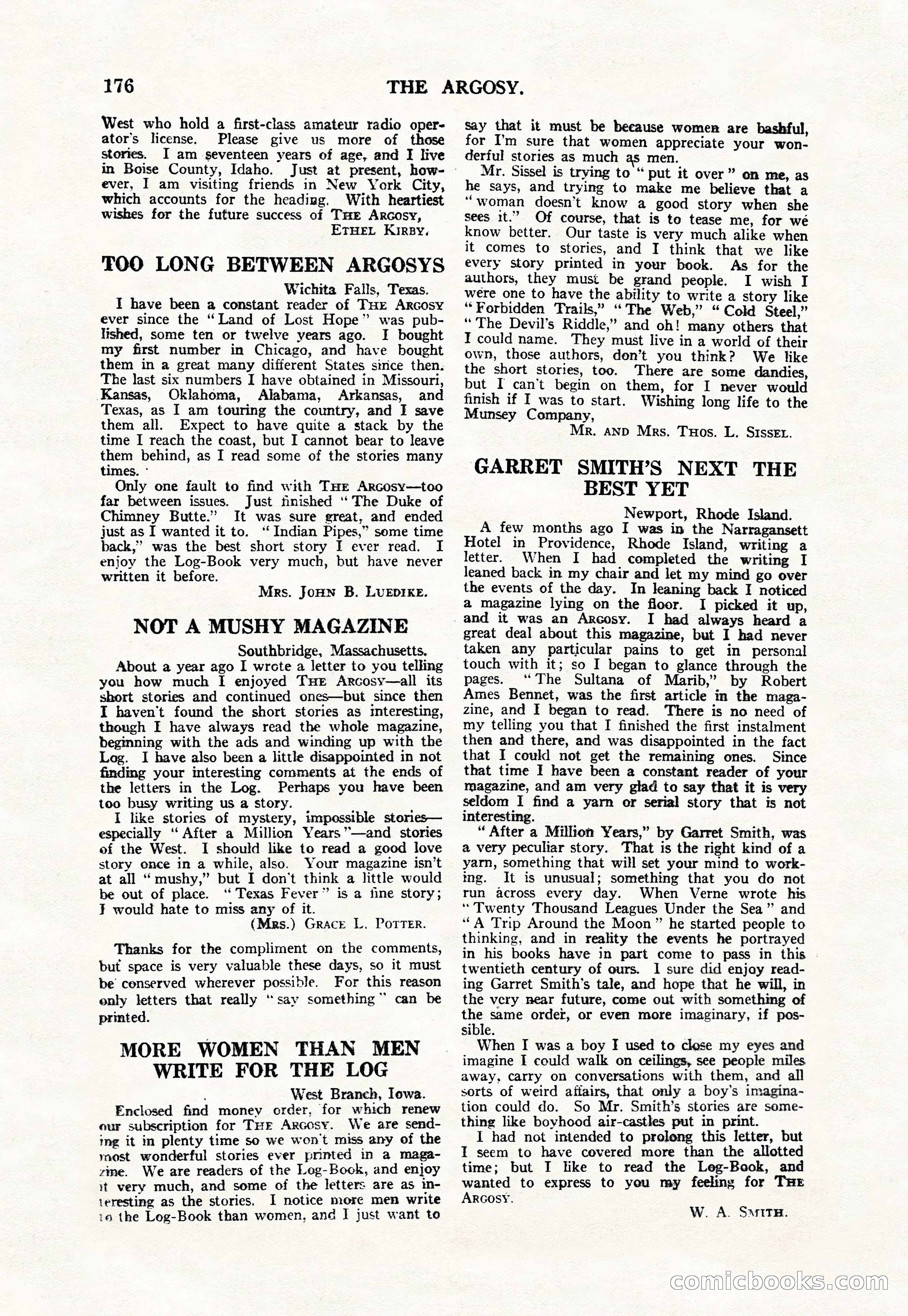
A restored page from Pulp Fiction, 1919. Page through the whole issue in the reader above.
📄 Transcribed text from this page (OCR, searchable)
Machine-transcribed from the original scan — historical spelling and the odd misread are preserved.
176 West who hold a first-class amateur radio oper- ator’s license. Please give us more of those stories. I am seventeen years of age, and I live in Boise County, Idaho. ever, I am visiting friends in New York City, which accounts for the heading. With heartiest wishes for the future success of THE ARGosy, ETHEL KIrBy, TOO LONG BETWEEN ARGOSYS Wichita Falls, Texas. I have been a constant reader of THE ARGosy ever since the “Land of Lost Hope” was pub- lished, some ten or twelve years ago. I bought my first number in Chicago, and have bought them in a great many different States since then. The last six numbers I have obtained in Missouri, ‘Kansas, Oklahoma, Alabama, Arkansas, and Texas, as I am touring the country, and I save them all. Expect to have quite a stack by the time I reach the coast, but I cannot bear to leave them behind, as I read some of the stories many times. ° Only one fault to find with THE Arcosy—too far between issues. Just finished ‘‘ The Duke of Chimney Butte.” It was sure great, and ended just as I wanted it to. ‘‘ Indian Pipes,” some time back,” was the best short story I ever read. I enjoy the Log-Book very much, but have never written it before. Mrs. JoHN B. LUEDIKE. NOT A MUSHY MAGAZINE Southbridge, Massachusetts. About a year ago I wrete a letter to you telling you how much I enjoyed THE Arcosy—all its short stories and continued ones—but since then I haven't found the short stories as interesting, though I have always read the whole magazine, beginning with the ads and winding up with the Log. I have also been a little disappointed in not finding your interesting comments at the ends of the letters in the Log. Perhaps you have been too busy writing us a story. I like stories of mystery, impossible stories— especially “After a Million Years ’’—and stories of the West. I should like to read a good love story ence in a while, also. Your magazine isn’t at all “ mushy,” but I don't think a little would be out of place. ‘‘ Texas Fever” is a fine story; ¥ would hate to miss any of it. (Mrs.) Grace L. POTTER. Thanks for the compliment on the comments, but space is very valuable these days, so it must be’ conserved wherever possible. For this reason only letters that really “sav something“ can be printed. MORE WOMEN THAN MEN WRITE FOR THE LOG ’ West Branch, Iowa. Enclosed find money order, for which renew our subscription for THE Arcosy. We are send- me it in plenty time so we won't miss any of the rnost wonderful stories ever pnnted in a maga- zme. We are readers of the Leg-Book, and enjoy it very much, and some of the letters are as in- teresting as the stories. I notice more men write 16 the Log-Book than women, and I just want to Just at present, how- - _ and it was an Areosy. THE ARGOSY. Say that it must be beeause women are bashful, for I'm sure that women appreciate your won- derful stories as much men. Mr. Sissel is trying to “ put it over” on me, as he says, and trying to make me believe that a ‘““woman doesn’t know a good story when she sees it.” Of course, that is to tease me, for we know better. Our taste is very much alike when it comes to stories, and I think that we like every story printed in your book. As for the authors, they must be grand people. I wish I were one to have the ability to write a story like “Forbidden Trails,” “The Web,” “ Cold Steel,” “The Devil’s Riddle,” and oh! many others that IT could name. They must live in a world of their own, those authors, don’t you think? We like the short stories, too. There are some dandies, but I can't begin on them, for I never would finish if I was to start. Wishing long life to the Munsey Company, Mr. ano Mrs. Tuos. L. SisseEv. GARRET SMITH’S NEXT THE BEST YET Newport, Rhode Island. A few months ago I was in the Narragansett Hotel in Providence, Rhode Island, writing a letter. When I had completed the writing I leaned back in my chair and let my mind go over the events of the day. In leaning back I noticed a magazine lying on the floor. I picked it up, I had always heard a great deal about this magazine, but I had never taken any particular pains to get in personal touch with it; so I began to glance through the pages. “The Sultana of Marib,’ by Robert Ames Bennet, was the first article in the maga- zine, and I began to read. There is no need of my telling you that I finished the first instalment then and there, and was disappointed in the fact that I could not get the remaining ones. Since that time I have been a constant reader of your magazine, and am very glad to say that it is very seldom I find a yarn or serial story that is not interesting. “ After a Million Years,” by Garret Smith, was a very peculiar story. That is the right kind of a yarn, something that will set your mind to work- ing. It is unusual; something that you do not run across every day. When Verne wrote his ‘Twenty Thousand Leagues Under the Sea” and ‘“A Trip Around the Moon” he started people to thinking, and in reality the events he portrayed in his books have in part come to pass in this twentieth century of ours. I sure did enjoy read- ing Garret Smith’s tale, and hope that he will, in the very near future, come out with something of the same order, or even more imaginary, if pos- sible. When I was a boy I used to close my eyes and imagine I could walk on ceilings, see people miles away, carry on conversations with them, and all sorts of weird aiiairs, that only a boy’s imagina- tion could do. So Mr. Smith’s stories are some- thing like boyhood air-castles put in print. I had not intended to prolong this letter, but I seem to have covered more than the allotted time; but I like to read the Leg-Book, and wanted to express to you my feeling for THE ARGOSY. W. A. SMITH. CO Up) cClooolk S (CO)