
Pulp Fiction, 1919 · page 180 of 188
Argosy, Vol. 111, No. 1 — page 180: what you’re looking at
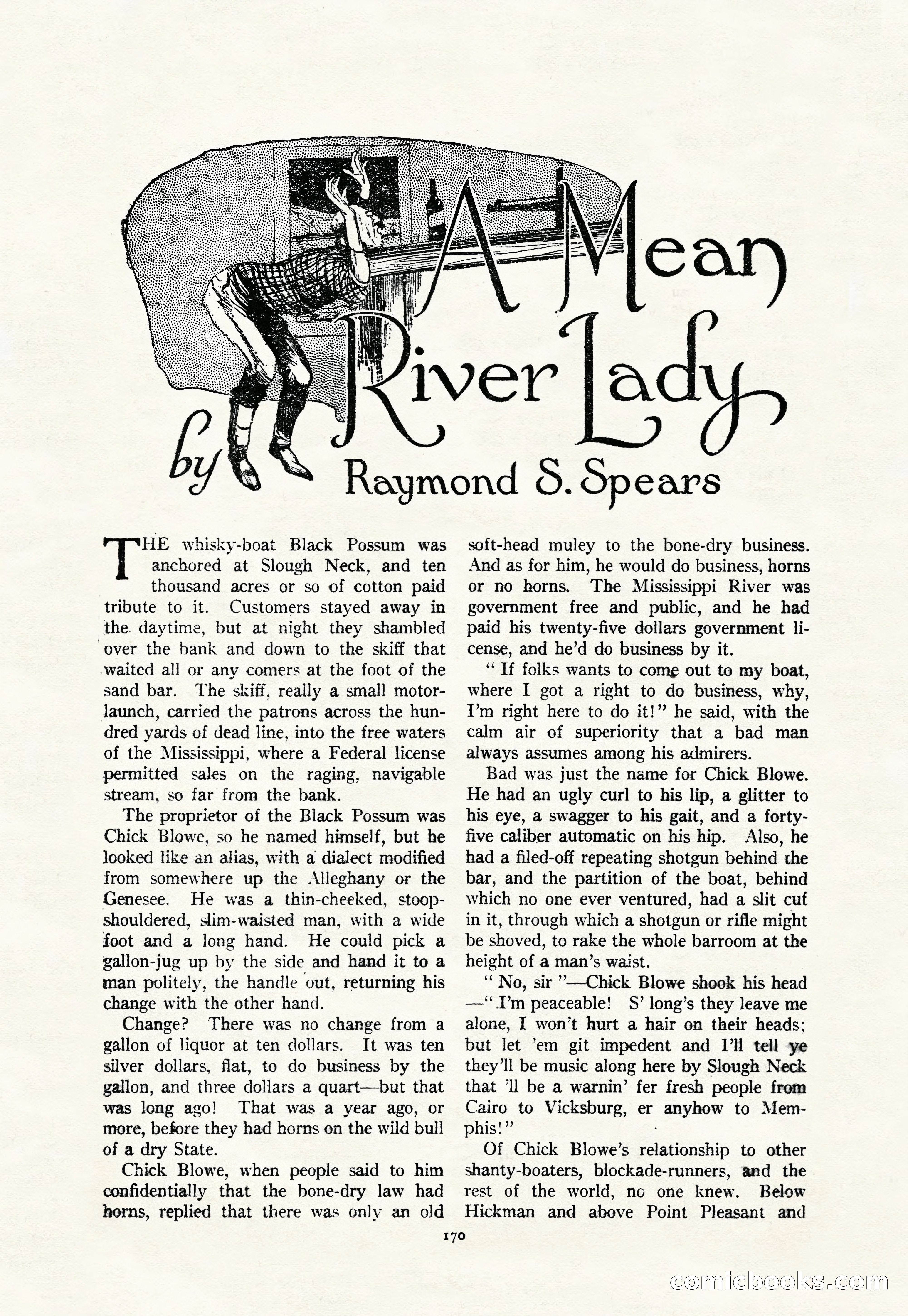
A restored page from Pulp Fiction, 1919. Page through the whole issue in the reader above.
📄 Transcribed text from this page (OCR, searchable)
Machine-transcribed from the original scan — historical spelling and the odd misread are preserved.
HE whisky-boat Black Possum was anchored at Slough Neck, and ten thousand acres or so of cotton paid tribute to it. Customers stayed away in the. daytime, but at night they shambled over the bank and down to the skiff that waited all or any comers at the foot of the sand bar. The skiff, really a small motor- Jaunch, carried the patrons across the hun- dred yards of dead line, into the free waters of the Mississippi, where a Federal license permitted sales on the raging, navigable stream, so far from the bank. The proprietor of the Black Possum was Chick Blowe, so he named himself, but he looked like an alias, with a dialect modified from somewhere up the Alleghany or the Genesee. He was a thin-cheeked, stoop- shouldered, slim-waisted man, with a wide foot and a long hand. He could pick a gallon-jug up by the side and hand it to a man politely, the handle out, returning his change with the other hand. Change? There was no change from a gallon of liquor at ten dollars. It was ten silver dollars, flat, to do business by the gallon, and three dollars a quart—but that was long ago! That was a year ago, or more, before they had horns on the wild bull of a dry State. Chick Blowe, when people said to him confidentially that the bone-dry law had horns, replied that there was only an old Raymond 5. Spears soft-head muley to the bone-dry business. And as for him, he would do business, horns or no horns. The Mississippi River was government free and public, and he had paid his twenty-five dollars government li- cense, and he’d do business by it. ‘Tf folks wants to come out to my boat, where I got a right to do business, why, I’m right here to do it!” he said, with the calm air of superiority that a bad man always assumes among his admirers. Bad was just the name for Chick Blowe. He had an ugly curl to his lip, a glitter to his eye, a swagger to his gait, and a forty- five caliber automatic on his hip. Also, he had a filed-off repeating shotgun behind the bar, and the partition of the boat, behind which no one ever ventured, had a slit cut in it, through which a shotgun or rifle might be shoved, to rake the whole barroom at the height of a man’s waist. ‘“ No, sir ”’—Chick Blowe shook his head —‘‘ I’m peaceable! S’ long’s they leave me alone, I won’t hurt a hair on their heads; but let ’em git impedent and I'll tell ye they'll be music along here by Slough Neck that ‘ll be a warnin’ fer fresh people from Cairo to Vicksburg, er anyhow to Mem- phis!” Of Chick Blowe’s relationship to other shanty-boaters, blockade-runners, and the rest of the world, no one knew. Below Hickman and above Point Pleasant and 170 Cconnicloool. (CO) 3}