
Pulp Fiction, 1919 · page 162 of 188
Argosy, Vol. 111, No. 1 — page 162: what you’re looking at
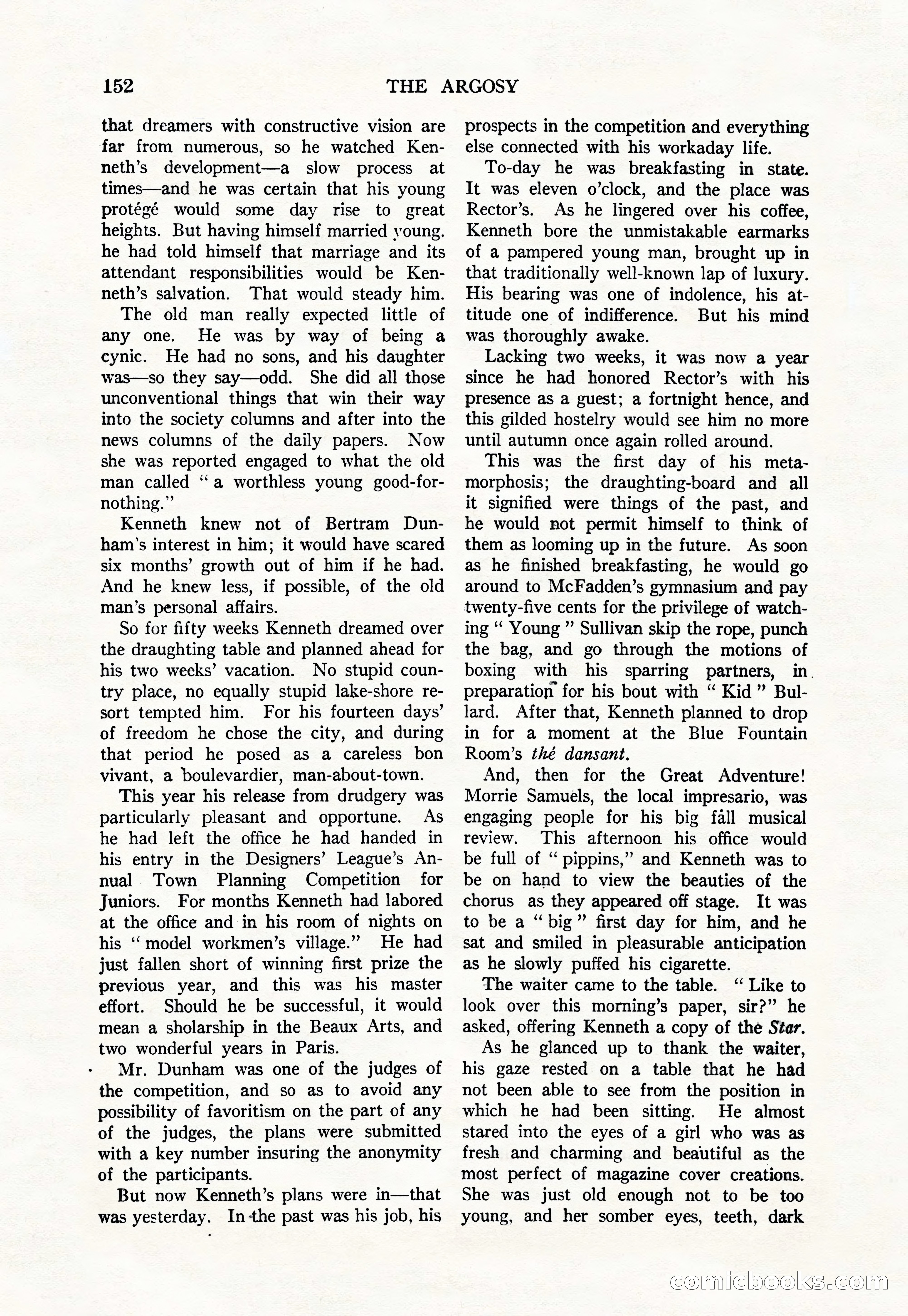
A restored page from Pulp Fiction, 1919. Page through the whole issue in the reader above.
📄 Transcribed text from this page (OCR, searchable)
Machine-transcribed from the original scan — historical spelling and the odd misread are preserved.
152 that dreamers with constructive vision are far from numerous, so he watched Ken- neth’s development—a slow process at times—and he was certain that his young protégé would some day rise to great heights. But having himself married voung. he had told himself that marriage and its attendant responsibilities would be Ken- neth’s salvation. That would steady him. The old man really expected little of any one. He was by way of being a cynic. He had no sons, and his daughter was—so they say—odd. She did all those unconventional things that win their way into the society columns and after into the news columns of the daily papers. Now she was reported engaged to what the old man called “a worthless young good-for- nothing.” Kenneth knew not of Bertram Dun- ham’s interest in him; it would have scared six months’ growth out of him if he had. And he knew less, if possible, of the old man’s personal affairs. So for fifty weeks Kenneth dreamed over the draughting table and planned ahead for his two weeks’ vacation. No stupid coun- try place, no equally stupid lake-shore re- sort tempted him. For his fourteen days’ of freedom he chose the city, and during that period he posed as a careless bon vivant, a boulevardier, man-about-town. This year his release from drudgery was particularly pleasant and opportune. As he had left the office he had handed in his entry in the Designers’ League’s An- nual Town Planning Competition for Juniors. For months Kenneth had labored at the office and in his room of nights on his ‘‘ model workmen’s village.”” He had just fallen short of winning first prize the previous year, and this was his master effort. Should he be successful, it would mean a sholarship in the Beaux Arts, and two wonderful years in Paris. Mr. Dunham was one of the judges of the competition, and so as to avoid any possibility of favoritism on the part of any of the judges, the plans were submitted with a key number insuring the anonymity of the participants. But now Kenneth’s plans were in—that was yesterday. In-the past was his job, his THE ARGOSY prospects in the competition and everything else connected with his workaday life. To-day he was breakfasting in state. It was eleven o’clock, and the place was Rector’s. As he lingered over his coffee, Kenneth bore the unmistakable earmarks of a pampered young man, brought up in that traditionally well-known lap of luxury. His bearing was one of indolence, his at- titude one of indifference. But his mind was thoroughly awake. Lacking two weeks, it was now a year since he had honored Rector’s with his presence as a guest; a fortnight hence, and this gilded hostelry would see him no more until autumn once again rolled around. This was the first day of his meta- morphosis; the draughting-board and all it signified were things of the past, and he would not permit himself to think of them as looming up in the future. As soon as he finished breakfasting, he would go around to McFadden’s gymnasium and pay twenty-five cents for the privilege of watch- ing “ Young ” Sullivan skip the rope, punch the bag, and go through the motions of boxing with his sparring partners, in. preparation for his bout with “ Kid” Bul- lard. After that, Kenneth planned to drop in for a moment at the Blue Fountain Room’s thé dansant. And, then for the Great Adventure! Morrie Samuels, the local impresario, was engaging people for his big fall musical review. This afternoon his office would be full of “ pippins,” and Kenneth was to be on hand to view the beauties of the chorus as they appeared off stage. It was to be a “big” first day for him, and he sat and smiled in pleasurable anticipation as he slowly puffed his cigarette. The waiter came to the table. “Like to look over this morning’s paper, sir?” he asked, offering Kenneth a copy of the Star. As he glanced up to thank the waiter, his gaze rested on a table that he had not been able to see from the position in which he had been sitting. He almost stared into the eyes of a girl who was as fresh and charming and beautiful as the most perfect of magazine cover creations. She was just old enough not to be too young, and her somber eyes, teeth, dark GOMIIGIOO SS (CO