
Pulp Fiction, 1919 · page 153 of 188
Argosy, Vol. 111, No. 1 — page 153: what you’re looking at
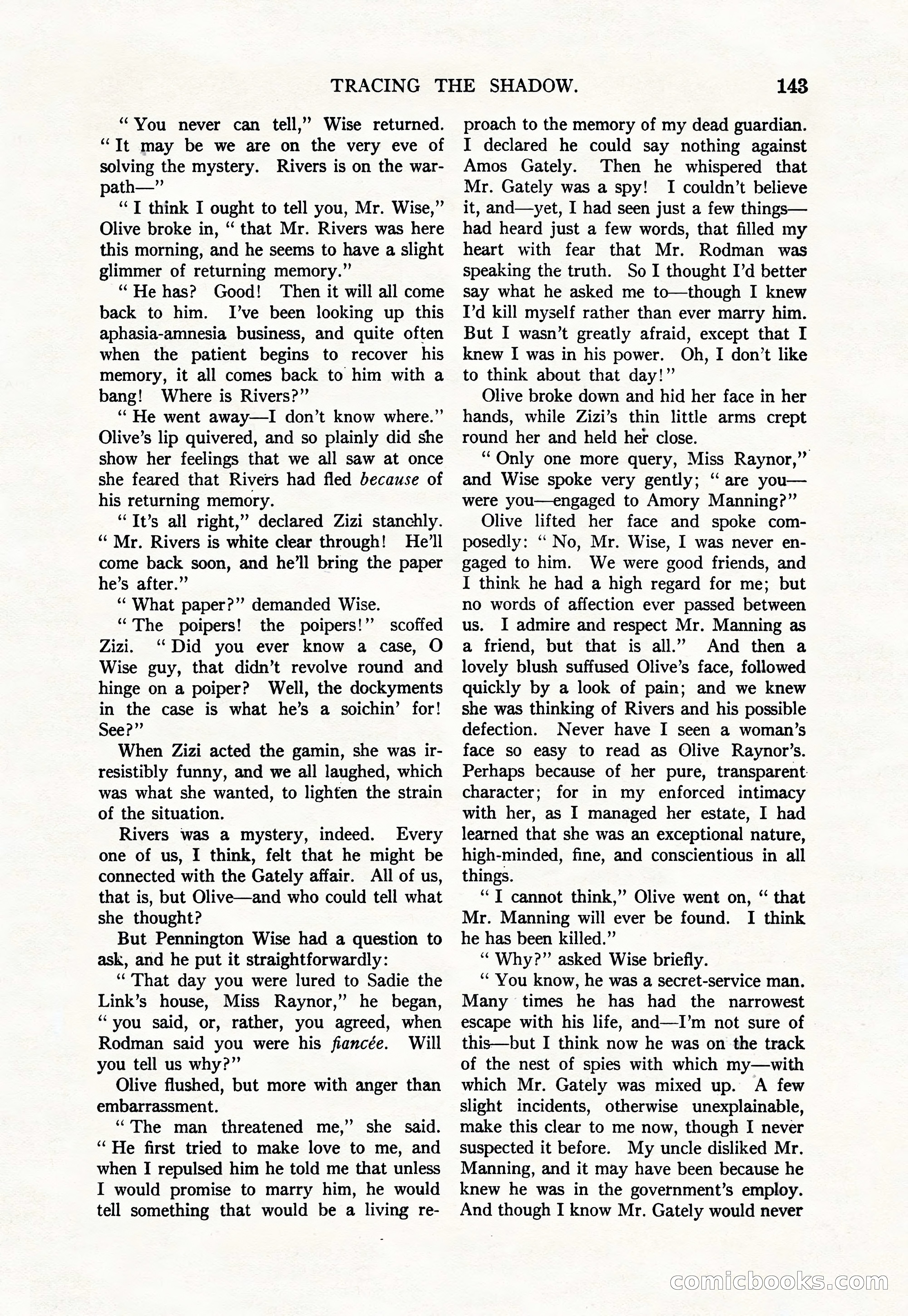
A restored page from Pulp Fiction, 1919. Page through the whole issue in the reader above.
📄 Transcribed text from this page (OCR, searchable)
Machine-transcribed from the original scan — historical spelling and the odd misread are preserved.
TRACING THE SHADOW. “You never can tell,” Wise returned. “It may be we are on the very eve of solving the mystery. Rivers is on the war- path—” “‘T think I ought to tell you, Mr. Wise,” Olive broke in, “ that Mr. Rivers was here this morning, and he seems to have a slight glimmer of returning memory.” “He has? Good! Then it will all come back to him. I’ve been looking up this aphasia-amnesia business, and quite often when the patient begins to recover his memory, it all comes back to him with a bang! Where is Rivers?” ‘He went away—I don’t know where.” Olive’s lip quivered, and so plainly did she show her feelings that we all saw at once she feared that Rivers had fled because of his returning memory. “It’s all right,” declared Zizi stanchly. ‘Mr. Rivers is white clear through! He'll come back soon, and he’ll bring the paper he’s after.” ‘‘ What paper?’’ demanded Wise. “The poipers! the poipers!’’ scoffed Zizi. “Did you ever know a case, O Wise guy, that didn’t revolve round and hinge on a poiper? Well, the dockyments in the case is what he’s a soichin’ for! See?” When Zizi acted the gamin, she was ir- resistibly funny, and we all laughed, which was what she wanted, to lighten the strain of the situation. Rivers was a mystery, indeed. Every one of us, I think, felt that he might be connected with the Gately affair. All of us, that is, but Olive—and who could tell what she thought? But Pennington Wise had a question to ask, and he put it straightforwardly: ‘That day you were lured to Sadie the Link’s house, Miss Raynor,” he began, ‘“‘vou said, or, rather, you agreed, when Rodman said you were his fiancée. Will you tell us why?” Olive flushed, but more with anger than embarrassment. “The man threatened me,” she said. ‘“‘ He first tried to make love to me, and when I repulsed him he told me that unless I would promise to marry him, he would tell something that would be a living re- 143 proach to the memory of my dead guardian. I declared he could say nothing against Amos Gately. Then he whispered that Mr. Gately was a spy! I couldn’t believe it, and—yet, I had seen just a few things— had heard just a few words, that filled my heart with fear that Mr. Rodman was speaking the truth. So I thought I’d better say what he asked me to—though I knew I'd kill myself rather than ever marry him. But I wasn’t greatly afraid, except that I knew I was in his power. Oh, I don’t like to think about that day!” Olive broke down and hid her face in her hands, while Zizi’s thin little arms crept round her and held her close. “Only one more query, Miss Raynor,” and Wise spoke very gently; “ are you— were you—engaged to Amory Manning?”’ Olive lifted her face and spoke com- posedly: “‘ No, Mr. Wise, I was never en- gaged to him. We were good friends, and I think he had a high regard for me; but no words of affection ever passed between us. I admire and respect Mr. Manning as a friend, but that is all.” And then a lovely blush suffused Olive’s face, followed quickly by a look of pain; and we knew she was thinking of Rivers and his possible defection. Never have I seen a woman’s face so easy to read as Olive Raynor’s. Perhaps because of her pure, transparent: character; for in my enforced intimacy with her, as I managed her estate, I had learned that she was an exceptional nature, high-minded, fine, and conscientious in all things. ‘‘T cannot think,” Olive went on, “ that Mr. Manning will ever be found. I think he has been killed.” “Why?” asked Wise briefly. ‘You know, he was a secret-service man. Many times he has had the narrowest escape with his life, and—I’m not sure of this—but I think now he was on the track of the nest of spies with which my—with which Mr. Gately was mixed up. A few slight incidents, otherwise unexplainable, make this clear to me now, though I never suspected it before. My uncle disliked Mr. Manning, and it may have been because he knew he was in the government’s employ. And though I know Mr. Gately would never CONMUC NOOLK CO