
Pulp Fiction, 1919 · page 133 of 188
Argosy, Vol. 111, No. 1 — page 133: what you’re looking at
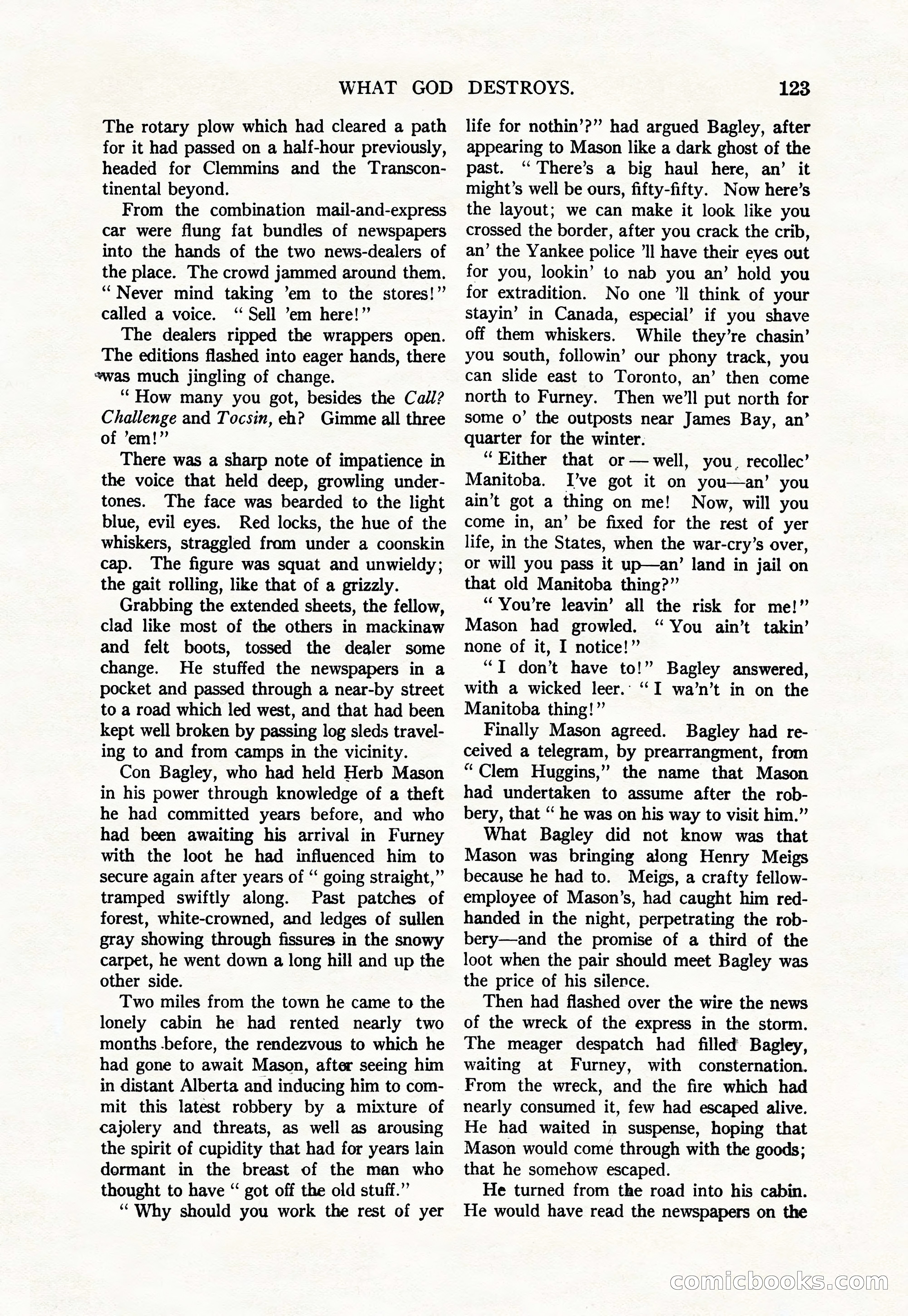
A restored page from Pulp Fiction, 1919. Page through the whole issue in the reader above.
📄 Transcribed text from this page (OCR, searchable)
Machine-transcribed from the original scan — historical spelling and the odd misread are preserved.
WHAT GOD The rotary plow which had cleared a path for it had passed on a half-hour previously, headed for Clemmins and the Transcon- tinental beyond. From the combination mail-and-express car were flung fat bundles of newspapers into the hands of the two news-dealers of the place. The crowd jammed around them. ‘Never mind taking ’em to the stores!”’ called a voice. ‘Sell ’em here!”’ The dealers ripped the wrappers open. The editions flashed into eager hands, there “was much jingling of change. ‘“ How many you got, besides the Call? Challenge and Tocsin, eh? Gimme all three of ’em!”’ There was a sharp note of impatience in the voice that held deep, growling under- tones. The face was bearded to the light blue, evil eyes. Red locks, the hue of the whiskers, straggled from under a coonskin cap. The figure was squat and unwieldy; the gait rolling, like that of a grizzly. Grabbing the extended sheets, the fellow, clad like most of the others in mackinaw and felt boots, tossed the dealer some change. He stuffed the newspapers in a pocket and passed through a near-by street to a road which led west, and that had been kept well broken by passing log sleds travel- ing to and from camps in the vicinity. Con Bagley, who had held Herb Mason in his power through knowledge of a theft he had committed years before, and who had been awaiting his arrival in Furney with the loot he had influenced him to secure again after years of “‘ going straight,” tramped swiftly along. Past patches of forest, white-crowned, and ledges of sullen gray showing through fissures in the snowy carpet, he went down a long hill and up the other side. Two miles from the town he came to the lonely cabin he had rented nearly two months -before, the rendezvous to which he had gone to await Mason, after seeing him in distant Alberta and inducing him to com- mit this latest robbery by a mixture of cajolery and threats, as well as arousing the spirit of cupidity that had for years lain dormant in the breast of the man who thought to have “ got off the old stuff.” ‘Why should you work the rest of yer DESTROYS. 123 life for nothin’?” had argued Bagley, after appearing to Mason like a dark ghost of the past. ‘“ There’s a big haul here, an’ it might’s well be ours, fifty-fifty. Now here’s the layout; we can make it look like you crossed the border, after you crack the crib, an’ the Yankee police ’ll have their eyes out for you, lookin’ to nab you an’ hold you for extradition. No one ‘ll think of your stayin’ in Canada, especial’ if you shave off them whiskers. While they’re chasin’ you south, followin’ our phony track, you can slide east to Toronto, an’ then come north to Furney. Then we’ll put north for some 0’ the outposts near James Bay, an’ quarter for the winter. “Either that or — well, you. recollec’ Manitoba. I’ve got it on you—an’ you ain’t got a thing on me! Now, will you come in, an’ be fixed for the rest of yer life, in the States, when the war-cry’s over, or will you pass it up—an’ land in jail on that old Manitoba thing?” ““You’re leavin’ all the risk for me!” Mason had growled. ‘“ You ain’t takin’ none of it, I notice!” “IT don’t have to!” Bagley answered, with a wicked leer.’ “I wa’n’t in on the Manitoba thing!” Finally Mason agreed. Bagley had re- ceived a telegram, by prearrangment, from “Clem Huggins,” the name that Mason had undertaken to assume after the rob- bery, that “ he was on his way to visit him.” What Bagley did not know was that Mason was bringing along Henry Meigs because he had to. Meigs, a crafty fellow- employee of Mason’s, had caught him red- handed in the night, perpetrating the rob- bery—and the promise of a third of the loot when the pair should meet Bagley was the price of his silence. Then had flashed over the wire the news of the wreck of the express in the storm. The meager despatch had filled Bagley, waiting at Furney, with consternation. From the wreck, and the fire which had nearly consumed it, few had escaped alive. He had waited in suspense, hoping that Mason would come through with the goods; that he somehow escaped. He turned from the road into his cabin. He would have read the newspapers on the GOMIIGIOO S CO