
Pulp Fiction, 1919 · page 119 of 188
Argosy, Vol. 111, No. 1 — page 119: what you’re looking at
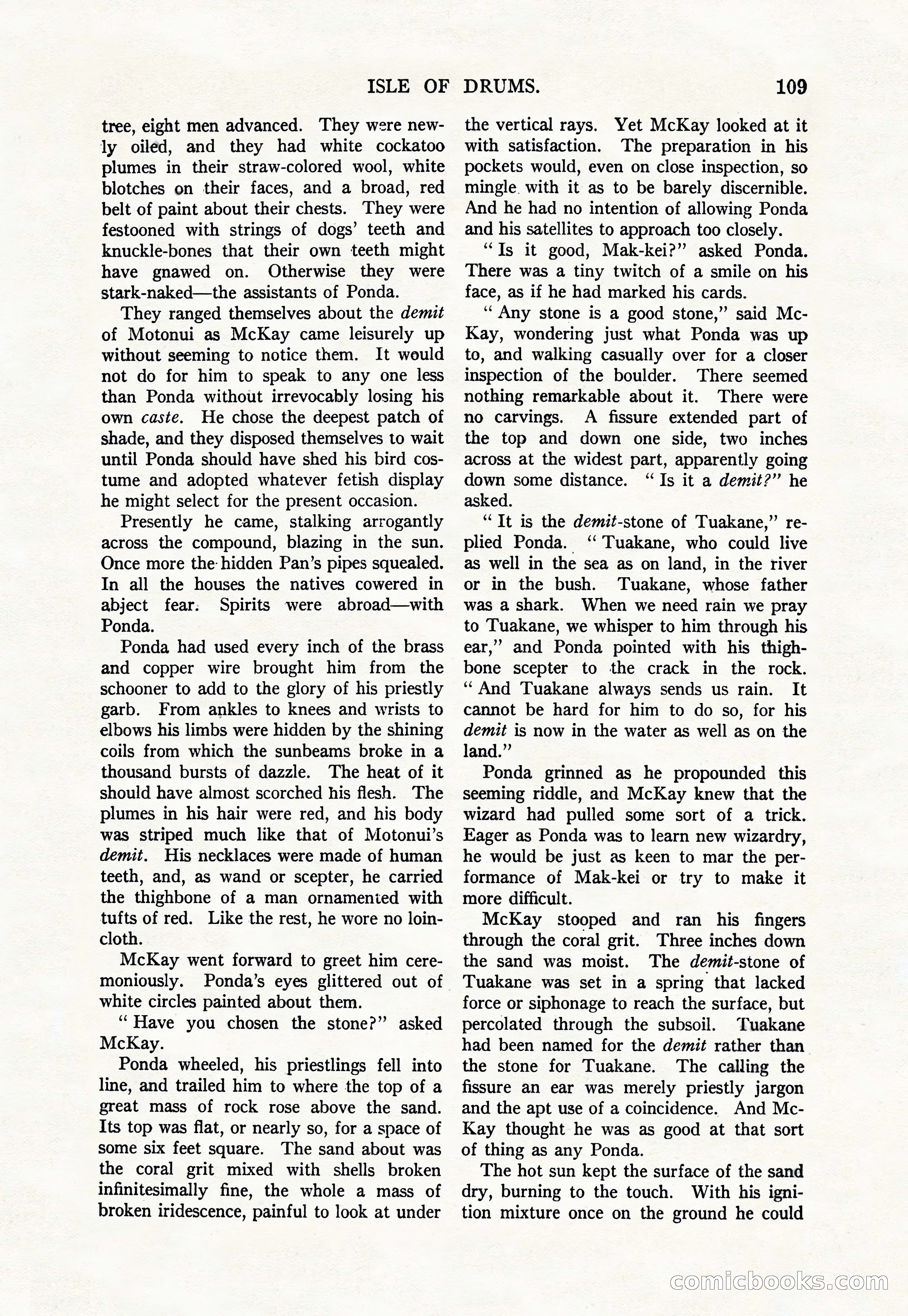
A restored page from Pulp Fiction, 1919. Page through the whole issue in the reader above.
📄 Transcribed text from this page (OCR, searchable)
Machine-transcribed from the original scan — historical spelling and the odd misread are preserved.
ISLE OF tree, eight men advanced. They were new- ly oiled, and they had white cockatoo plumes in their straw-colored wool, white blotches on their faces, and a broad, red belt of paint about their chests. They were festooned with strings of dogs’ teeth and knuckle-bones that their own teeth might have gnawed on. Otherwise they were stark-naked—the assistants of Ponda. They ranged themselves about the demit of Motonui as McKay came leisurely up without seeming to notice them. It would not do for him to speak to any one less than Ponda without irrevocably losing his own caste. He chose the deepest patch of shade, and they disposed themselves to wait until Ponda should have shed his bird cos- tume and adopted whatever fetish display he might select for the present occasion. Presently he came, stalking arrogantly across the compound, blazing in the sun. Once more the hidden Pan’s pipes squealed. In all the houses the natives cowered in abject fear: Spirits were abroad—with Ponda. Ponda had used every inch of the brass and copper wire brought him from the schooner to add to the glory of his priestly garb. From ankles to knees and wrists to elbows his limbs were hidden by the shining coils from which the sunbeams broke in a thousand bursts of dazzle. The heat of it should have almost scorched his flesh. The plumes in his hair were red, and his body was striped much like that of Motonui’s demit. His necklaces were made of human teeth, and, as wand or scepter, he carried the thighbone of a man ornamenied with tufts of red. Like the rest, he wore no loin- cloth. McKay went forward to greet him cere- moniously. Ponda’s eyes glittered out of white circles painted about them. ‘““Have you chosen the stone?” asked McKay. Ponda wheeled, his priestlings fell into line, and trailed him to where the top of a great mass of rock rose above the sand. Its top was flat, or nearly so, for a space of some six feet square. The sand about was the coral grit mixed with shells broken infinitesimally fine, the whole a mass of broken iridescence, painful to look at under DRUMS. 109 the vertical rays. Yet McKay looked at it with satisfaction. The preparation in his pockets would, even on close inspection, so mingle. with it as to be barely discernible. And he had no intention of allowing Ponda and his satellites to approach too closely. ‘““Is it good, Mak-kei?” asked Ponda. There was a tiny twitch of a smile on his face, as if he had marked his cards. ‘“ Any stone is a good stone,” said Mc- Kay, wondering just what Ponda was up to, and walking casually over for a closer inspection of the boulder. There seemed nothing remarkable about it. There were no carvings. A fissure extended part of the top and down one side, two inches across at the widest part, apparently going down some distance. “Is it a demit?” he asked. “It is the demit-stone of Tuakane,’’ re- plied Ponda. ‘“‘ Tuakane, who could live as well in the sea as on land, in the river or in the bush. Tuakane, whose father was a shark. When we need rain we pray to Tuakane, we whisper to him through his ear,’ and Ponda pointed with his thigh- bone scepter to the crack in the rock. “And Tuakane always sends us rain. It cannot be hard for him to do so, for his demit is now in the water as well as on the land.” Ponda grinned as he propounded this seeming riddle, and McKay knew that the wizard had pulled some sort of a trick. Eager as Ponda was to learn new wizardry, he would be just as keen to mar the per- formance of Mak-kei or try to make it more difficult. McKay stooped and ran his fingers through the coral grit. Three inches down the sand was moist. The demit-stone of Tuakane was set in a spring that lacked force or siphonage to reach the surface, but percolated through the subsoil. Tuakane had been named for the demit rather than the stone for Tuakane. The calling the fissure an ear was merely priestly jargon and the apt use of a coincidence. And Mc- Kay thought he was as good at that sort of thing as any Ponda. The hot sun kept the surface of the sand dry, burning to the touch. With his igni- tion mixture once on the ground he could CONMUC NOOLK