
Pulp Fiction, 1919 · page 115 of 188
Argosy, Vol. 111, No. 1 — page 115: what you’re looking at
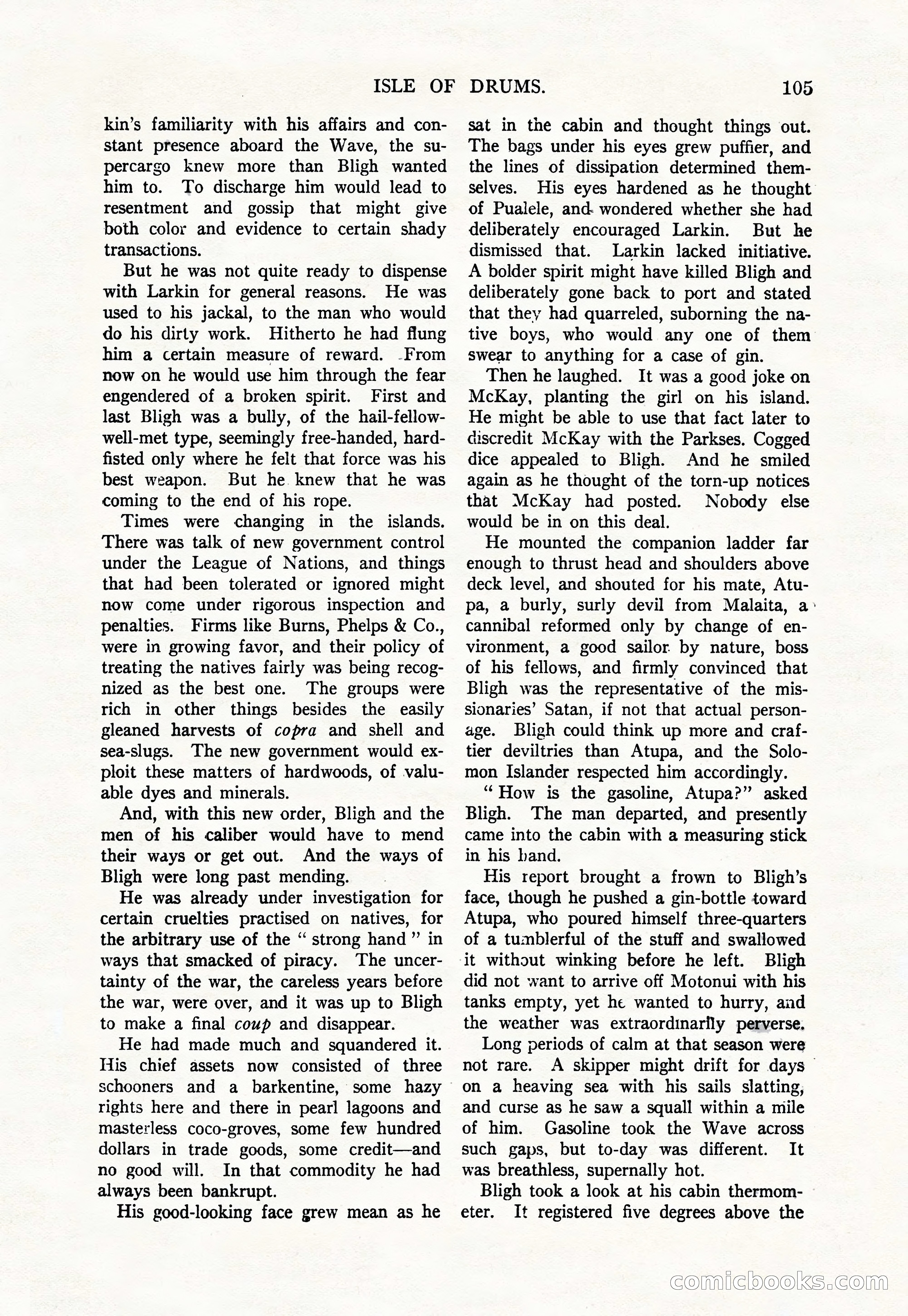
A restored page from Pulp Fiction, 1919. Page through the whole issue in the reader above.
📄 Transcribed text from this page (OCR, searchable)
Machine-transcribed from the original scan — historical spelling and the odd misread are preserved.
ISLE OF kin’s familiarity with his affairs and con- stant presence aboard the Wave, the su- percargo knew more than Bligh wanted him to. To discharge him would lead to resentment and gossip that might give both color and evidence to certain shady transactions. But he was not quite ready to dispense with Larkin for general reasons. He was used to his jackal, to the man who would do his dirty work. Hitherto he had flung him a certain measure of reward. -From now on he would use him through the fear engendered of a broken spirit. First and last Bligh was a bully, of the hail-fellow- well-met type, seemingly free-handed, hard- fisted only where he felt that force was his best weapon. But he. knew that he was coming to the end of his rope. Times were changing in the islands. There was talk of new government control under the League of Nations, and things that had been tolerated or ignored might now come under rigorous inspection and penalties. Firms like Burns, Phelps & Co., were in growing favor, and their policy of treating the natives fairly was being recog- nized as the best one. The groups were rich in other things besides the easily gleaned harvests of copra and shell and sea-slugs. The new government would ex- ploit these matters of hardwoods, of valu- able dyes and minerals. And, with this new order, Bligh and the men of his caliber would have to mend their ways or get out. And the ways of Bligh were long past mending. He was already under investigation for certain cruelties practised on natives, for the arbitrary use of the “ strong hand” in ways that smacked of piracy. The uncer- tainty of the war, the careless years before the war, were over, and it was up to Bligh to make a final coup and disappear. He had made much and squandered it. His chief assets now consisted of three schooners and a barkentine, some hazy rights here and there in pearl lagoons and masterless coco-groves, some few hundred dollars in trade goods, some credit—and no good will. In that commodity he had always been bankrupt. His good-looking face grew mean as he DRUMS. 105 sat in the cabin and thought things out. The bags under his eyes grew puffier, and the lines of dissipation determined them- selves. His eyes hardened as he thought of Pualele, and- wondered whether she had deliberately encouraged Larkin. But he dismissed that. Larkin lacked initiative. A bolder spirit might have killed Bligh and deliberately gone back to port and stated that they had quarreled, suborning the na- tive boys, who would any one of them swear to anything for a case of gin. Then he laughed. It was a good joke on McKay, planting the girl on his island. He might be able to use that fact later to ciscredit McKay with the Parkses. Cogged dice appealed to Bligh. And he smiled again as he thought of the torn-up notices that McKay had posted. Nobody else would be in on this deal. He mounted the companion ladder far enough to thrust head and shoulders above deck level, and shouted for his mate, Atu- pa, a burly, surly devil from Malaita, a> cannibal reformed only by change of en- vironment, a good sailor by nature, boss of his fellows, and firmly convinced that Bligh was the representative of the mis- sionaries’ Satan, if not that actual person- age. Bligh could think up more and craf- tier deviltries than Atupa, and the Solo- mon Islander respected him accordingly. “How is the gasoline, Atupa?” asked Bligh. The man departed, and presently came into the cabin with a measuring stick in his band. His report brought a frown to Bligh’s face, though he pushed a gin-bottle toward Atupa, who poured himself three-quarters of a tumblerful of the stuff and swallowed it without winking before he left. Bligh did not want to arrive off Motonui with his tanks empty, yet he wanted to hurry, and the weather was extraordinarily perverse. Long periods of calm at that season were not rare. on a heaving sea with his sails slatting, and curse as he saw a squall within a mile of him. Gasoline took the Wave across such gaps, but to-day was different. It was breathless, supernally hot. Bligh took a look at his cabin thermom- eter. It registered five degrees above the CONMUC NOOLK A skipper might drift for days — CO