
Pulp Fiction, 1919 · page 109 of 188
Argosy, Vol. 111, No. 1 — page 109: what you’re looking at
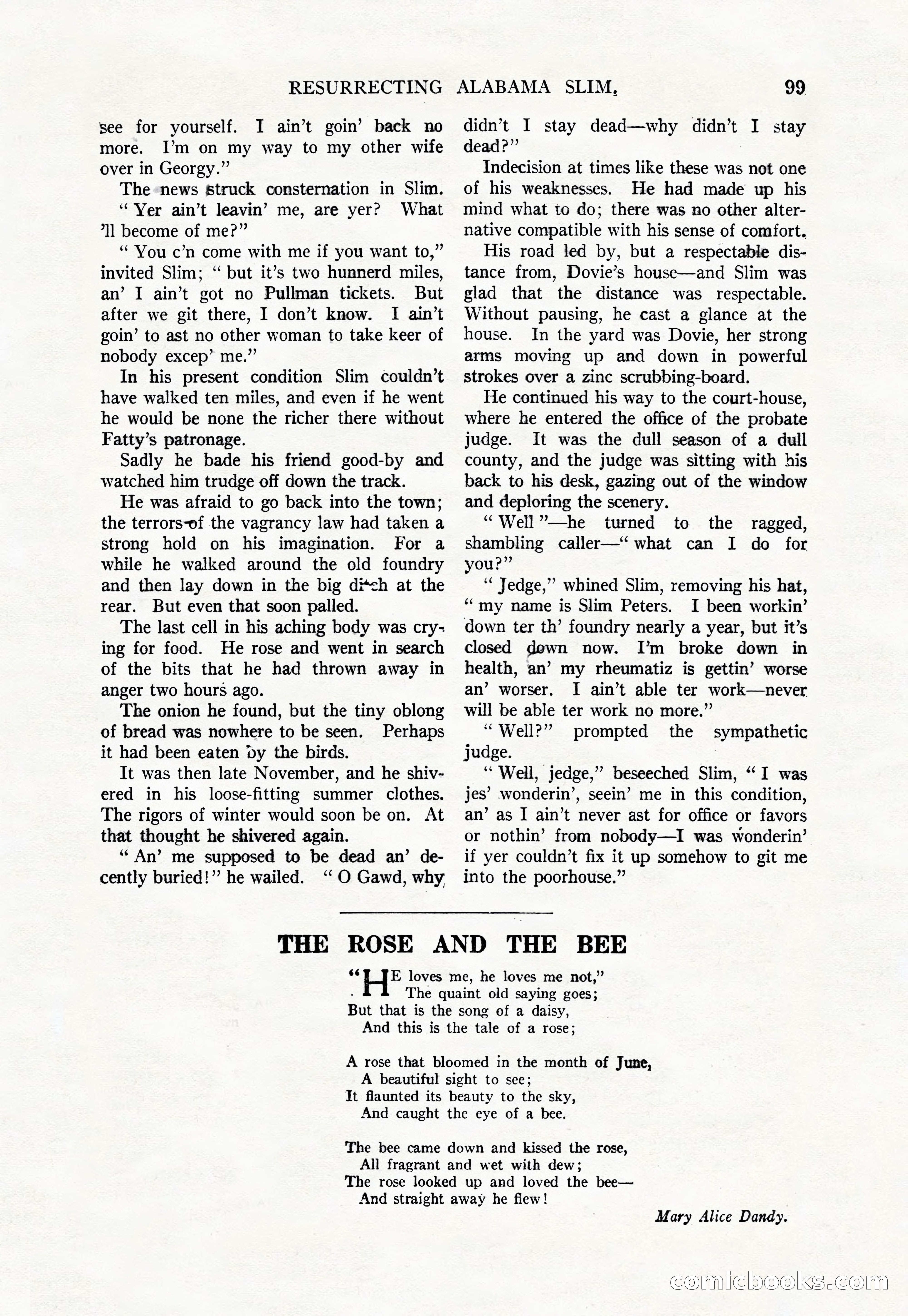
A restored page from Pulp Fiction, 1919. Page through the whole issue in the reader above.
📄 Transcribed text from this page (OCR, searchable)
Machine-transcribed from the original scan — historical spelling and the odd misread are preserved.
RESURRECTING see for yourself. JI ain’t goin’ back no more. I’m on my way to my other wife over in Georgy.” The news struck consternation in Slim. “Yer ain’t leavin’ me, are yer? What "11 become of me?” ‘You c’n come with me if you want to,” invited Slim; “‘ but it’s two hunnerd miles, an’ I ain’t got no Pullman tickets. But after we git there, I don’t know. I ain't goin’ to ast no other woman to take keer of nobody excep’ me.” In his present condition Slim couldn’t have walked ten miles, and even if he went he would be none the richer there without Fatty’s patronage. Sadly he bade his friend good-by and watched him trudge off down the track. He was afraid to go back into the town; the terrors-of the vagrancy law had taken a strong hold on his imagination. For a while he walked around the old foundry and then lay down in the big di*ch at the rear. But even that soon palled. The last cell in his aching body was cry- ing for food. He rose and went in search of the bits that he had thrown away in anger two hours ago. The onion he found, but the tiny oblong of bread was nowhere to be seen. Perhaps it had been eaten oy the birds. It was then late November, and he shiv- ered in his loose-fitting summer clothes. The rigors of winter would soon be on. At that thought he shivered again. ‘‘ An’ me supposed to be dead an’ de- cently buried!” he wailed. ‘‘ O Gawd, why ALABAMA SLIM. 99 didn’t I stay dead—why didn’t I stay dead?” Indecision at times like these was not one of his weaknesses. He had made up his mind what to do; there was no other alter- native compatible with his sense of comfort. His road led by, but a respectable dis- tance from, Dovie’s house—and Slim was glad that the distance was respectable. Without pausing, he cast a glance at the house. In the yard was Dovie, her strong arms moving up and down in powerful strokes over a zinc scrubbing-board. He continued his way to the court-house, where he entered the office of the probate judge. It was the dull season of a dull county, and the judge was sitting with his back to his desk, gazing out of the window and deploring the scenery. ‘““Well”’—he turned to the ragged, shambling caller—‘‘ what can I do for your” ‘« Jedge,” whined Slim, removing his hat, ‘“my name is Slim Peters. I been workin’ down ter th’ foundry nearly a year, but it’s closed down now. I’m broke down in health, an’ my rheumatiz is gettin’ worse an’ worser. I ain’t able ter work—never will be able ter work no more.” “Well?” prompted the sympathetic judge. 7 ‘Well, jedge,” beseeched Slim, “I was jes’ wonderin’, seein’ me in this condition, an’ as I ain’t never ast for office or favors or nothin’ from nobody—I was wonderin’ if yer couldn’t fix it up somehow to git me into the poorhouse.”’ THE ROSE AND THE BEE 66 E loves me, he loves me not,” The quaint old saying goes; But that is the song of a daisy, And this is the tale of a rose; A rose that bloomed in the month of June, A beautiful sight to see; It flaunted its beauty to the sky, And caught the eye of a bee. The bee came down and kissed the rose, All fragrant and wet with dew; The rose looked up and loved the bee—~ And straight away he flew! Mary Alice Dandy. COIN celoa@oalkks (C(O)