
Pulp Fiction, 1919 · page 106 of 188
Argosy, Vol. 111, No. 1 — page 106: what you’re looking at
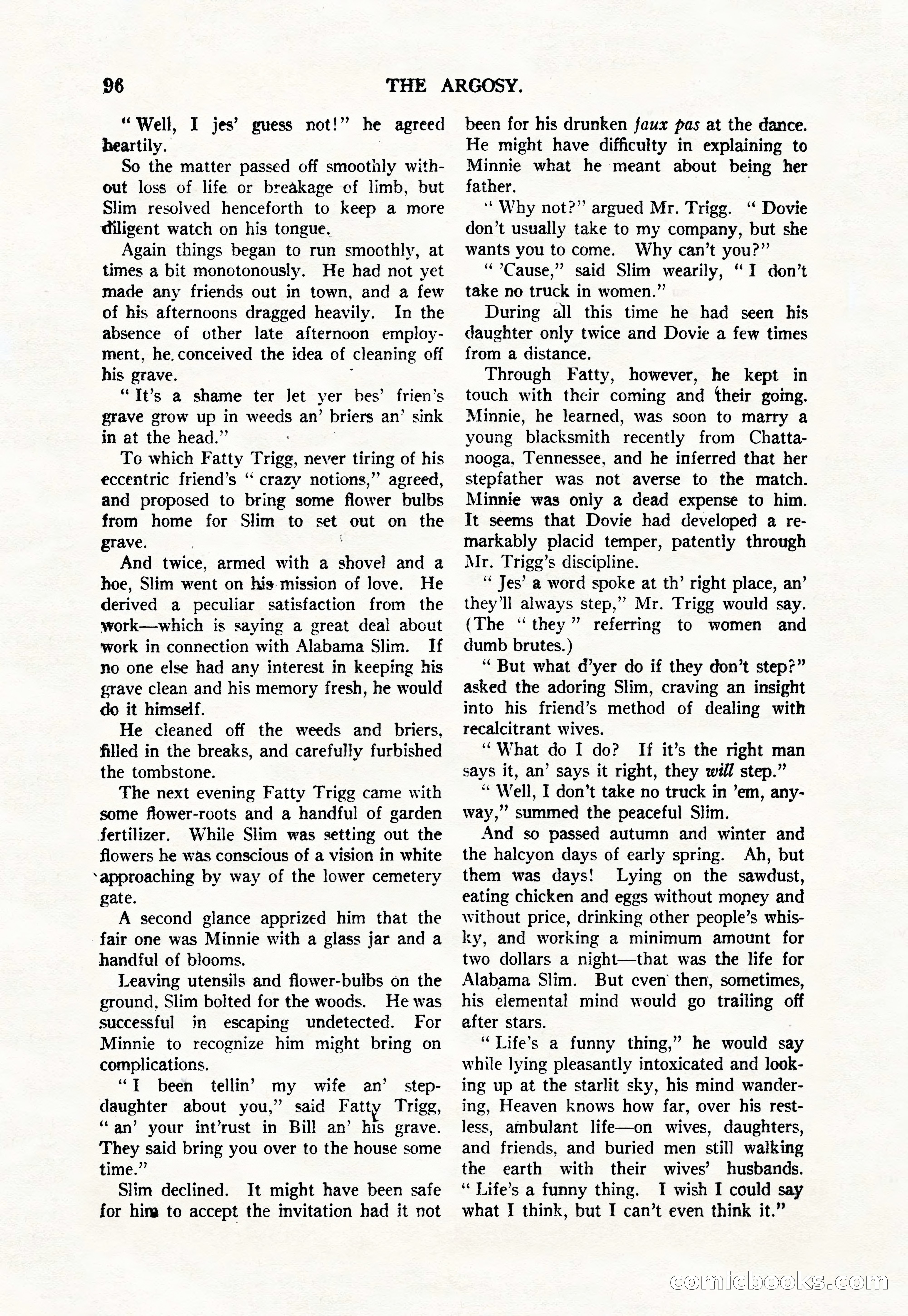
A restored page from Pulp Fiction, 1919. Page through the whole issue in the reader above.
📄 Transcribed text from this page (OCR, searchable)
Machine-transcribed from the original scan — historical spelling and the odd misread are preserved.
96 “Well, I jes’ guess not!” he agreed heartily. 3 So the matter passed off smoothly with- out loss of life or breakage cf limb, but Slim resolved henceforth to keep a more diligent watch on his tongue. Again things began to run smoothly, at times a bit monotonously. He had not yet made any friends out in town, and a few of his afternoons dragged heavily. In the absence of other late afternoon employ- ment, he. conceived the idea of cleaning off his grave. ; “It’s a shame ter let yer bes’ frien’s grave grow up in weeds an’ briers an’ sink in at the head.”’ : To which Fatty Trigg, never tiring of his eccentric friend’s ‘‘ crazy notions,’ agreed, and proposed to bring some flower bulbs from home for Slim to set out on the grave. | And twice, armed with a shovel and a hoe, Slim went on his-mission of love. He derived a peculiar satisfaction from the work—which is saying a great deal about work in connection with Alabama Slim. If no one else had any interest in keeping his grave clean and his memory fresh, he would do it himseif. He cleaned off the weeds and _ briers, filled in the breaks, and carefully furbished the tombstone. The next evening Fatty Trigg came with some flower-roots and a handful of garden fertilizer. While Slim was setting out the flowers he was conscious of a vision in white ‘approaching by way of the lower cemetery gate. A second glance apprized him that the fair one was Minnie with a glass jar and a handful of blooms. Leaving utensils and flower-bulbs on the ground, Slim bolted for the woods. He was successful in escaping undetected. For Minnie to recognize him might bring on complications. “TY been tellin’ my wife an’ step- daughter about you,” said Fatty Trigg, ‘an’ your int’rust in Bill an’ his grave. They said bring you over to the house some time.” Slim declined. It might have been safe for hina to accept the invitation had it not THE ARGOSY. been for his drunken faux pas at the dance. He might have difficulty in explaining to Minnie what he meant about being her father. 3 ‘“ Why not?” argued Mr. Trigg. ‘ Dovie don’t usually take to my company, but she wants you to come. Why can’t you?” “Cause,” said Slim wearily, “I don’t take no truck in women.” During all this time he had seen his daughter only twice and Dovie a few times from a distance. Through Fatty, however, he kept in touch with their coming and their going. Minnie, he learned, was soon to marry a young blacksmith recently from Chatta- nooga, Tennessee, and he inferred that her stepfather was not averse to the match. Minnie was only a dead expense to him. It seems that Dovie had developed a re- markably placid temper, patently through Mr. Trigg’s discipline. ‘Jes’ a word spoke at th’ right place, an’ they'll always step,” Mr. Trigg would say. (The “they” referring to women and dumb brutes. ) “But what d’yer do if they don’t step?” asked the adoring Slim, craving an insight into his friend’s method of dealing with recalcitrant wives. “What do I do? If it’s the right man says it, an’ says it right, they will step.” ‘Well, I don’t take no truck in ’em, any- way,’ summed the peaceful Slim. And so passed autumn and winter and the halcyon days of early spring. Ah, but them was days! Lying on the sawdust, eating chicken and eggs without money and without price, drinking other people’s whis- ky, and working a minimum amount for two dollars a night—that was the life for Alabama Slim. But cven then, sometimes, his elemental mind would go trailing off after stars. ‘“Life’s a funny thing,” he would say while lying pleasantly intoxicated and look- ing up at the starlit sky, his mind wander- ing, Heaven knows how far, over his rest- less, ambulant life—on wives, daughters, and friends, and buried men still walking the earth with their wives’ husbands. ‘“‘ Life’s a funny thing. I wish I could say what I think, but I can’t even think it.” nn S (CO CO JOO)