
Pulp Fiction, 1919 · page 102 of 188
Argosy, Vol. 111, No. 1 — page 102: what you’re looking at
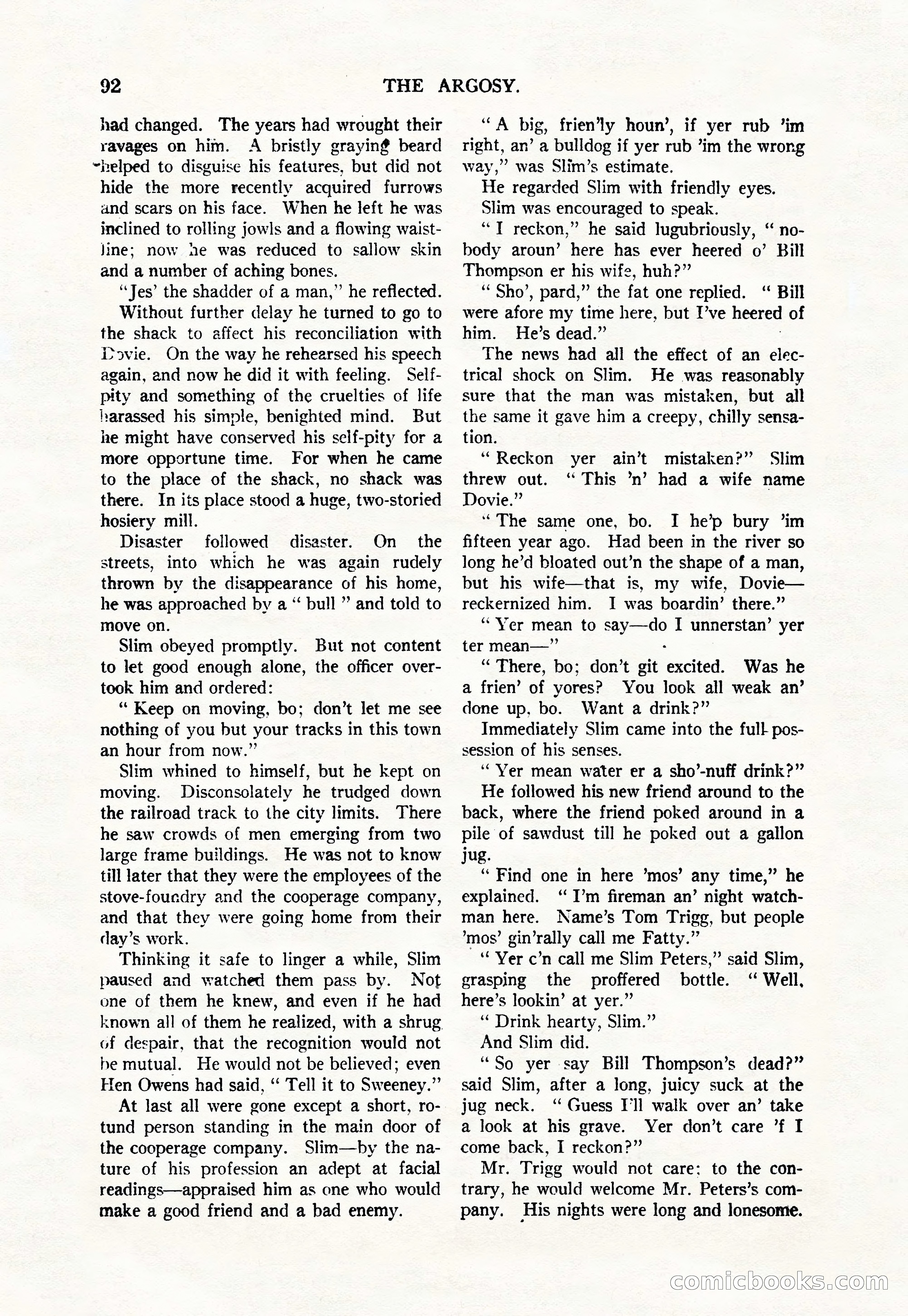
A restored page from Pulp Fiction, 1919. Page through the whole issue in the reader above.
📄 Transcribed text from this page (OCR, searchable)
Machine-transcribed from the original scan — historical spelling and the odd misread are preserved.
92 had changed. The years had wrought their ravages on him. A bristly grayin® beard -relped to disguise his features, but did not hide the more recently acquired furrows and scars on his face. When he left he was inclined to rolling jowls and a flowing waist- Jine; now ne was reduced to sallow skin and a number of aching bones. ‘‘Jes’ the shadder of a man,” he reflected. Without further delay he turned to go to the shack to affect his reconciliation with (Dovie. On the way he rehearsed his speech again, and now he did it with feeling. Self- pity and something of the cruelties of life harassed his simple, benighted mind. But he might have conserved his self-pity for a more opportune time. For when he came to the place of the shack, no shack was there. In its place stood a huge, two-storied hosiery mill. Disaster followed disaster. On _ the streets, into which he was again rudely thrown by the disappearance of his home, he was approached by a “ bull ” and told to move on. Slim obeyed promptly. But not content to let good enough alone, the officer over- took him and ordered: “ Keep on moving, bo; don’t let me see nothing of you but your tracks in this town an hour from now.” Slim whined to himself, but he kept on moving. Disconsolately he trudged down the railroad track to the city limits. There he saw crowds of men emerging from two large frame buildings. He was not to know till later that they were the employees of the stove-foucdry and the cooperage company, and that they were going home from their day’s work. Thinking it safe to linger a while, Slim paused and watched them pass by. Not one of them he knew, and even if he had known all of them he realized, with a shrug of despair, that the recognition would not he mutual. He would not be believed; even Hen Owens had said, ‘“‘ Tell it to Sweeney.”’ At last all were gone except a short, ro- tund person standing in the main door of the cooperage company. Slim—by the na- ture of his profession an adept at facial readings—appraised him as one who would make a good friend and a bad enemy. THE ARGOSY. ‘A big, frien’ly houn’, if yer rub ’ right, an’ a bulldog if yer rub ’im the wrong way,” was Slim’s estimate. He regarded Slim with friendly eyes. Slim was encouraged to speak. ‘““T reckon,” he said lugubriously, “ no- body aroun’ here has ever heered o’ Bill Thompson er his wife, huh?” ‘Sho’, pard,” the fat one replied. ‘ Bill were afore my time here, but I’ve heered of him. He’s dead.” The news had all the effect of an elec- trical shock on Slim. He was reasonably sure that the man was mistaken, but all the same it gave him a creepy, chilly sensa- tion. ‘“Reckon yer ain’t mistaken?” threw out. Dovie.” “The same one, bo. I he’p bury ’ fifteen year ago. Had been in the river so long he’d bloated out’n the shape of a man, but his wife—that is, my wife, Dovie— reckernized him. I was boardin’ there.” % Ver mean to 20 I unnerstan’ yer ter mean—”’ “There, bo; don’t git lercied Was he a frien’ of yores? You look all weak an’ done up, bo. Want a drink?” Immediately Slim came into the full pos- session of his senses. ‘“Yer mean water er a sho’-nuff drink?” He followed his new friend around to the back, where the friend poked around in a pile of sawdust till he poked out a gallon jug. “Find one in here ’mos’ any time,” he explained. ‘I’m fireman an’ night watch- man here. Name’s Tom Trigg, but people ‘mos’ gin’rally call me Fatty.” ‘Yer c’n call me Slim Peters,” said Slim, grasping the proffered bottle. ‘ Well, here’s lookin’ at yer.” ‘“* Drink hearty, Slim.” And Slim did. ‘“So yer say Bill Thompson’s dead?” said Slim, after a long, juicy suck at the jug neck. ‘“‘ Guess I'll walk over an’ take a look at his grave. Yer don’t care ’f I come back, I reckon?” Mr. Trigg would not care: to the con- trary, he would welcome Mr. Peters’s com- pany. His nights were long and lonesome. Slim “This ’n’ had a wife name HOO) = a CO S (CO