
Pulp Fiction, 1917 · page 76 of 192
The Argosy, Vol. 84 No. 2 — page 76: what you’re looking at
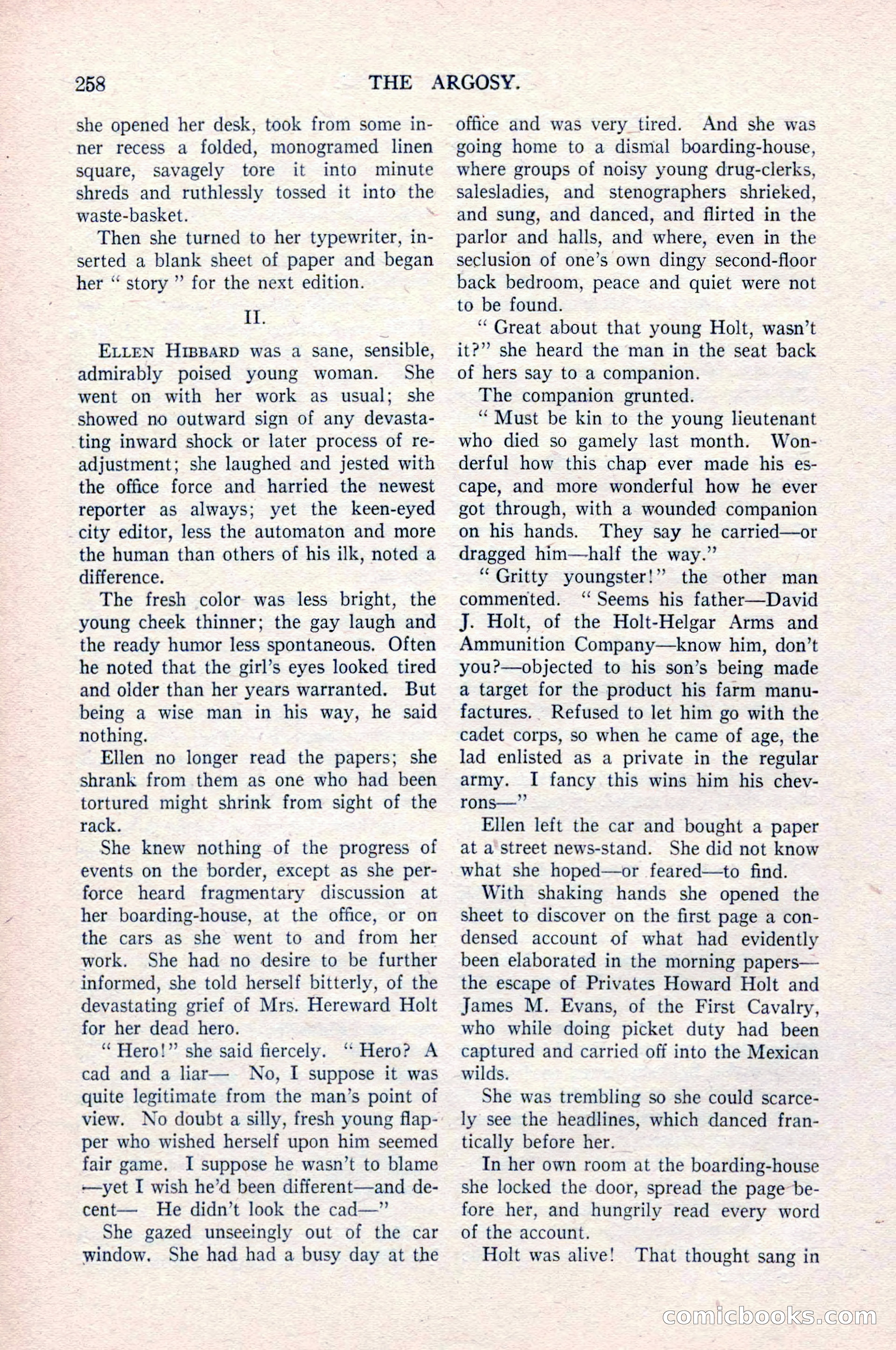
A restored page from Pulp Fiction, 1917. Page through the whole issue in the reader above.
📄 Transcribed text from this page (OCR, searchable)
Machine-transcribed from the original scan — historical spelling and the odd misread are preserved.
258 she opened her desk, took from some in- ner recess a folded, monogramed linen square, savagely tore it into minute shreds and ruthlessly tossed it into the waste-basket. Then she turned to her typewriter, in- serted a blank sheet of paper and began her “ story ” for the next edition. If. ELLEN HIBBARD was a sane, sensible, admirably poised young woman. She went on with her work as usual; she showed no outward sign of any devasta- ting inward shock or later process of re- adjustment; she laughed and jested with the office force and harried the newest reporter as always; yet the keen-eyed city editor, less the automaton and more the human than others of his ilk, noted a difference. The fresh color was less bright, the young cheek thinner; the gay laugh and the ready humor less spontaneous. Often he noted that the girl’s eyes looked tired and older than her years warranted. But being a wise man in his way, he said nothing. Ellen no longer read the papers; she shrank from them as one who had been tortured might shrink from sight of the rack. She knew nothing of the progress of events on the border, except as she per- force heard fragmentary discussion at her boarding-house, at the office, or on the cars as she went to and from her work. She had no desire to be further informed, she told herself bitterly, of the devastating grief of Mrs. Hereward Holt for her dead hero. “ Hero!” she said fiercely. “‘ Hero? A cad and a liar— No, I suppose it was quite legitimate from the man’s point of view. No doubt a silly, fresh young flap- per who wished herself upon him seemed fair game. I suppose he wasn’t to blame —yet I wish he’d been different—and de- cent— He didn’t look the cad—”’ She gazed unseeingly out of the car window. She had had a busy day at the THE ARGOSY. office and was very tired. And she was going home to a dismal boarding-house, where groups of noisy young drug-clerks, salesladies, and stenographers shrieked, and sung, and danced, and flirted in the parlor and halls, and where, even in the seclusion of one’s own dingy second-floor back bedroom, peace and quiet were not to be found. “Great about that young Holt, wasn’t it?” she heard the man in the seat back of hers say to a companion. The companion grunted. “Must be kin to the young lieutenant who died so gamely last month. Won- derful how this chap ever made his es- cape, and more wonderful how he ever got through, with a wounded companion on his hands. They say he carried—or dragged him—half the way.” “ Gritty youngster!” the other man commented. ‘“ Seems his father—David J. Holt, of the Holt-Helgar Arms and Ammunition Company—know him, don’t you?—objected to his son’s being made a target for the product his farm manu- factures. Refused to let him go with the cadet corps, so when he came of age, the lad enlisted as a private in the regular army. I fancy this wins him his chev- rons—” Ellen left the car and bought a paper at a street news-stand. She did not know what she hoped—or feared—to find. With shaking hands she opened the sheet to discover on the first page a con- densed account of what had evidently been elaborated in the morning papers— the escape of Privates Howard Holt and James M. Evans, of the First Cavalry, who while doing picket duty had been captured and carried off into the Mexican wilds. She was trembling so she could scarce- ly see the headlines, which danced fran- tically before her. In her own room at the boarding-house she locked the door, spread the page be- fore her, and hungrily read every word of the account. Holt was alive! That thought sang in Go .TOO NUNC <S) (©