
Pulp Fiction, 1917 · page 75 of 192
The Argosy, Vol. 84 No. 2 — page 75: what you’re looking at
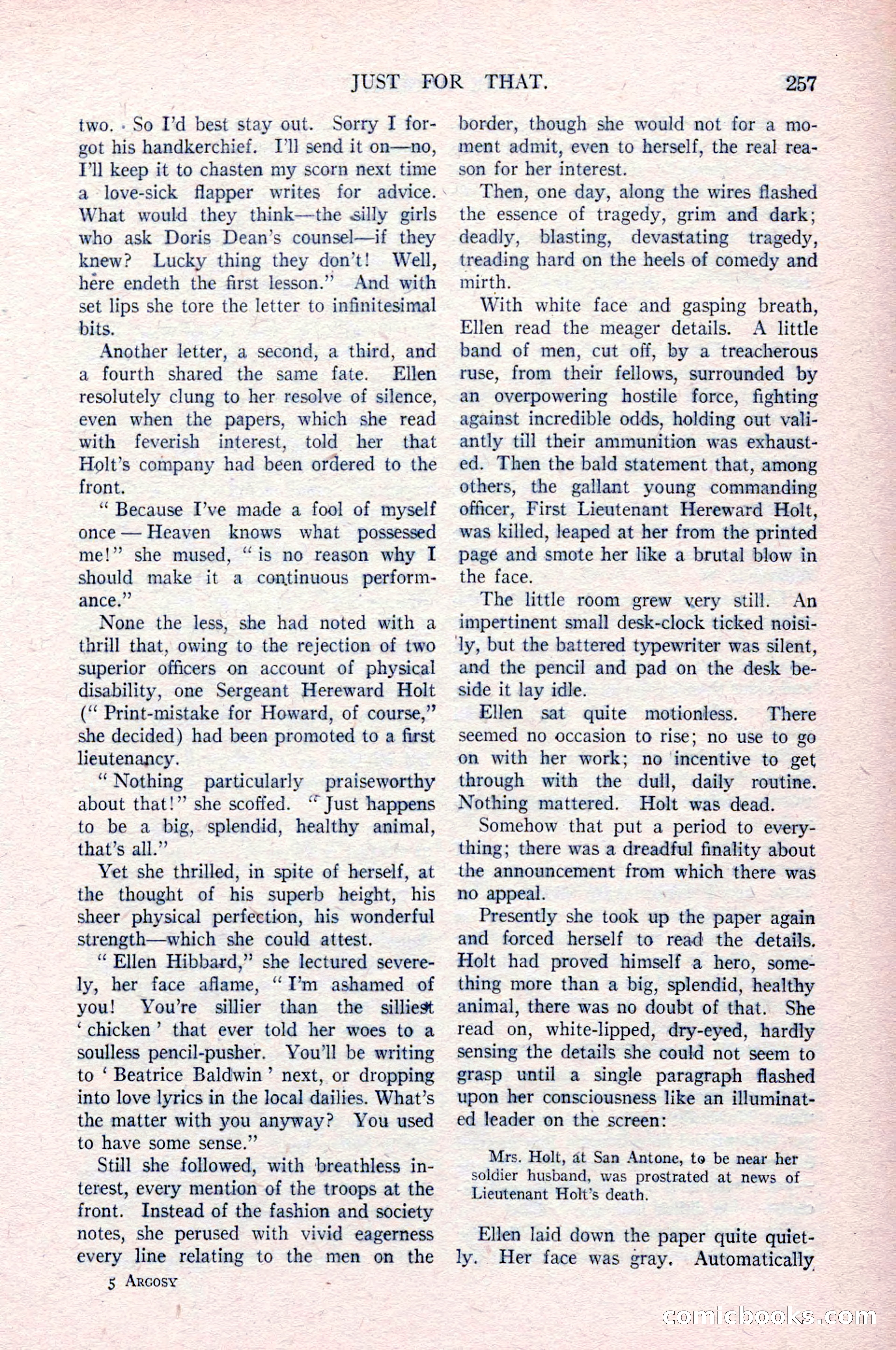
A restored page from Pulp Fiction, 1917. Page through the whole issue in the reader above.
📄 Transcribed text from this page (OCR, searchable)
Machine-transcribed from the original scan — historical spelling and the odd misread are preserved.
JUST FOR THAT. two. - So I’d best stay out. Sorry I for- got his handkerchief. I’ll send it on—no, I'll keep it to chasten my scorn next time a love-sick flapper writes for advice. What would they think—the silly girls who ask Doris Dean’s counsel—if they knew? Lucky thing they don’t! Well, here endeth the first lesson.” And with set lips she tore the letter to infinitesimal bits. Another letter, a second, a third, and a fourth shared the same fate. Ellen resolutely clung to her resolve of silence, even when the papers, which she read with feverish interest, told her that Holt’s company had been ordered to the front. ‘“ Because I’ve made a fool of myself once — Heaven knows what possessed me!” she mused, “is no reason why I should make it a continuous perform- ance.” : None the less, she had noted with a thrill that, owing to the rejection of two superior officers on account of physical disability, one Sergeant Hereward Holt (‘‘ Print-mistake for Howard, of course,” she decided) had been promoted to a first lieutenancy. “Nothing particularly praiseworthy about that!” she scoffed. ‘“ Just happens to be a big, splendid, healthy animal, that’s all.” Yet she thrilled, in spite of herself, at the thought of his superb height, his sheer physical perfection, his wonderful strength—which she could attest. ‘Ellen Hibbard,” she lectured severe- ly, her face aflame, “I’m ashamed of you! You're sillier than the silliest ‘chicken’ that ever told her woes to a soulless pencil-pusher. You'll be writing to ‘ Beatrice Baldwin’ next, or dropping into love lyrics in the local dailies. What’s the matter with you anyway? You used to have some sense.” Still she followed, with breathless in- terest, every mention of the troops at the front. Instead of the fashion and society notes, she perused with vivid eagerness every line relating to the men on the 5 Arcosy - 257 border, though she would not for a mo- ment admit, even to herself, the real rea- son for her interest. Then, one day, along the wires flashed the essence of tragedy, grim and dark; deadly, blasting, devastating tragedy, treading hard on the heels of comedy and mirth. With white face and gasping breath, Ellen read the meager details. A little band of men, cut off, by a treacherous ruse, from their fellows, surrounded by an overpowering hostile force, fighting against incredible odds, holding out vali- antly till their ammunition was exhaust- ed. Then the bald statement that, among others, the gallant young commanding officer, First Lieutenant Hereward Holt, was killed, leaped at her from the printed page and smote her like a brutal blow in the face. The little room grew very still. An impertinent small desk-clock ticked noisi- ly, but the battered typewriter was silent, and the pencil and pad on the desk be- side it lay idle. Ellen sat quite motionless. There seemed no occasion to rise; no use to go on with her work; no incentive to get through with the dull, daily routine. Nothing mattered. Holt was dead. Somehow that put a period to every- thing; there was a dreadful finality about the announcement from which there was no appeal. Presently she took up the paper again and forced herself to read the details. Holt had proved himself a hero, some- thing more than a big, splendid, healthy animal, there was no doubt of that. She read on, white-lipped, dry-eyed, hardly sensing the details she could not seem to grasp until a single paragraph flashed upon her consciousness like an illuminat- ed leader on the screen: Mrs. Holt, at San Antone, to be near her soldier husband, was prostrated at news of Lieutenant Holt’s death. Ellen laid down the paper quite quiet- ly. Her face was gray. Automatically CORMICLOOOKS (C@