
Pulp Fiction, 1917 · page 54 of 192
The Argosy, Vol. 84 No. 2 — page 54: what you’re looking at
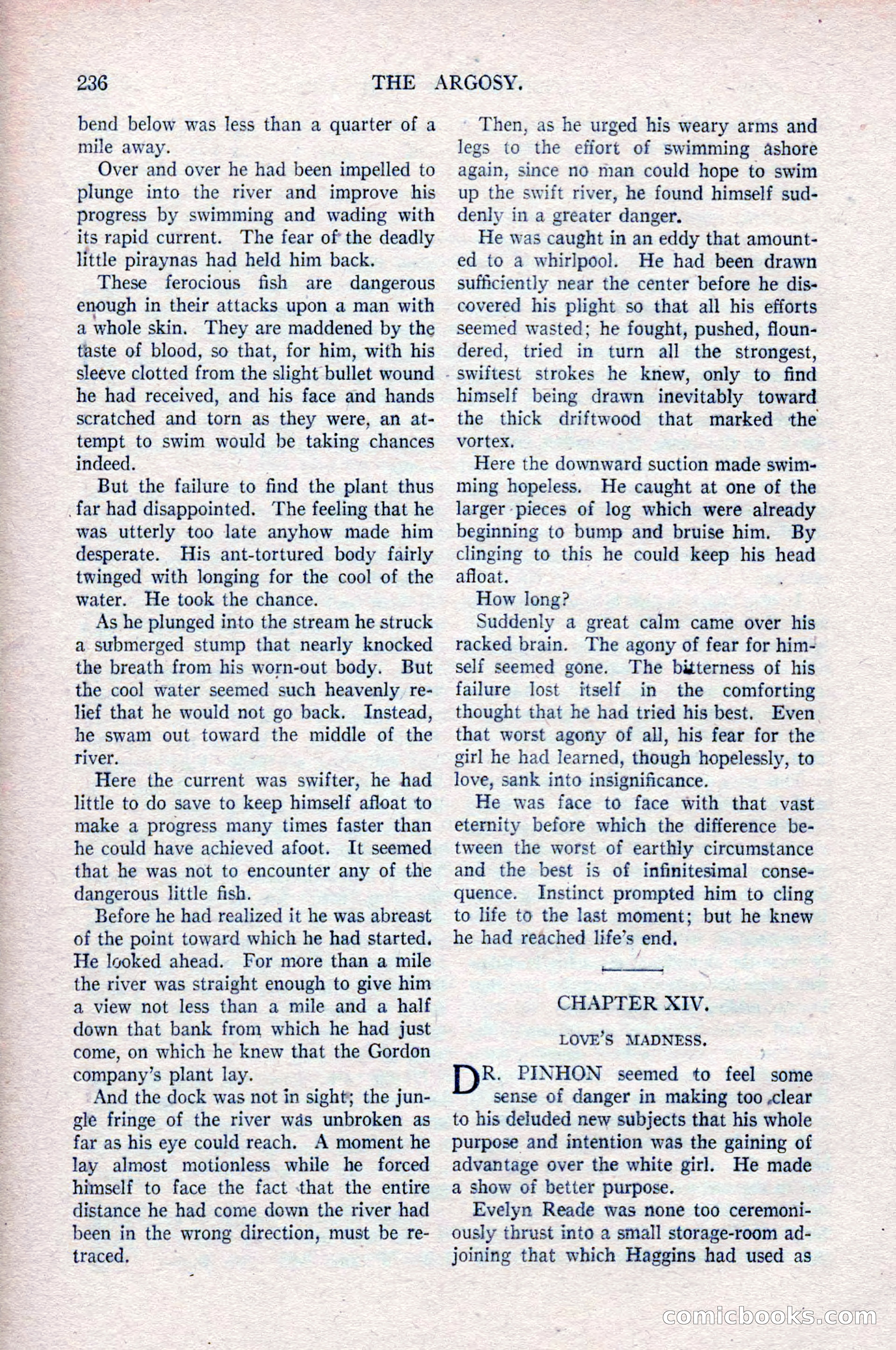
A restored page from Pulp Fiction, 1917. Page through the whole issue in the reader above.
📄 Transcribed text from this page (OCR, searchable)
Machine-transcribed from the original scan — historical spelling and the odd misread are preserved.
236 bend below was less than a quarter of a mile away. Over and over he had been impelled to plunge into the river and improve his progress by swimming and wading with ‘its rapid current. The fear of the deadly little piraynas had held him back. These ferocious fish are dangerous enough in their attacks upon a man with a whole skin. They are maddened by the taste of blood, so that, for him, with his sleeve clotted from the slight bullet wound he had received, and his face and hands scratched and torn as they were, an at- tempt to swim would be taking chances indeed. But the failure to find the plant thus far had disappointed. ‘The feeling that he was utterly too late anyhow made him desperate. His ant-tortured body fairly twinged with longing for the cool of the water. He took the chance. As he plunged into the stream he struck a submerged stump that nearly knocked the breath from his worn-out body. But the cool water seemed such heavenly re- lief that he would not go back. Instead, he swam out toward the middle of the river. Here the current was swifter, he had little to do save to keep himself afloat to make a progress many times faster than he could have achieved afoot. It seemed that he was not to encounter any of the dangerous little fish. Before he had realized it he was abreast of the point toward which he had started. He looked ahead. For more than a mile the river was straight enough to give him a view not less than a mile and a half down that bank from which he had just come, on which he knew that the Gordon company’s plant lay. And the dock was not in sight; the jun- gle fringe of the river was unbroken as far as his eye could reach. A moment he lay almost motionless while he forced himself to face the fact that the entire distance he had come down the river had been in the wrong direction, must be re- traced, THE ARGOSY. Then, as he urged his weary arms and legs to the efiort of swimming ashore again, since no man could hope to swim up the swift river, he found himself sud- denly in a greater danger. He was caught in an eddy that amount- ed to a whirlpool. He had been drawn sufficiently near the center before he dis- covered his plight so that all his efforts seemed wasted; he fought, pushed, floun- dered, tried in turn all the strongest, - swiftest strokes he knew, only to find himself being drawn inevitably toward the thick driftwood that marked the vortex. Here the downward suction made swim- ming hopeless. He caught at one of the larger pieces of log which were already beginning to bump and bruise him. By clinging to this he could keep his head afioat. How long? Suddenly a great calm came over his racked brain. The agony of fear for him- self seemed gone. The bitterness of his failure lost itself in the comforting thought that he had tried his best. Even that worst agony of all, his fear for the girl he had learned, though hopelessly, to love, sank into insignificance. He was face to face with that vast eternity before which the difference be- tween the worst of earthly circumstance and the best is of infinitesimal conse- quence. Instinct prompted him to cling to life to the last moment; but he knew he had reached life’s end. CHAPTER XIV, LOVE’S MADNESS, R. PINHON seemed to feel some sense of danger in making too ,clear to his deluded new subjects that his whole purpose and intention was the gaining of advantage over the white girl. He made a show of better purpose. Evelyn Reade was none too ceremoni- ously thrust into a small storage-room ad- joining that which Haggins had used as CORNICLOOOKS (C@