
Pulp Fiction, 1917 · page 53 of 192
The Argosy, Vol. 84 No. 2 — page 53: what you’re looking at
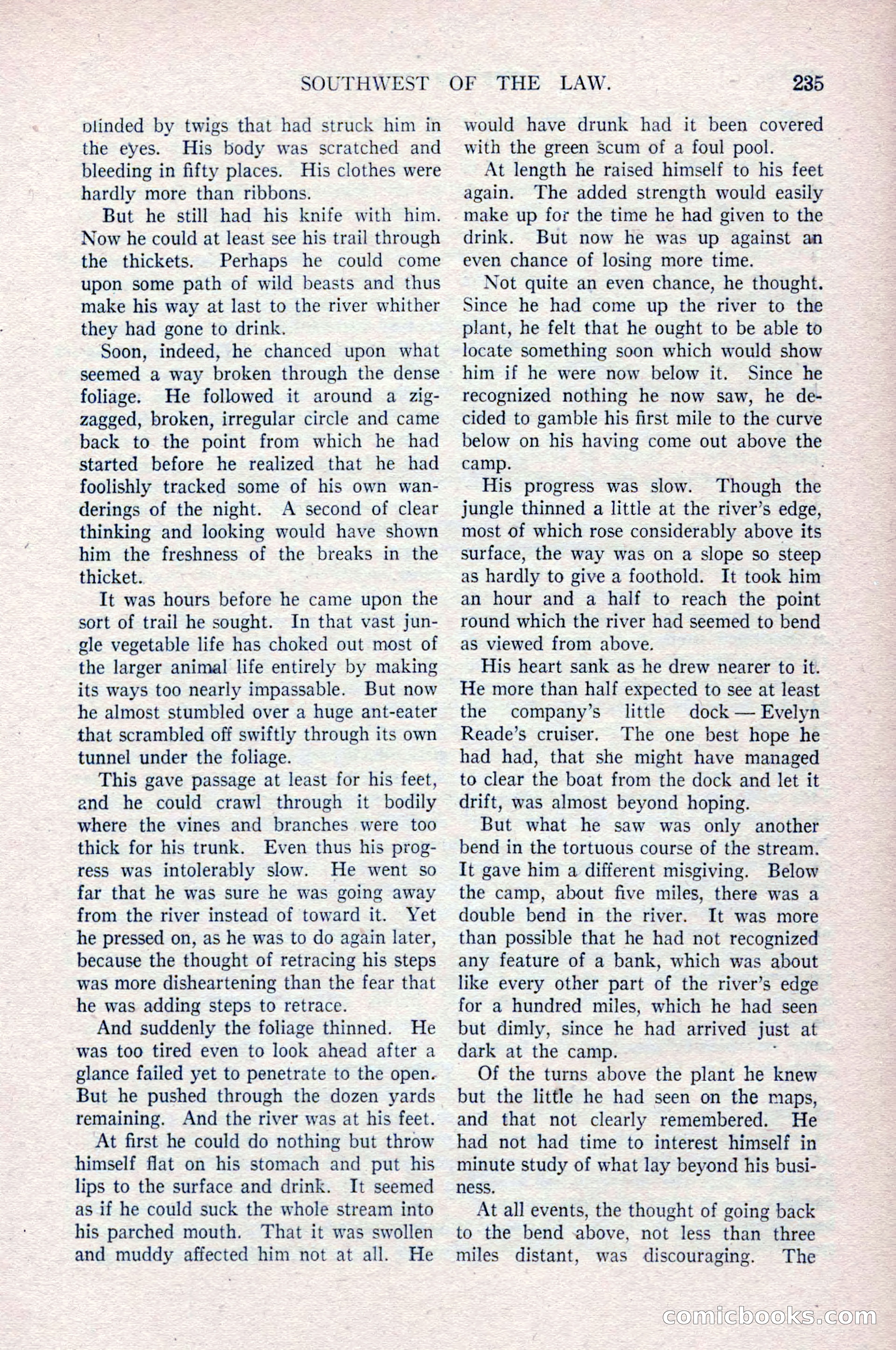
A restored page from Pulp Fiction, 1917. Page through the whole issue in the reader above.
📄 Transcribed text from this page (OCR, searchable)
Machine-transcribed from the original scan — historical spelling and the odd misread are preserved.
SOUTHWEST OF THE LAW. olinded by twigs that had struck him in the eyes. His body was scratched and bleeding in fifty places. His clothes were hardly more than ribbons. But he still had his knife with him. Now he could at least see his trail through the thickets. Perhaps he could come upon some path of wild beasts and thus make his way at last to the river whither they had gone to drink. Soon, indeed, he chanced upon what seemed a way broken through the dense foliage. He followed it around a zig- zagged, broken, irregular circle and came back to the point from which he had started before he realized that he had foolishly tracked some of his own wan- derings of the night. A second of clear thinking and looking would have shown him the freshness of the breaks in the thicket. It was hours before he came upon the sort of trail he sought. In that vast jun- gle vegetable life has choked out most of the larger animal life entirely by making its ways too nearly impassable. But now he almost stumbled over a huge ant-eater that scrambled off swiftly through its own tunnel under the foliage. This gave passage at least for his feet, and he could crawl through it bodily where the vines and branches were too thick for his trunk. Even thus his prog- ress was intolerably slow. He went so far that he was sure he was going away from the river instead of toward it. Yet he pressed on, as he was to do again later, because the thought of retracing his steps was more disheartening than the fear that he was adding steps to retrace. And suddenly the foliage thinned. He was too tired even to look ahead after a glance failed yet to penetrate to the open. But he pushed through the dozen yards remaining. And the river was at his feet. At first he could do nothing but throw himself flat on his stomach and put his lips to the surface and drink. It seemed as if he could suck the whole stream into his parched mouth. That it was swollen and muddy affected him not at all. He 235 would have drunk had it been covered with the green Scum of a foul pool. At length he raised himself to his feet again. The added strength would easily make up for the time he had given to the drink. But now he was up against an even chance of losing more time. Not quite an even chance, he thought. Since he had come up the river to the plant, he felt that he ought to be able to locate something soon which would show him if he were now below it. Since he recognized nothing he now saw, he de- cided to gamble his first mile to the curve below on his having come out above the camp. His progress was slow. jungle thinned a little at the river’s edge, most of which rose considerably above its surface, the way was on a slope so steep as hardly to give a foothold. It took him an hour and a half to reach the point round which the river had seemed to bend as viewed from above. His heart sank as he drew nearer to it. He more than half expected to see at least the company’s little dock — Evelyn Reade’s cruiser. The one best hope he had had, that she might have managed to clear the boat from the dock and let it drift, was almost beyond hoping. But what he saw was only another bend in the tortuous course of the stream. It gave him a different misgiving. Below the camp, about five miles, there was a double bend in the river. It was more than possible that he had not recognized any feature of a bank, which was about like every other part of the river’s edge for a hundred miles, which he had seen but dimly, since he had arrived just at dark at the camp. Of the turns above the plant he knew but the little he had seen on the maps, and that not clearly remembered. He had not had time to interest himself in minute study of what lay beyond his busi- ness. At all events, the thought of going back to the bend above, not less than three miles distant, was discouraging. The ecomiclbhooks, Though the (C@