
Pulp Fiction, 1917 · page 138 of 192
The Argosy, Vol. 84 No. 2 — page 138: what you’re looking at
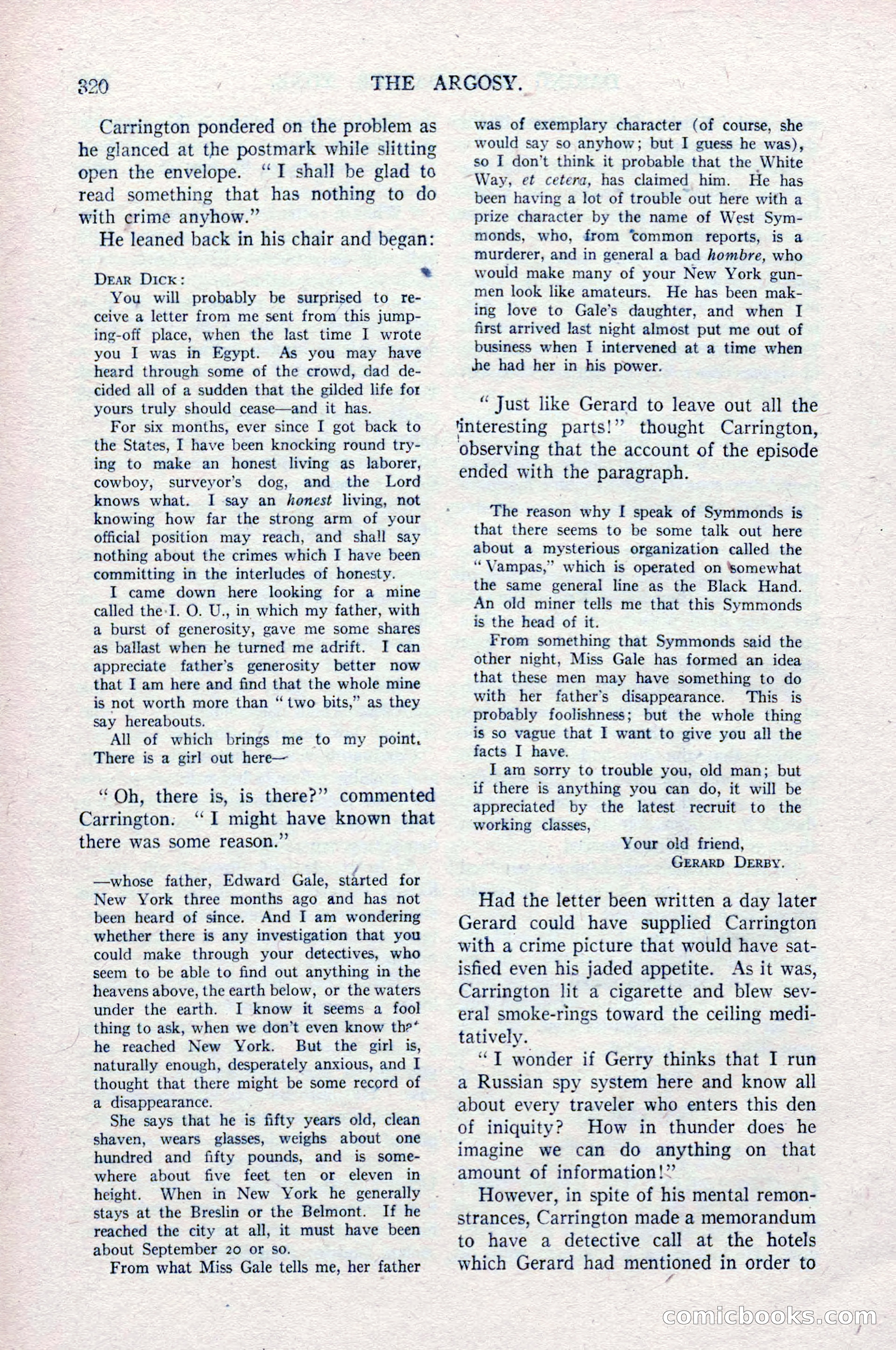
A restored page from Pulp Fiction, 1917. Page through the whole issue in the reader above.
📄 Transcribed text from this page (OCR, searchable)
Machine-transcribed from the original scan — historical spelling and the odd misread are preserved.
B20 Carrington pondered on the problem as he glanced at the postmark while slitting open the envelope. ‘I shall be glad to read something that has nothing to do with crime anyhow.” He leaned back in his chair and began: Dear Dick: ee You will probably be surprised to re- ceive a letter from me sent from this jump- ing-off place, when the last time I wrote you I was in Egypt. As you may have heard through some of the crowd, dad de- cided all of a sudden that the gilded life for yours truly should cease—and it has. For six months, ever since I got back to the States, I have been knocking round try- ing to make an honest living as laborer, cowboy, surveyor’s dog, and the Lord knows what. I say an sonest living, not knowing how far the strong arm of your official position may reach, and shall say nothing about the crimes which I have been committing in the interludes of honesty. I came down here looking for a mine called the: I. O. U., in which my father, with a burst of generosity, gave me some shares as ballast when he turned me adrift. I can appreciate father’s generosity better now that I am here and find that the whole mine is not worth more than “ two bits,” as they say hereabouts. All of which brings me to my point. There is a girl out here— ‘Oh, there is, is there?”’ commented Carrington: ‘“ I might have known that there was some reason.” —whose father, Edward Gale, started for New York three months ago and has not been heard of since. And I am wondering whether there is any investigation that you could make through your detectives, who seem to be able to find out anything in the heavens above, the earth below, or the waters under the earth. I know it seems a fool thing to ask, when we don’t even know th?* he reached New York. But the girl is, naturally enough, desperately anxious, and I thought that there might be some record of a disappearance. She says that he is fifty years old, clean shaven, wears glasses, weighs about one hundred and fifty pounds, and is some- where about five feet ten or eleven in height. When in New York he generally stays at the Breslin or the Belmont. If he reached the city at all, it must have been about September 20 or so. From what Miss Gale tells me, her father THE ARGOSY. was of exemplary character (of course, she would say so anyhow; but I guess he was), so I don’t think it probable that the White Way, et cetera, has claimed him. He has been having a lot of trouble out here with a prize character by the name of West Sym- monds, who, from tommon reports, is a murderer, and in general a bad hombre, who would make many of your New York gun- men look like amateurs. He has been mak- ing love to Gale’s daughter, and when I first arrived last night almost put me out of business when I intervened at a time when he had her in his power. “Just like Gerard to leave out all the interesting parts!” thought Carrington, observing that the account of the episode ended with the paragraph. The reason why I speak of Symmonds is that there seems to be some talk out here about a mysterious organization called the ‘“Vampas,” which is operated on ‘somewhat the same general line as the Black Hand. An old miner tells me that this Symmonds is the head of it. From something that Symmonds said the other night, Miss Gale has formed an idea that these men may have something to do with her father’s disappearance. This is probably foolishness; but the whole thing is so vague that I want to give you all the facts I have. I am sorry to trouble you, old man; but if there is anything you can do, it will be appreciated by the latest recruit to the working classes, Your old friend, GERARD DERBY. Had the letter been written a day later Gerard could have supplied Carrington with a crime picture that would have sat- isfied even his jaded appetite. As it was, Carrington lit a cigarette and blew sev- eral smoke-rings toward the ceiling medi- tatively. ‘“T wonder if Gerry thinks that I run a Russian spy system here and know all about every traveler who enters this den of iniquity? How in thunder does he imagine we can do anything on that amount of information!’ However, in spite of his mental remon- strances, Carrington made a memorandum to have a detective call at the hotels which Gerard had mentioned in order to COMMCMOOOKS EO]