
Pulp Fiction, 1916 · page 99 of 204
The Argosy, Vol. 83 No. 1 — page 99: what you’re looking at
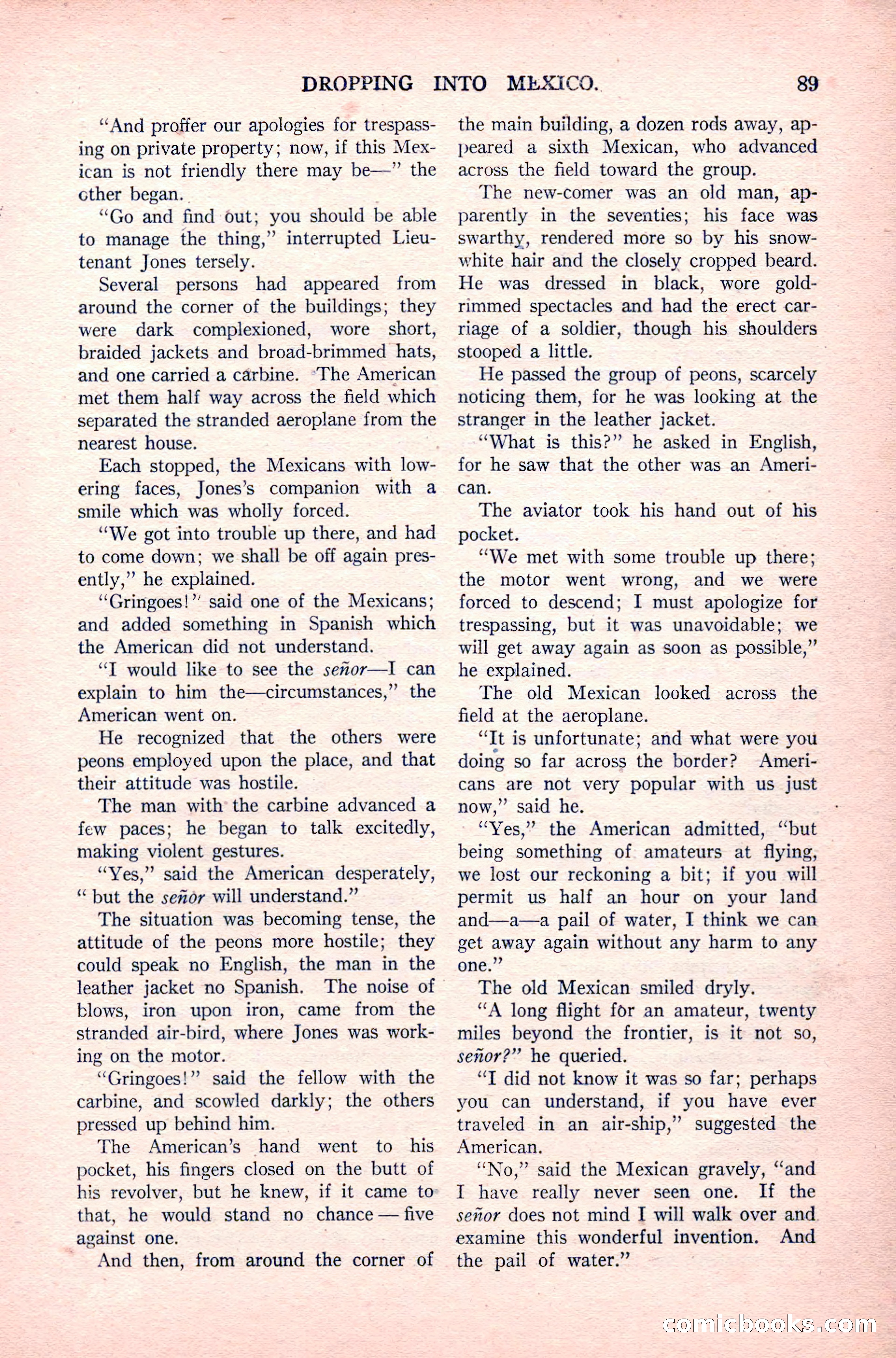
A restored page from Pulp Fiction, 1916. Page through the whole issue in the reader above.
📄 Transcribed text from this page (OCR, searchable)
Machine-transcribed from the original scan — historical spelling and the odd misread are preserved.
DROPPING INTO MEXICO. “And proffer our apologies for trespass- ing on private property; now, if this Mex- ican is not friendly there may be—” the other began. “Go and find out; you should be able to manage the thing,” interrupted Lieu- tenant Jones tersely. Several persons had appeared from around the corner of the buildings; they were dark complexioned, wore short, braided jackets and broad-brimmed hats, and one carried a carbine. “The American met them half way across the field which separated the stranded aeroplane from the nearest house. Each stopped, the Mexicans with low- ering faces, Jones’s companion with a smile which was wholly forced. ‘We got into trouble up there, and had to come down; we shall be off again pres- ently,” he explained. ‘“Gringoes!’’ said one of the Mexicans; and added something in Spanish which the American did not understand. “T would like to see the senor—I can explain to him the—circumstances,” the American went on. He recognized that the others were peons employed upon the place, and that their attitude was hostile. The man with the carbine advanced a few paces; he began to talk excitedly, making violent gestures. “Ves,” said the American desperately, “but the sevor will understand.” The situation was becoming tense, the attitude of the peons more hostile; they could speak no English, the man in the leather jacket no Spanish. The noise of blows, iron upon iron, came from the stranded air-bird, where Jones was work- ing on the motor. “Gringoes!” said the fellow with the carbine, and scowled darkly; the others pressed up behind him. The American’s hand went to his pocket, his fingers closed on the butt of his revolver, but he knew, if it came to that, he would stand no chance — five against one. And then, from around the corner of 89 the main building, a dozen rods away, ap- peared a sixth Mexican, who advanced across the field toward the group. The new-comer was an old man, ap- parently in the seventies; his face was swarthy, rendered more so by his snow- white hair and the closely cropped beard. He was dressed in black, wore gold- rimmed spectacles and had the erect car- riage of a soldier, though his shoulders stooped a little. He passed the group of peons, scarcely noticing them, for he was looking at the stranger in the leather jacket. “What is this?” he asked in English, for he saw that the other was an Ameri- can. : The aviator took his hand out of his pocket. “We met with some trouble up there; the motor went wrong, and we were forced to descend; I must apologize for trespassing, but it was unavoidable; we will get away again as soon as possible,” he explained. The old Mexican looked across the field at the aeroplane. “It is unfortunate; and what were you doing so far across the border? Ameri- cans are not very popular with us just now,” said he. “Yes,” the American admitted, ‘but being something of amateurs at flying, we lost our reckoning a bit; if you will permit us half an hour on your land and—a—a pail of water, I think we can get away again without any harm to any one.” The old Mexican smiled dryly. “A long flight for an amateur, twenty miles beyond the frontier, is it not so, senor?” he queried. “T did not know it was so far; perhaps you can understand, if you have ever traveled in an air-ship,” suggested the American. “No,” said the Mexican gravely, “and I have really never seen one. If the senor does not mind I will walk over and. examine this wonderful invention. And the pail of water.” ECORMICLOOOK (C@)