
Pulp Fiction, 1916 · page 100 of 204
The Argosy, Vol. 83 No. 1 — page 100: what you’re looking at
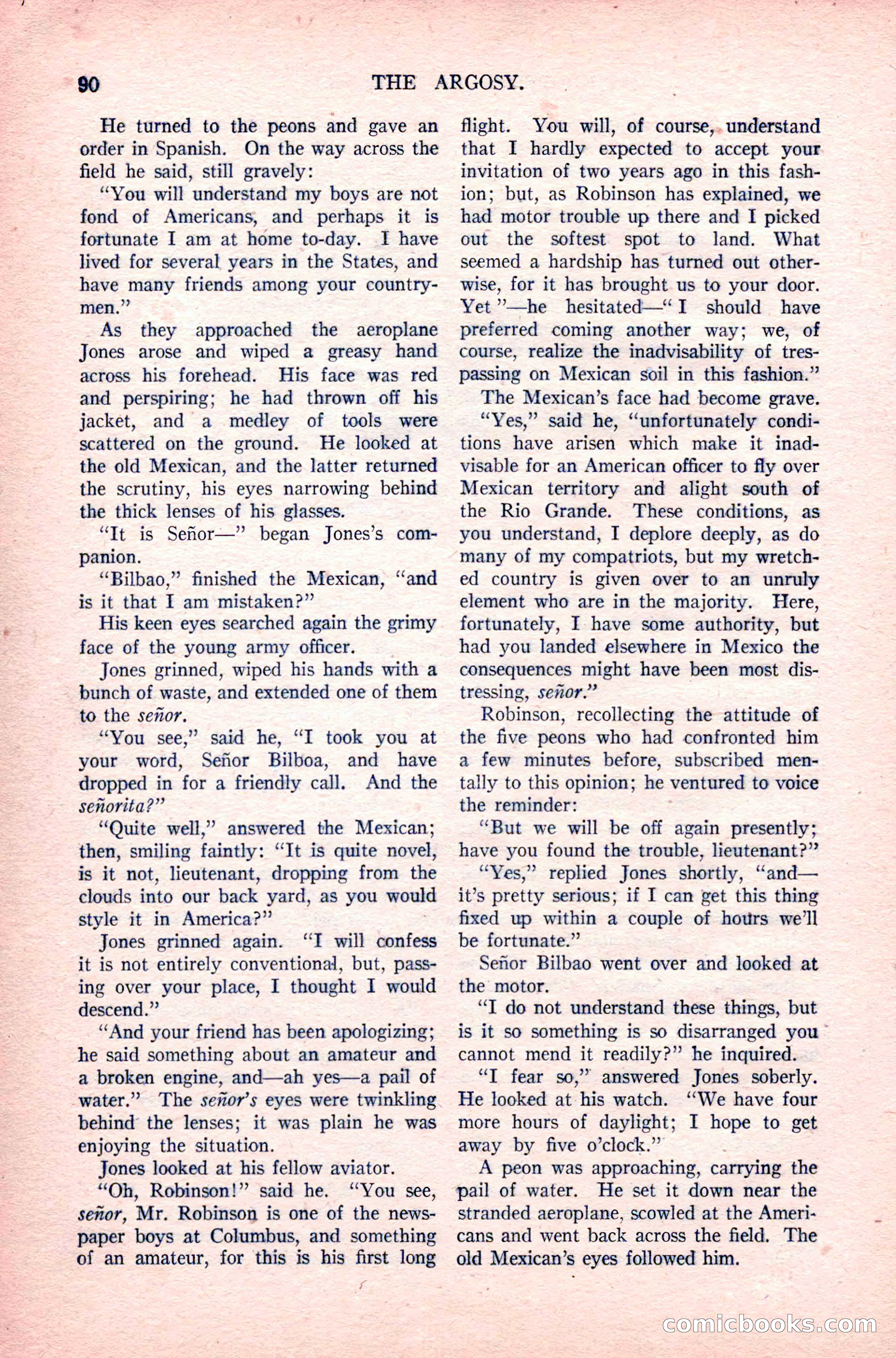
A restored page from Pulp Fiction, 1916. Page through the whole issue in the reader above.
📄 Transcribed text from this page (OCR, searchable)
Machine-transcribed from the original scan — historical spelling and the odd misread are preserved.
90 He turned to the peons and gave an order in Spanish. On the way across the field he said, still gravely: “Vou will understand my boys are not fond of Americans, and perhaps it is fortunate I am at home to-day. I have lived for several years in the States, and have many friends among your country- men.” As they approached the aeroplane Jones arose and wiped a greasy hand across his forehead. His face was red and perspiring; he had thrown off his jacket, and a medley of tools were scattered on the ground. He looked at the old Mexican, and the latter returned the scrutiny, his eyes narrowing behind the thick lenses of his glasses. “Tt is Senor—” began Jones’s com- panion. “Bilbao,” finished the Mexican, is it that I am mistaken?” His keen eyes searched again the grimy face of the young army officer. Jones grinned, wiped his hands with a bunch of waste, and extended one of them to the senor. “Vou see,” said he, “I took you at your word, Senor Bilboa, and have dropped in for a friendly call. And the senorita?” “Quite well,” answered the Mexican; then, smiling faintly: “It is quite novel, is it not, lieutenant, dropping from the clouds into our back yard, as you would style it in America?” Jones grinned again. “I will confess it is not entirely conventional, but, pass- ing over your place, I thought I would descend.” “And your friend has been apologizing; he said something about an amateur and a broken engine, and—ah yes—a pail of water.” The sevor’s eyes were twinkling behind the lenses; it was plain he was enjoying the situation. Jones looked at his fellow aviator. “Oh, Robinson!” said he. ‘You see, senor, Mr. Robinson is one of the news- paper boys at Columbus, and something of an amateur, for this is his first long “ond THE ARGOSY. flight. You will, of course,. understand that I hardly expected to accept your invitation of two years ago in this fash- ion; but, as Robinson has explained, we had motor trouble up there and I picked out the softest spot to land. What seemed a hardship has turned out other- wise, for it has brought us to your door. Yet ’—he hesitated—‘I should have preferred coming another way; we, of course, realize the inadvisability of tres- passing on Mexican soil in this fashion.” The Mexican’s face had become grave. “Yes,” said he, “unfortunately condi- tions have arisen which make it inad- visable for an American officer to fly over Mexican territory and alight south of the Rio Grande. These conditions, as you understand, I deplore deeply, as do many of my compatriots, but my wretch- ed country is given over to an unruly element who are in the majority. Here, fortunately, I have some authority, but had you landed elsewhere in Mexico the consequences might have been most dis- tressing, seor.” Robinson, recollecting the attitude of the five peons who had confronted him a few minutes before, subscribed men- tally to this opinion; he ventured to voice the reminder: “But we will be off again presently; have you found the trouble, lieutenant?” “Ves,” replied Jones shortly, “and— it’s pretty serious; if I can get this thing fixed up within a couple of hours we'll be fortunate.” Senor Bilbao went over and looked at the motor. “T do not understand these things, but is it so something is so disarranged you cannot mend it readily?” he inquired. “T fear so,’ answered Jones soberly. He looked at his watch. “We have four more hours of daylight; I hope to get away by five o’clock.” A peon was approaching, carrying the pail of water. He set it down near the stranded aeroplane, scowled at the Ameri- cans and went back across the field. The old Mexican’s eyes followed him. GO VOO|KS AUG (C@