
Pulp Fiction, 1916 · page 47 of 204
The Argosy, Vol. 83 No. 1 — page 47: what you’re looking at
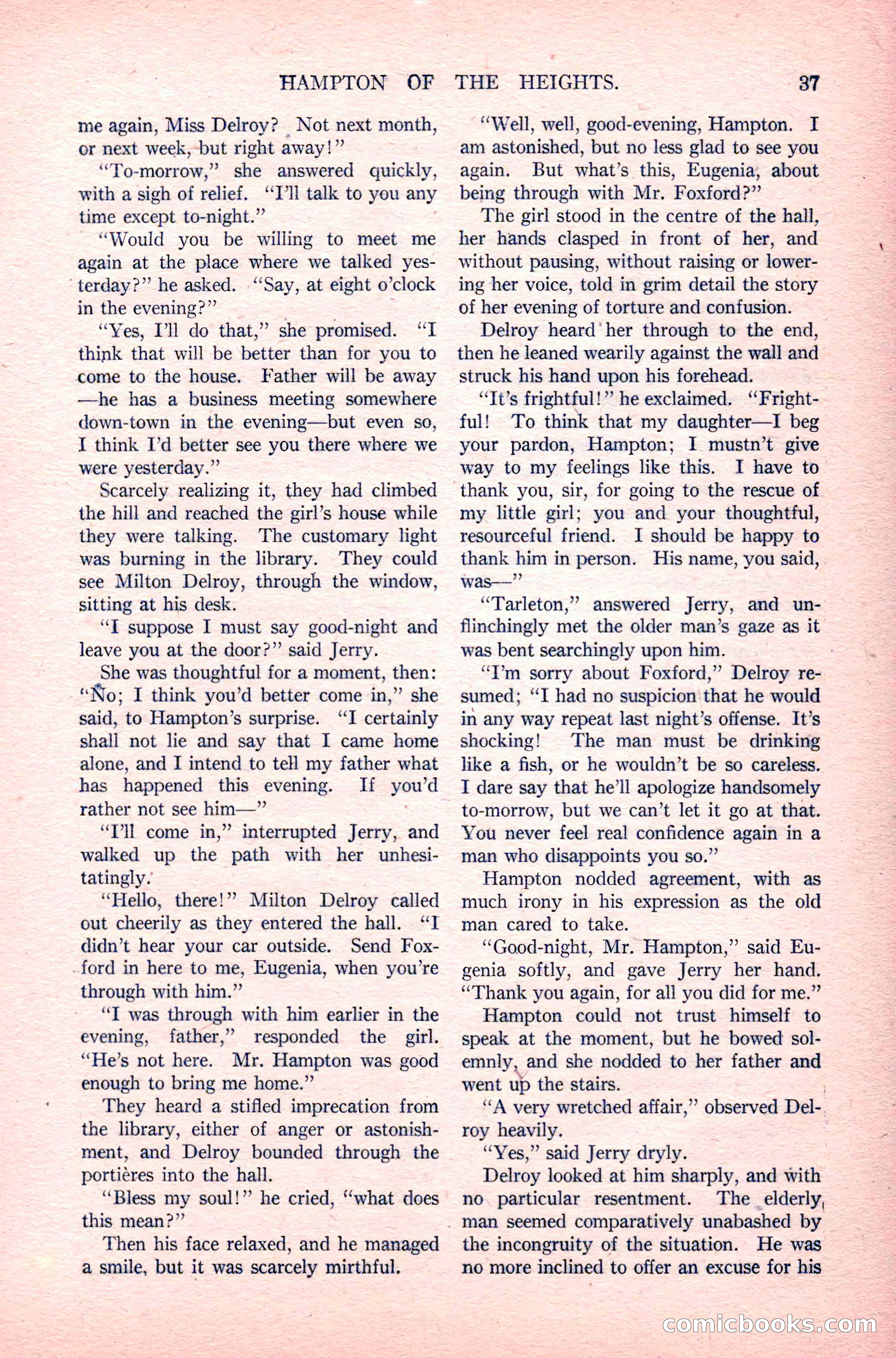
A restored page from Pulp Fiction, 1916. Page through the whole issue in the reader above.
📄 Transcribed text from this page (OCR, searchable)
Machine-transcribed from the original scan — historical spelling and the odd misread are preserved.
HAMPTON OF me again, Miss Delroy? Not next month, or next week, but right away!” “To-morrow,” she answered quickly, with a sigh of relief. “I'll talk to you any time except to-night.” 3 “Would you be willing to meet me again at the place where we talked yes- ‘terday?” he asked. ‘Say, at eight o’clock in the evening?” “Yes, Dll do that,” she promised. “I think that will be better than for you to come to the house. Father will be away —he has a business meeting somewhere down-town in the evening—but even so, I think I’d better see you there where we were yesterday.” Scarcely realizing it, they had climbed the hill and reached the girl’s house while they were talking. The customary light was burning in the library. They could see Milton Delroy, through the window, sitting at his desk. “T suppose I must say good-night and leave you at the door?” said Jerry. She was thoughtful for a moment, then: “No; I think you’d better come in,” she said, to Hampton’s surprise. “I certainly shall not lie and say that I came home alone, and I intend to tell my father what has happened this evening. If you’d rather not see him—” “T’ll come in,’ interrupted Jerry, and walked up the path with her unhesi- tatingly. “Hello, there!” Milton Delroy called out cheerily as they entered the hall. “I didn’t hear your car outside. Send Fox- ford in here to me, Eugenia, when you’re through with him.” “T was through with him earlier in the evening, father,’ responded the girl. “He’s not here. Mr. Hampton was good enough to bring me home.” They heard a stifled imprecation from the library, either of anger or astonish- ment, and Delroy bounded through the portiéres into the hall. “Bless my soul!” he cried, “what does this mean?”’ Then his face relaxed, and he managed a smile, but it was scarcely mirthful. THE HEIGHTS. 37 “Well, well, good-evening, Hampton. I am astonished, but no less glad to see you again. But what’s this, Eugenia, about being through with Mr. Foxford?” The girl stood in the centre of the hall, her hands clasped in front of her, and without pausing, without raising or lower- ing her voice, told in grim detail the story of her evening of torture and confusion. Delroy heard’ her through to the end, then he leaned wearily against the wall and struck his hand upon his forehead. “Tt’s frightful!” he exclaimed. ‘Fright- ful! To think that my daughter—I beg your pardon, Hampton; I mustn’t give way to my feelings like this. I have to. thank you, sir, for going to the rescue of my little girl; you and your thoughtful, resourceful friend. I should be happy to thank him in person. His name, you said, | was—”’ “Tarleton,” answered Jerry, and un- flinchingly met the older man’s gaze as it was bent searchingly upon him. “Tm sorry about Foxford,” Delroy re- sumed; ‘I had no suspicion that he would in any way repeat last night’s offense. It’s shocking! The man must be drinking like a fish, or he wouldn’t be so careless. I dare say that he’ll apologize handsomely to-morrow, but we can’t let it go at that. You never feel real confidence again in a man who disappoints you so.” Hampton nodded agreement, with as much irony in his expression as the old man cared to take. “Good-night, Mr. Hampton,” said Eu- genia softly, and gave Jerry her hand. “Thank you again, for all you did for me.” Hampton could not trust himself to speak at the moment, but he bowed sol- emnly, and she nodded to her father and went up the stairs. 3 ‘““A very wretched affair,” observed Del-. roy heavily. | “Ves,” said Jerry dryly. Delroy looked at him sharply, and with no particular resentment. The _ elderly, . man seemed comparatively unabashed by the incongruity of the situation. He was no more inclined to offer an excuse for his (E@ CORMICLOO® S