
Pulp Fiction, 1916 · page 46 of 204
The Argosy, Vol. 83 No. 1 — page 46: what you’re looking at
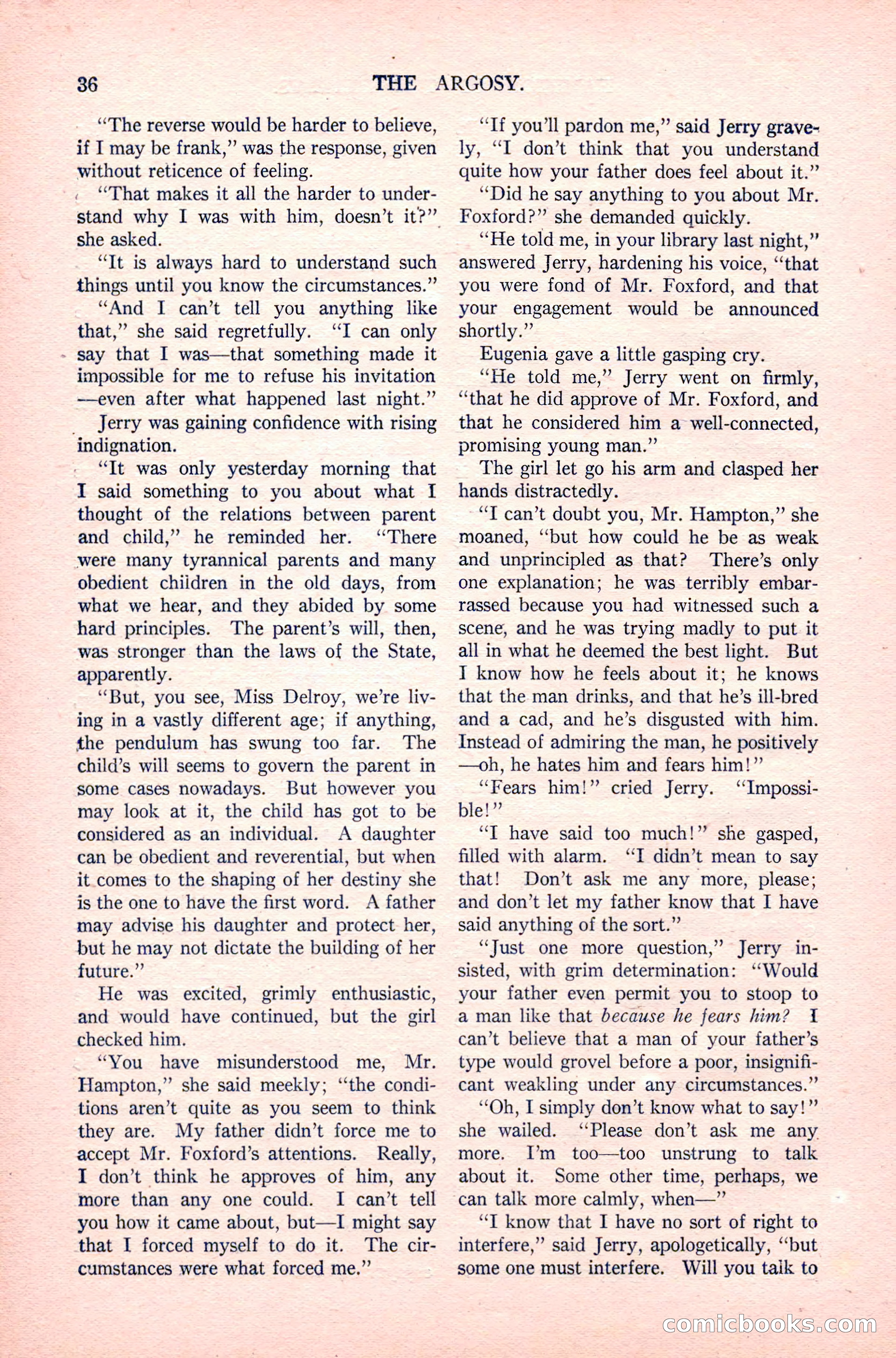
A restored page from Pulp Fiction, 1916. Page through the whole issue in the reader above.
📄 Transcribed text from this page (OCR, searchable)
Machine-transcribed from the original scan — historical spelling and the odd misread are preserved.
36 “The reverse would be harder to believe, if I may be frank,” was the response, given without reticence of feeling. ‘That makes it all the harder to under- stand why I was with him, doesn’t it?” she asked. “It is always hard to understand such things until you know the circumstances.” “And I can’t tell you anything like that,” she said regretfully. “I can only - say that I was—that something made it impossible for me to refuse his invitation —even after what happened last night.” _ Jerry was gaining confidence with rising indignation. “Tt was only yesterday morning that I said something to you about what I thought of the relations between parent and child,” he reminded her. ‘There were many tyrannical parents and many obedient chiidren in the old days, from what we hear, and they abided by some hard principles. The parent’s will, then, was stronger than the laws of the State, apparently. “But, you see, Miss Delroy, we’re liv- ing in a vastly different age; if anything, the pendulum has swung too far. The child’s will seems to govern the parent in some cases nowadays. But however you may look at it, the child has got to be considered as an individual. A daughter can be obedient and reverential, but when it_comes to the shaping of her destiny she is the one to have the first word. A father may advise his daughter and protect her, but he may not dictate the building of her future.” He was excited, grimly enthusiastic, and would have continued, but the girl checked him. “You have misunderstood me, Mr. Hampton,” she said meekly; “the condi- tions aren’t quite as you seem to think they are. My father didn’t force me to accept Mr. Foxford’s attentions. Really, I don’t think he approves of him, any more than any one could. I can’t tell you how it came about, but—I might say that I forced myself to do it. The cir- cumstances were what forced me.” THE ARGOSY. “If you'll pardon me,” said Jerry grave- ly, “I don’t think that you understand quite how your father does feel about it.” ‘Did he say anything to you about Mr. Foxford?” she demanded quickly. ‘“He told me, in your library last night,” answered Jerry, hardening his voice, “‘that you were fond of Mr. Foxford, and that your engagement would be announced shortly.” Eugenia gave a little gasping cry. “He told me,” Jerry went on firmly, “that he did approve of Mr. Foxford, and that he considered him a well-connected, promising young man.” The girl let go his arm and clasped her hands distractedly. “T can’t doubt you, Mr. Hampton,” she moaned, ‘‘but how could he be as weak and unprincipled as that? There’s only one explanation; he was terribly embar- rassed because you had witnessed such a scene, and he was trying madly to put it all in what he deemed the best light. But IT know how he feels about it; he knows that the man drinks, and that he’s ill-bred and a cad, and he’s disgusted with him. Instead of admiring the man, he positively —oh, he hates him and fears him!”’ “Fears him!” cried Jerry. ‘‘Impossi- ble!” “T have said too much!” she gasped, filled with alarm. “I didn’t mean to say that! Don’t ask me any more, please; and don’t let my father know that I have said anything of the sort.” ‘“‘Just one more question,” Jerry in- sisted, with grim determination: ‘Would your father even permit you to stoop to a man like that because he fears him? 1 can’t believe that a man of your father’s type would grovel before a poor, insignifi- cant weakling under any circumstances.” “Oh, I simply don’t know what to say!” she wailed. ‘‘Please don’t ask me any more. I’m too—too unstrung to talk about it. Some other time, perhaps, we can talk more calmly, when—”’ “T know that I have no sort of right to interfere,” said Jerry, apologetically, “‘but some one must interfere. Will you taik to JOOKS COMMUC (C@)