
Pulp Fiction, 1916 · page 21 of 204
The Argosy, Vol. 83 No. 1 — page 21: what you’re looking at
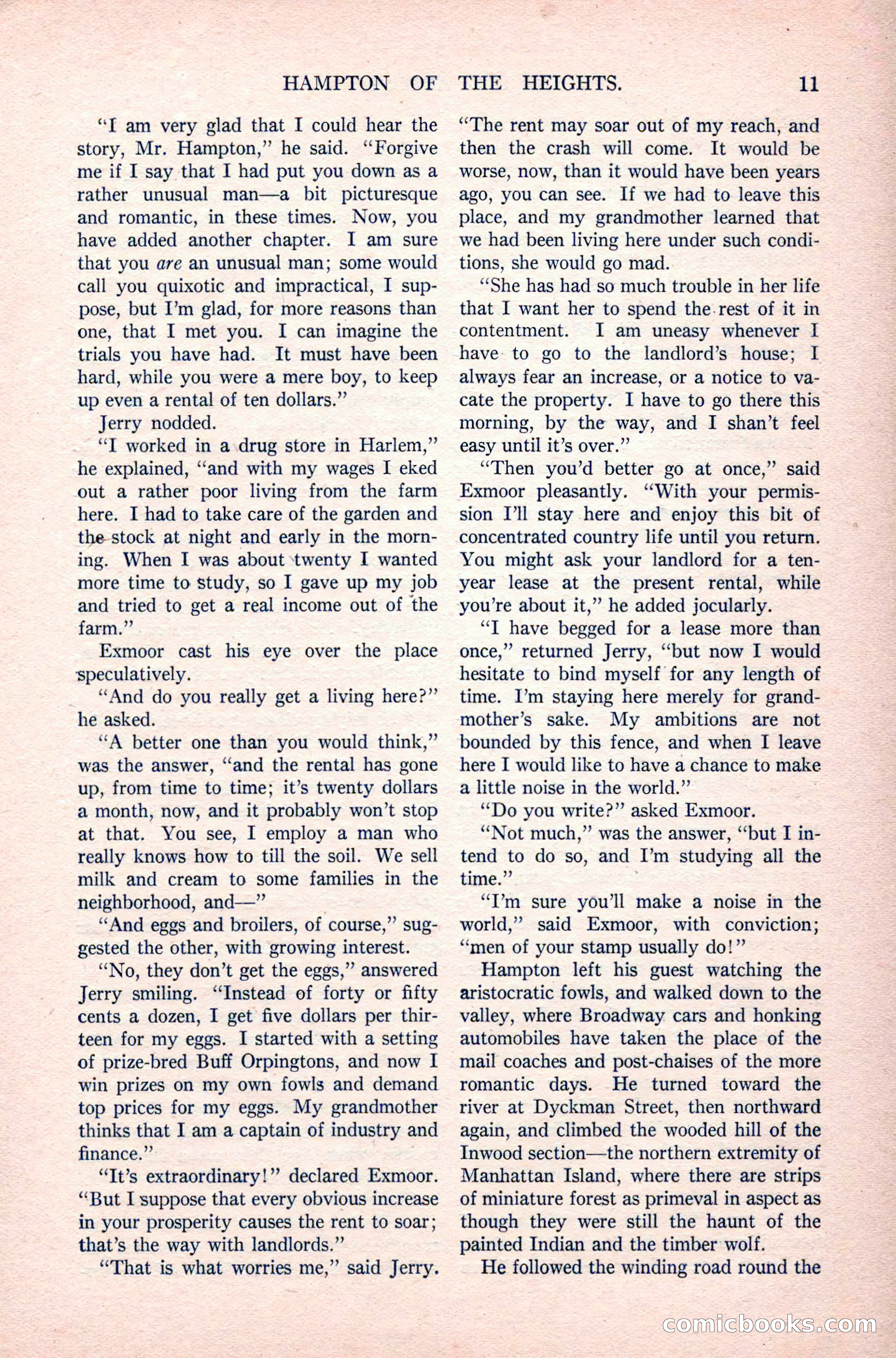
A restored page from Pulp Fiction, 1916. Page through the whole issue in the reader above.
📄 Transcribed text from this page (OCR, searchable)
Machine-transcribed from the original scan — historical spelling and the odd misread are preserved.
HAMPTON OF “fam very glad that I could hear the story, Mr. Hampton,” he said. ‘Forgive me if I say that I had put you down as a rather unusual man—a bit picturesque and romantic, in these times. Now, you have added another chapter. I am sure that you are an unusual man; some would call you quixotic and impractical, I sup- pose, but I’m glad, for more reasons than one, that I met you. I can imagine the trials you have had. It must have been hard, while you were a mere boy, to keep up even a rental of ten dollars.”’ Jerry nodded. “Tl worked in a drug store in Harlem,” he explained, ‘‘and with my wages I eked out a rather poor living from the farm here. I had to take care of the garden and the-stock at night and early in the morn- ing. When I was about twenty I wanted more time to study, so I gave up my job and tried to get a real income out of the farm.” Exmoor cast his eye over the place speculatively. “And do you really get a living here?”’ he asked. “A better one than you would think,” was the answer, “and the rental has gone up, from time to time; it’s twenty dollars a month, now, and it probably won’t stop at that. You see, I employ a man who really knows how to till the soil. We sell milk and cream to some families in the neighborhood, and—” “And eggs and broilers, of course,” sug- gested the other, with growing interest. “No, they don’t get the eggs,” answered Jerry smiling. ‘Instead of forty or fifty cents a dozen, I get five dollars per thir- teen for my eggs. I started with a setting of prize-bred Buff Orpingtons, and now I win prizes on my own fowls and demand top prices for my eggs. My grandmother thinks that I am a captain of industry and finance.” “Tt’s extraordinary!” declared Exmoor. “But I suppose that every obvious increase in your prosperity causes the rent to soar; that’s the way with landlords.” “That is what worries me,” said Jerry. THE HEIGHTS. 11 “The rent may soar out of my reach, and then the crash will come. It would be worse, now, than it would have been years ago, you can see. If we had to leave this place, and my grandmother learned that we had been living here under such condi- tions, she would go mad. “She has had so much trouble in her life that I want her to spend the.rest of it in contentment. I am uneasy whenever I have: to go to the landlord’s house; I always fear an increase, or a notice to va- cate the property. I have to go there this morning, by the way, and I shan’t feel easy until it’s over.” “Then you’d better go at once,” said Exmoor pleasantly. “With your permis- sion I’ll stay here and enjoy this bit of concentrated country life until you return. You might ask your landlord for a ten- year lease at the present rental, while you're about it,” he added jocularly. “T have begged for a lease more than once,” returned Jerry, “but now I would hesitate to bind myself for any length of time. I’m staying here merely for grand- mother’s sake. My ambitions are not bounded by this fence, and when I leave here I would like to have a chance to make a little noise in the world.” “Do you write?” asked Exmoor. ‘“‘Not much,” was the answer, “‘but I in- tend to do so, and I’m studying all the time.” “l’m sure youll make a noise in the world,” said Exmoor, with conviction; “men of your stamp usually do!” Hampton left his guest watching the aristocratic fowls, and walked down to the valley, where Broadway cars and honking automobiles have taken the place of the mail coaches and post-chaises of the more romantic days. He turned toward the river at Dyckman Street, then northward again, and climbed the wooded hill of the Inwood section—the northern extremity of Manhattan Island, where there are strips of miniature forest as primeval in aspect as though they were still the haunt of the painted Indian and the timber wolf. He followed the winding road round the COLA (Cc S 06) (©)