
Pulp Fiction, 1916 · page 20 of 204
The Argosy, Vol. 83 No. 1 — page 20: what you’re looking at
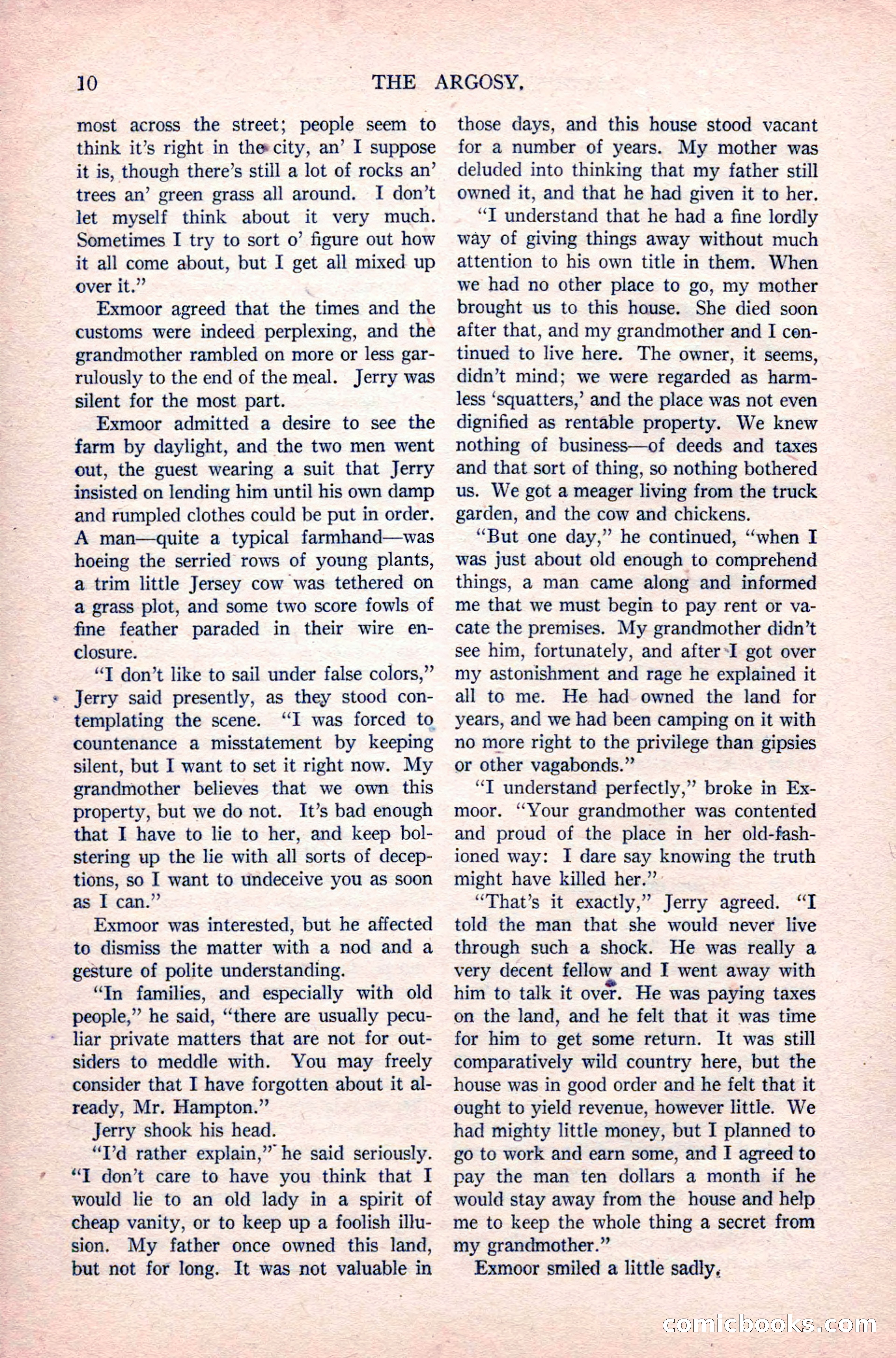
A restored page from Pulp Fiction, 1916. Page through the whole issue in the reader above.
📄 Transcribed text from this page (OCR, searchable)
Machine-transcribed from the original scan — historical spelling and the odd misread are preserved.
10 THE most across the street; people seem to think it’s right in the-city, an’ I suppose it is, though there’s still a lot of rocks an’ trees an’ green grass all around. I don’t let myself think about it very much. Sometimes I try to sort o’ figure out how it all come about, but I get all mixed up over it.” Exmoor agreed that the times and the customs were indeed perplexing, and the grandmother rambled on more or less gar- rulously to the end of the meal. Jerry was silent for the most part. Exmoor admitted a desire to see the farm by daylight, and the two men went out, the guest wearing a suit that Jerry insisted on lending him until his own damp and rumpled clothes could be put in order. A man—dquite a typical farmhand—was hoeing the serried rows of young plants, a trim little Jersey cow was tethered on a grass plot, and some two score fowls of fine feather paraded in their wire en- closure. “T don’t like to sail under false colors,” Jerry said presently, as they stood con- templating the scene. “I was forced to countenance a misstatement by keeping silent, but I want to set it right now. My grandmother believes that we own this property, but we do not. It’s bad enough that I have to lie to her, and keep bol- stering up the lie with all sorts of decep- tions, so I want to undeceive you as soon as I can.” Exmoor was interested, but he affected to dismiss the matter with a nod and a gesture of polite understanding. “In families, and especially with old people,” he said, “there are usually pecu- liar private matters that are not for out- siders to meddle with. You may freely consider that I have forgotten about it al- ready, Mr. Hampton.” Jerry shook his head. “T’d rather explain,” he said seriously. “T don’t care to have you think that I would lie to an old lady in a spirit of cheap vanity, or to keep up a foolish illu- sion. My father once owned this land, but not for long. It was not valuable in ARGOSY, those days, and this house stood vacant for a number of years. My mother was deluded into thinking that my father still owned it, and that he had given it to her. “IT understand that he had a fine lordly way of giving things away without much attention to his own title in them. When we had no other place to go, my mother brought us to this house. She died soon after that, and my grandmother and I cen- tinued to live here. The owner, it seems, didn’t mind; we were regarded as harm- less ‘squatters,’ and the place was not even dignified as rentable property. We knew nothing of business—of deeds and taxes and that sort of thing, so nothing bothered us. We got a meager living from the truck garden, and the cow and chickens. “But one day,” he continued, “when I was just about old enough to comprehend things, a man came along and informed me that we must begin to pay rent or va- cate the premises. My grandmother didn’t see him, fortunately, and after*I got over my astonishment and rage he explained it all to me. He had owned the land for years, and we had been camping on it with no more right to the privilege than gipsies or other vagabonds.” “T understand perfectly,” broke in Ex- moor. “Your grandmother was contented and proud of the place in her old-fash- ioned way: I dare say knowing the truth might have killed her.” “That’s it exactly,” Jerry agreed. “I told the man that she would never live through such a shock. He was really a very decent fellow and I went away with him to talk it over. He was paying taxes on the land, and he felt that it was time for him to get some return. It was still comparatively wild country here, but the house was in good order and he felt that it ought to yield revenue, however little. We had mighty little money, but I planned to go to work and earn some, and I agreed to pay the man ten dollars a month if he would stay away from the house and help me to keep the whole thing a secret from my grandmother.” Exmoor smiled a little sadly, VOOKS CONMUC (E@