
Pulp Fiction, 1916 · page 197 of 204
The Argosy, Vol. 83 No. 1 — page 197: what you’re looking at
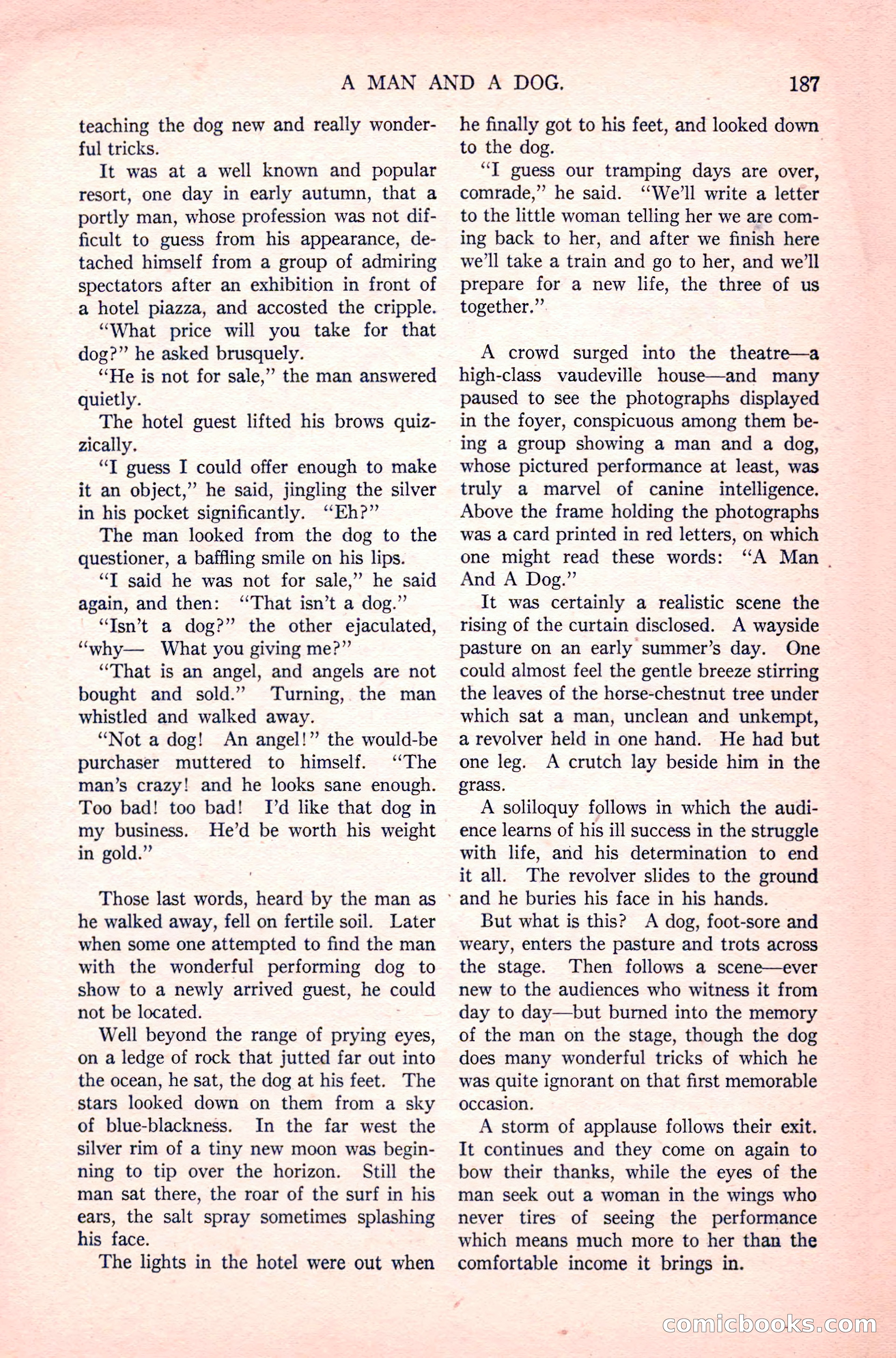
A restored page from Pulp Fiction, 1916. Page through the whole issue in the reader above.
📄 Transcribed text from this page (OCR, searchable)
Machine-transcribed from the original scan — historical spelling and the odd misread are preserved.
A MAN AND A DOG. teaching the dog new and really wonder- ful tricks. It was at a well known and popular resort, one day in early autumn, that a portly man, whose profession was not dif- ficult to guess from his appearance, de- tached himself from a group of admiring spectators after an exhibition in front of a hotel piazza, and accosted the cripple. “What price will you take for that dog?” he asked brusquely. ‘“‘He is not for sale,” the man answered quietly. The hotel guest lifted his brows quiz- zically, “T guess I could offer enough to make it an object,” he said, jingling the silver in his pocket significantly. ‘Eh?” The man looked from the dog to the questioner, a baffling smile on his lips. “T said he was not for sale,’ he said again, and then: “That isn’t a dog.” “Isn’t a dog?” the other ejaculated, ‘““why— What you giving me?” “That is an angel, and angels are not bought and sold.” Turning, the man whistled and walked away. “Not a dog! An angel!” the would-be purchaser muttered to himself. ‘The man’s crazy! and he looks sane enough. Too bad! too bad! Id like that dog in my business. He’d be worth his weight in gold.” Those last words, heard by the man as he walked away, fell on fertile soil. Later when some one attempted to find the man with the wonderful performing dog to show to a newly arrived guest, he could not be located. 3 Well beyond the range of prying eyes, on a ledge of rock that jutted far out into the ocean, he sat, the dog at his feet. The stars looked down on them from a sky of blue-blackness. In the far west the silver rim of a tiny new moon was begin- ning to tip over the horizon. Still the man sat there, the roar of the surf in his ears, the salt spray sometimes splashing his face. The lights in the hotel were out when 187 he finally got to his feet, and looked down to the dog. “I guess our tramping days are over, comrade,” he said. ‘‘We’ll write a letter to the little woman telling her we are com- ing back to her, and after we finish here we'll take a train and go to her, and we'll prepare for a new life, the three of us together.”’. A crowd surged into the theatre—a high-class vaudeville house—and many paused to see the photographs displayed in the foyer, conspicuous among them be- ing a group showing a man and a dog, whose pictured performance at least, was truly a marvel of canine intelligence. Above the frame holding the photographs was a card printed in red letters, on which one might read these words: And A Dog.” It was certainly a realistic scene the rising of the curtain disclosed. A wayside pasture on an early summer’s day. One could almost feel the gentle breeze stirring the leaves of the horse-chestnut tree under which sat a man, unclean and unkempt, a revolver held in one hand. He had but one leg. A crutch lay beside him in the grass. A soliloquy follows in which the audi- ence learns of his ill success in the struggle with life, and his determination to end it all. The revolver slides to the ground ‘ and he buries his face in his hands. But what is this? <A dog, foot-sore and weary, enters the pasture and trots across the stage. Then follows a scene—ever new to the audiences who witness it from day to day—but burned into the memory of the man on the stage, though the dog does many wonderful tricks of which he was quite ignorant on that first memorable occasion. A storm of applause follows their exit. It continues and they come on again to bow their thanks, while the eyes of the man seek out a woman in the wings who never tires of seeing the performance which means much more to her than the comfortable income it brings in. Gomichbook “A Man - (C@)