
Pulp Fiction, 1916 · page 195 of 204
The Argosy, Vol. 83 No. 1 — page 195: what you’re looking at
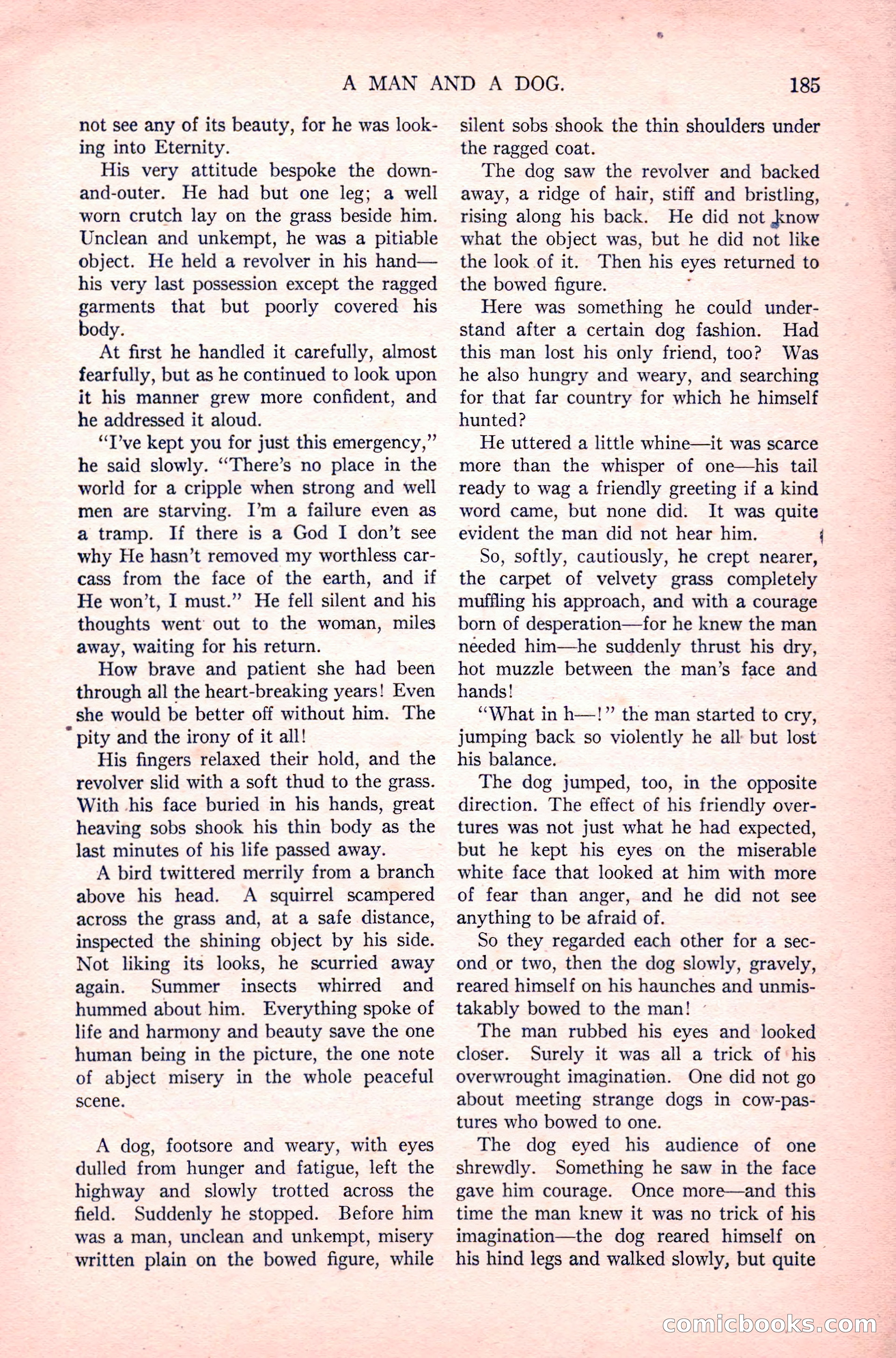
A restored page from Pulp Fiction, 1916. Page through the whole issue in the reader above.
📄 Transcribed text from this page (OCR, searchable)
Machine-transcribed from the original scan — historical spelling and the odd misread are preserved.
A MAN AND A DOG. not see any of its beauty, for he was look- ing into Eternity. His very attitude bespoke the down- and-outer. He had but one leg; a well worn crutch lay on the grass beside him. Unclean and unkempt, he was a pitiable object. He held a revolver in his hand— his very last possession except the ragged garments that but poorly covered his body. At first he handled it carefully, almost fearfully, but as he continued to look upon it his manner grew more confident, and he addressed it aloud. “T’ve kept you for just this emergency,” he said slowly. ‘‘There’s no place in the world for a cripple when strong and well men are starving. I’m a failure even as a tramp. If there is a God I don’t see why He hasn’t removed my worthless car- cass from the face of the earth, and if He won’t, I must.” He fell silent and his thoughts went out to the woman, miles away, waiting for his return. How brave and patient she had been through all the heart-breaking years! Even she would be better off without him. The “pity and the irony of it all! His fingers relaxed their hold, and the revolver slid with a soft thud to the grass. With his face buried in his hands, great heaving sobs shook his thin body as the last minutes of his life passed away. A bird twittered merrily from a branch above his head. A squirrel scampered across the grass and, at a safe distance, inspected the shining object by his side. Not liking its looks, he scurried away again. Summer insects whirred and hummed about him. Everything spoke of life and harmony and beauty save the one human being in the picture, the one note of abject misery in the whole peaceful scene. A dog, footsore and weary, with eyes dulled from hunger and fatigue, left the highway and slowly trotted across the field. Suddenly he stopped. Before him was a man, unclean and unkempt, misery written plain on the bowed figure, while 185 silent sobs shook the thin shoulders under the ragged coat. The dog saw the revolver and backed away, a ridge of hair, stiff and bristling, rising along his back. He did not know what the object was, but he did not like the look of it. Then his eyes returned to the bowed figure. 2 Here was something he could under- stand after a certain dog fashion. Had this man lost his only friend, too? Was he also hungry and weary, and searching for that far country for which he himself hunted? He uttered a little whine—it was scarce more than the whisper of one—his tail ready to wag a friendly greeting if a kind word came, but none did. It was quite evident the man did not hear him. ‘ So, softly, cautiously, he crept nearer, the carpet of velvety grass completely muffling his approach, and with a courage born of desperation—for he knew the man needed him—he suddenly thrust his dry, hot muzzle between the man’s face and hands! 2 ‘What in h—!” the man started to cry, jumping back so violently he all but lost his balance. The dog jumped, too, in the opposite direction. The effect of his friendly over- tures was not just what he had expected, but he kept his eyes on the miserable white face that looked at him with more of fear than anger, and he did not see anything to be afraid of. So they regarded each other for a sec- ond or two, then the dog slowly, gravely, reared himself on his haunches and unmis- takably bowed to the man! ~ The man rubbed his eyes and looked closer. overwrought imagination. One did not go about meeting strange dogs in cow-pas- tures who bowed to one. The dog eyed his audience of one shrewdly. Something he saw in the face gave him courage. Once more—and this time the man knew it was no trick of his Surely it was all a trick of ‘his - imagination—the dog reared himself on_ his hind legs and walked slowly, but quite CORMICLOOOKS (C@)