
Pulp Fiction, 1916 · page 184 of 204
The Argosy, Vol. 83 No. 1 — page 184: what you’re looking at
A restored page from Pulp Fiction, 1916. Page through the whole issue in the reader above.
📄 Transcribed text from this page (OCR, searchable)
Machine-transcribed from the original scan — historical spelling and the odd misread are preserved.
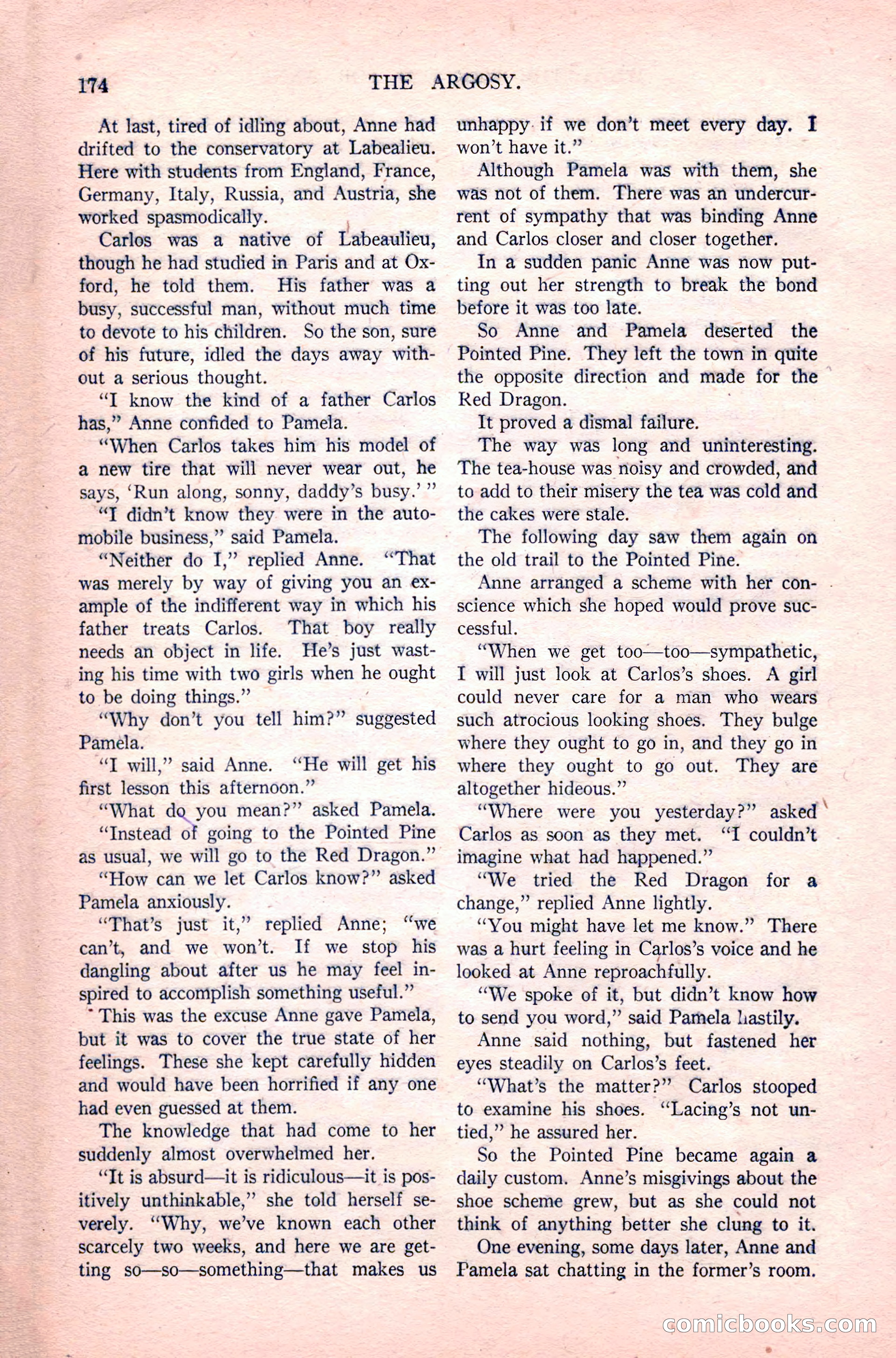
174 At last, tired of idling about, Anne had drifted to the conservatory at Labealieu. Here with students from England, France, Germany, Italy, Russia, and Austria, she worked spasmodically. Carlos was a native of Labeaulieu, though he had studied in Paris and at Ox- ford, he told them. His father was a busy, successful man, without much time to devote to his children. So the son, sure of his future, idled the days away with- out a serious thought. “T know the kind of a father Carlos has,” Anne confided to Pamela. “When Carlos takes him his model of a new tire that will never wear out, he says, ‘Run along, sonny, daddy’s busy.’ ” “T didn’t know they were in the auto- mobile business,” said Pamela. “Neither do I,” replied Anne. “That was merely by way of giving you an ex- ample of the indifferent way in which his father treats Carlos. That boy really needs an object in life. He’s just wast- ing his time with two girls when ne ought to be doing things.” “Why don’t you tell him?” suggested Pamela. “T will,” said Anne. ‘He will get his first lesson this afternoon.” “What do you mean?” asked Pamela. “Instead of going to the Pointed Pine as usual, we will go to the Red Dragon.” “How can we let Carlos know?” asked Pamela anxiously. “That’s just it,” replied Anne; “we can’t, and we won’t. If we stop his dangling about after us he may feel in- spired to accomplish something useful.” ~ This was the excuse Anne gave Pamela, but it was to cover the true state of her feelings. These she kept carefully hidden and would have been horrified if any one had even guessed at them. The knowledge that had come to her suddenly almost overwhelmed her. “Tt is absurd—it is ridiculous—it is pos- itively unthinkable,” she told herself se- verely. “Why, we’ve known each other scarcely two weeks, and here we are get- ting so—so—something—that makes us THE ARGOSY. unhappy if we don’t meet every day. I won’t have it.” Although Pamela was with them, she was not of them. There was an undercur- rent of sympathy that was binding Anne and Carlos closer and closer together. In a sudden panic Anne was now put- ting out her strength to break the bond before it was too late. So Anne and Pamela deserted the Pointed Pine. They left the town in quite the opposite direction and made for the Red Dragon. It proved a dismal failure. The way was long and uninteresting. The tea-house was noisy and crowded, and to add to their misery the tea was cold and the cakes were stale. The following day saw them again on the old trail to the Pointed Pine. Anne arranged a scheme with her con- - science which she hoped would prove suc- cessful. “When we get too—too—sympathetic, T will just look at Carlos’s shoes. A girl could never care for a man who wears such atrocious looking shoes. They bulge where they ought to go in, and they go in where they ought to go out. They are altogether hideous.” “Where were you yesterday?” asked ‘ Carlos as soon as they met. ‘“I couldn’t imagine what had happened.” “We tried the Red Dragon for a change,” replied Anne lightly. “Vou might have let me know.” There was a hurt feeling in Carlos’s voice and he looked at Anne reproachfully. “We spoke of it, but didn’t know how to send you word,” said Parhela hastily. Anne said nothing, but fastened her eyes steadily on Carlos’s feet. ‘“What’s the matter?” Carlos stooped to examine his shoes. “Lacing’s not un- tied,” he assured her. So the Pointed Pine became again a daily custom. Anne’s misgivings about the shoe scheme grew, but as she could not think of anything better she clung to it. One evening, some days later, Anne and Pamela sat chatting in the former’s room. EO) 0)() mie S « (C@