
Pulp Fiction, 1916 · page 183 of 204
The Argosy, Vol. 83 No. 1 — page 183: what you’re looking at
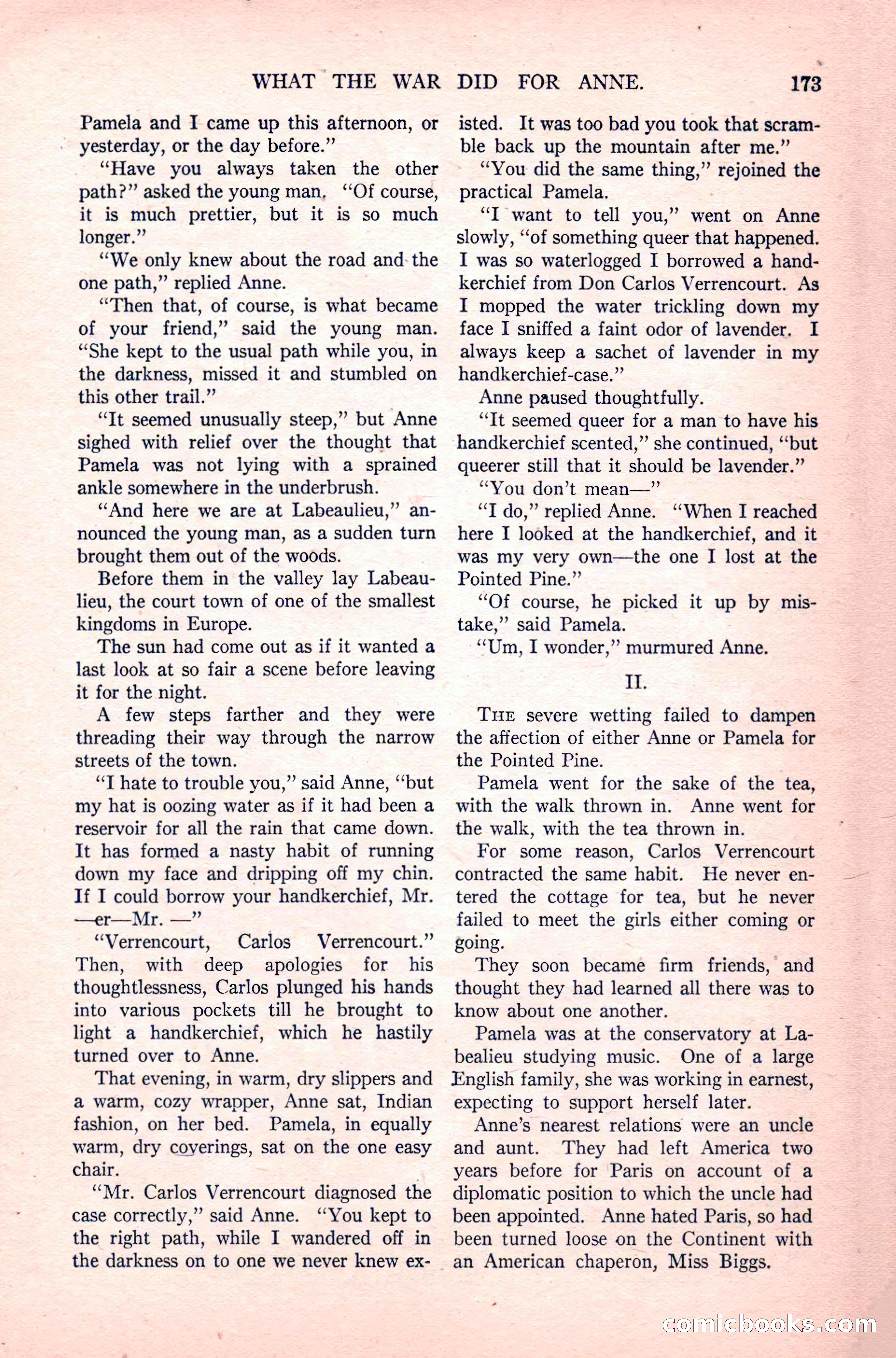
A restored page from Pulp Fiction, 1916. Page through the whole issue in the reader above.
📄 Transcribed text from this page (OCR, searchable)
Machine-transcribed from the original scan — historical spelling and the odd misread are preserved.
WHAT THE WAR Pamela and I came up this afternoon, or yesterday, or the day before.” “Have you always taken the other path?” asked the young man, “Of course, it is much prettier, but it is so much longer.”’ “We only knew about the road and: the one path,” replied Anne. “Then that, of course, is what became of your friend,” said the young man. “She kept to the usual path while you, in the darkness, missed it and stumbled on this other trail.” “Tt seemed unusually steep,” but Anne sighed with relief over the thought that Pamela was not lying with a sprained ankle somewhere in the underbrush. ‘And here we are at Labeaulieu,” an- nounced the young man, as a sudden turn brought them out of the woods. Before them in the valley lay Labeau- lieu, the court town of one of the smallest kingdoms in Europe. The sun had come out as if it wanted a last look at so fair a scene before leaving it for the night. A few steps farther and they were threading their way through the narrow streets of the town. “T hate to trouble you,” said Anne, “‘but my hat is oozing water as if it had been a reservoir for all the rain that came down. It has formed a nasty habit of running down my face and dripping off my chin. If I could borrow your handkerchief, Mr. —er—Mr. —” “Verrencourt, Carlos Verrencourt.” Then, with deep apologies for his thoughtlessness, Carlos plunged his hands into various pockets till he brought to light a handkerchief, which he hastily turned over to Anne. That evening, in warm, dry slippers and a warm, cozy wrapper, Anne sat, Indian fashion, on her bed. Pamela, in equally warm, dry coverings, sat on the one easy chair. | “Mr. Carlos Verrencourt diagnosed the case correctly,” said Anne. “You kept to the right path, while I wandered off in the darkness on to one we never knew ex- \ DID FOR ANNE. 173 isted. It was too bad you took that scram- ble back up the mountain after me.” “You did the same thing,’ rejoined the practical Pamela. “T want to tell you,” went on Anne slowly, “of something queer that happened. I was so waterlogged I borrowed a hand- kerchief from Don Carlos Verrencourt. As I mopped the water trickling down my face I sniffed a faint odor of lavender. I always keep a sachet of lavender in my handkerchief-case.”’ Anne paused thoughtfully. “It seemed queer for a man to have his handkerchief scented,” she continued, ‘‘but queerer still that it should be lavender.” “You don’t mean—” “T do,” replied Anne. ‘When I reached here I looked at the handkerchief, and it was my very own—the one I lost at the Pointed Pine.” “Of course, he picked it up by mis- take,” said Pamela. ‘‘Um, I wonder,” murmured Anne. ES THE severe wetting failed to dampen the affection of either Anne or Pamela for the Pointed Pine. Pamela went for the sake of the tea, with the walk thrown in. Anne went for the walk, with the tea thrown in. For some reason, Carlos Verrencourt contracted the same habit. He never en- tered the cottage for tea, but he never failed to meet the girls either coming or going. They soon became firm friends, and thought they had learned all there was to know about one another. Pamela was at the conservatory at La- bealieu studying music. One of a large English family, she was working in earnest, expecting to support herself later. Anne’s nearest relations were an uncle and aunt. ‘They had left America two years before for Paris on account of a diplomatic position to which the uncle had been appointed. Anne hated Paris, so had been turned loose on the Continent with an American chaperon, Miss Biggs. COMMUC NOOLKS (E@)