
Pulp Fiction, 1916 · page 138 of 204
The Argosy, Vol. 83 No. 1 — page 138: what you’re looking at
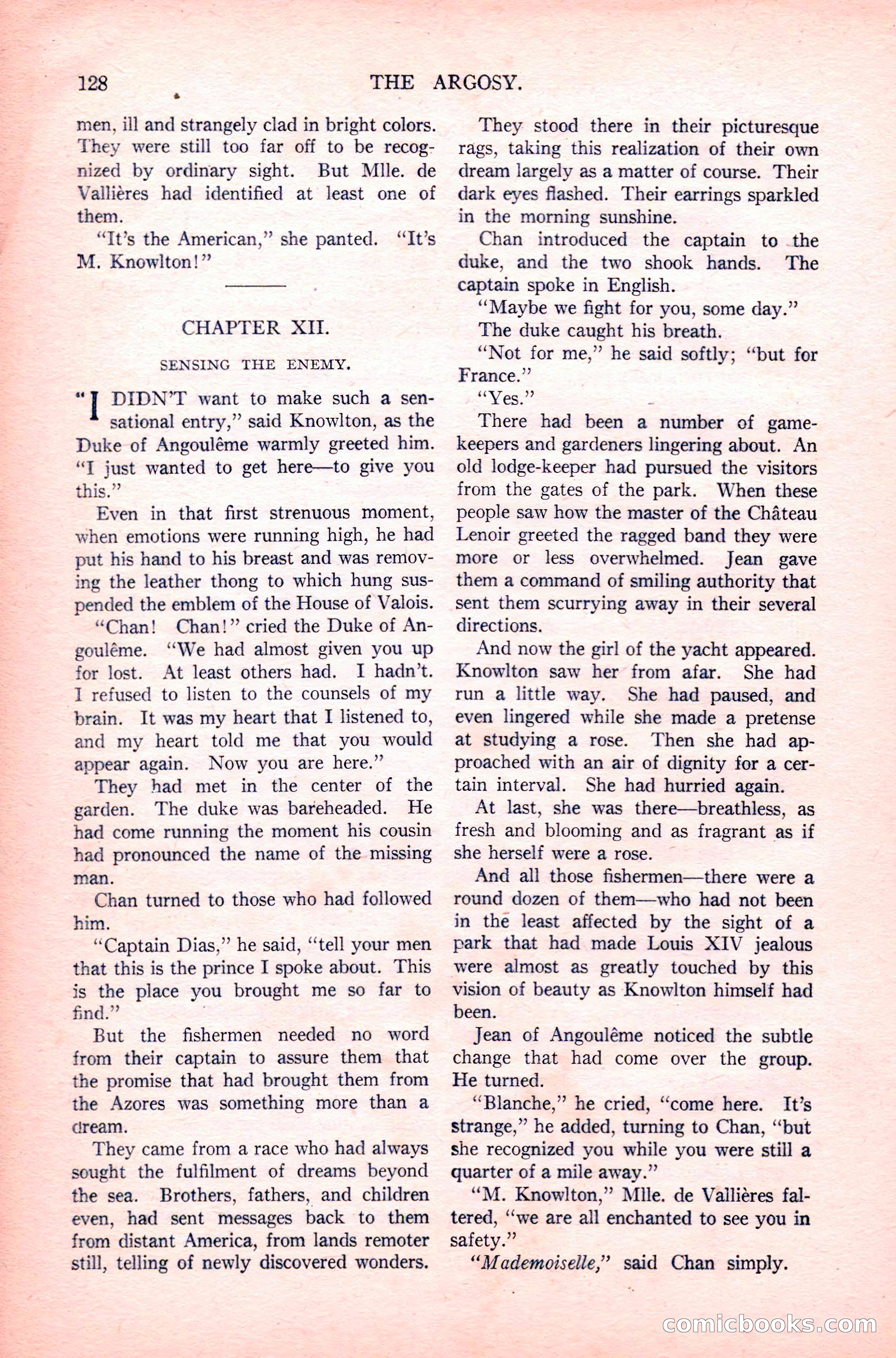
A restored page from Pulp Fiction, 1916. Page through the whole issue in the reader above.
📄 Transcribed text from this page (OCR, searchable)
Machine-transcribed from the original scan — historical spelling and the odd misread are preserved.
128 men, ill and strangely clad in bright colors. They were still too far off to be recog- nized by ordinary sight. But Mlle. de Valliéres had identified at least one of them. “Tt’s the American,” she panted. M. Knowlton!” “Tt’s CHAPTER XII. SENSING THE ENEMY. “7 DIDN’T want to make such a sen- sational entry,” said Knowlton, as the Duke of Angouléme warmly greeted him. “J just wanted to get here—to give you this.” Even in that first strenuous moment, when emotions were running high, he had put his hand to his breast and was remov- ing the leather thong to which hung sus- pended the emblem of the House of Valois. “Chan! Chan!” cried the Duke of An- gouléme. ‘We had almost given you up for lost. At least others had. I hadn’t. I refused to listen to the counsels of my brain. It was my heart that I listened to, and my heart told me that you would appear again. Now you are here.”’ They had met in the center of the garden. The duke was bareheaded. He had come running the moment his cousin had pronounced the name of the missing man. Chan turned to those who had followed him. “Captain Dias,” he said, “tell your men that this is the prince I spoke about. This is the place you brought me so far to find.” But the fishermen needed no word from their captain to assure them that the promise that had brought them from the Azores was something more than a dream. They came from a race who had always sought the fulfilment of dreams beyond the sea. Brothers, fathers, and children even, had sent messages back to them from distant America, from lands remoter still, telling of newly discovered wonders. THE ARGOSY. They stood there in their picturesque rags, taking this realization of their own dream largely as a matter of course. Their dark eyes flashed. Their earrings sparkled in the morning sunshine. Chan introduced the captain to _the duke, and the two shook hands. The captain spoke in English. “Maybe we fight for you, some day.” The duke caught his breath. “Not for me,” he said softly; “but for France.” Vag? : There had been a number of game- keepers and gardeners lingering about. An old lodge-keeper had pursued the visitors from the gates of the park. When these people saw how the master of the Chateau Lenoir greeted the ragged band they were more or less overwhelmed. Jean gave them a command of smiling authority that sent them scurrying away in their several directions. And now the girl of the yacht appeared. Knowlton saw her from afar. She had run a little way. She had paused, and even lingered while she made a pretense at studying a rose. Then she had ap- proached with an air of dignity for a cer- tain interval. She had hurried again. At last, she was there—breathless, as fresh and blooming and as fragrant as if she herself were a rose. And all those fishermen—there were a round dozen of them—who had not been in the least affected by the sight of a park that had made Louis XIV jealous were almost as greatly touched by this vision of beauty as Knowlton himself had been. Jean of Angouléme noticed the subtle change that had come over the group. He turned. “Blanche,” he cried, “come here. It’s strange,” he added, turning to Chan, “but she recognized you while you were still a quarter of a mile away.” “M. Knowlton,” Mile. de Valliéres fal- tered, ‘“we are all enchanted to see you in safety.” “Mademoiselle,” said Chan simply. Gomichbook (C@