
Pulp Fiction, 1916 · page 137 of 204
The Argosy, Vol. 83 No. 1 — page 137: what you’re looking at
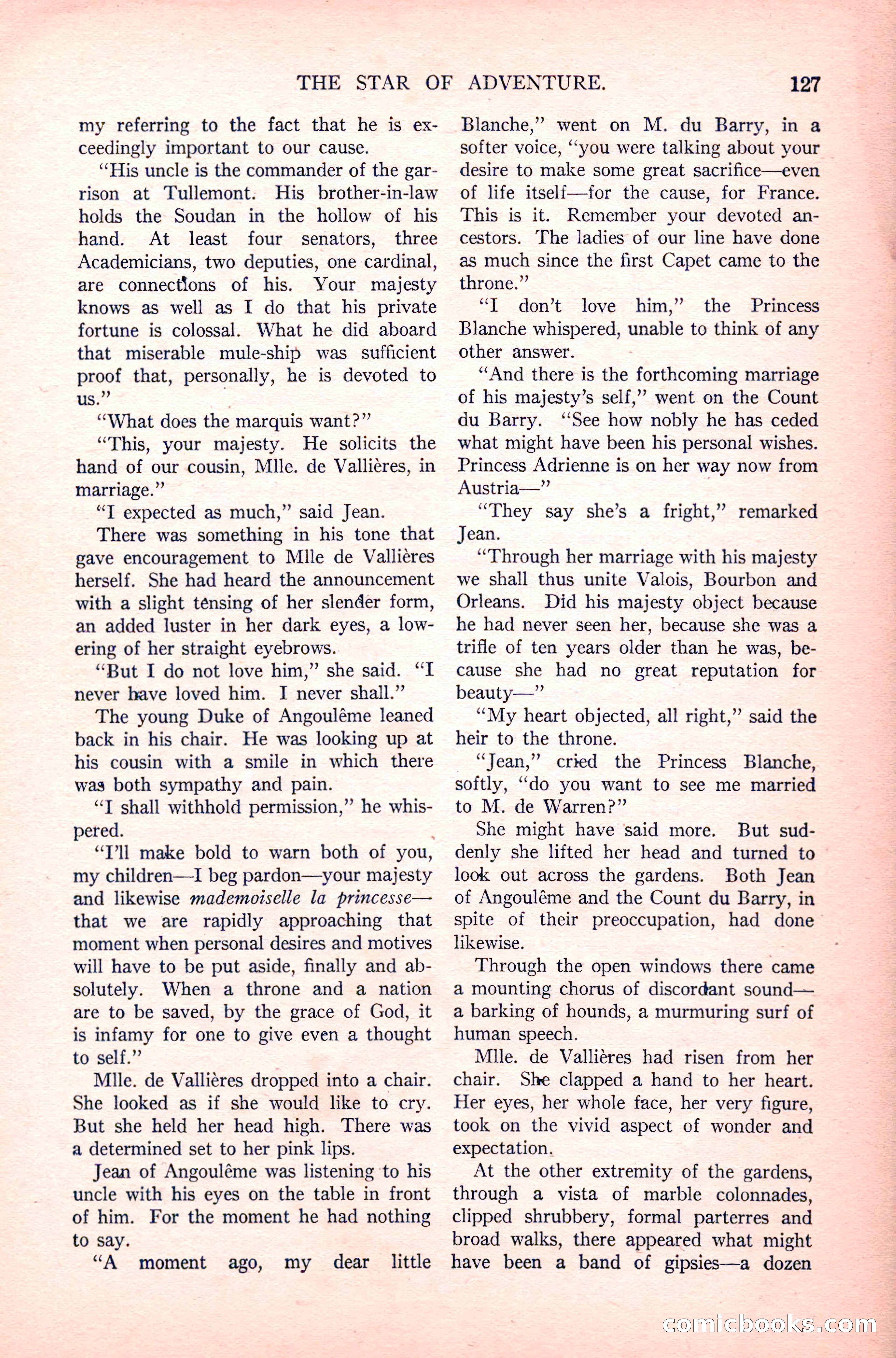
A restored page from Pulp Fiction, 1916. Page through the whole issue in the reader above.
📄 Transcribed text from this page (OCR, searchable)
Machine-transcribed from the original scan — historical spelling and the odd misread are preserved.
THE STAR OF ADVENTURE. my referring to the fact that he is ex- ceedingly important to our cause. “His uncle is the commander of the gar- rison at Tullemont. His brother-in-law holds the Soudan in the hollow of his hand. At least four senators, three Academicians, two deputies, one cardinal, are connections of his. Your majesty knows as well as I do that his private fortune is colossal. What he did aboard that miserable mule-ship was sufficient proof that, personally, he is devoted to us.” “What does the marquis want?” “This, your majesty. He solicits the hand of our cousin, Mlle. de Valliéres, in marriage.” “T expected as much,” said Jean. There was something in his tone that gave encouragement to Mlle de Valliéres herself. She had heard the announcement with a slight ténsing of her slender form, an added luster in her dark eyes, a low- ering of her straight eyebrows. “But I do not love him,” she said. never have loved him. I never shall.” The young Duke of Angouléme leaned back in his chair. He was looking up at his cousin with a smile in which there was both sympathy and pain. “T shall withhold permission,” he whis- pered. UT “T’ll make bold to warn both of you, my children—TI beg pardon—your majesty and likewise mademoiselle la princesse— that we are rapidly approaching that moment when personal desires and motives will have to be put aside, finally and ab- solutely. When a throne and a nation are to be saved, by the grace of God, it is infamy for one to give even a thought to self.” Mlle. de Vallieres dropped into a chair. She looked as if she would like to cry. But she held her head high. There was a determined set to her pink lips. Jean of Angouléme was listening to his uncle with his eyes on the table in front of him. For the moment he had nothing to say. “A moment ago, little my dear 127 Blanche,” went on M. du Barry, in a softer voice, ‘‘you were talking about your desire to make some great sacrifice—even of life itseli—for the cause, for France. This is it. Remember your devoted an- cestors. The ladies of our line have done as much since the first Capet came to the throne.” “TI don’t love him,” the Princess Blanche whispered, unable to think of any other answer. ‘“‘And there is the forthcoming marriage of his majesty’s self,’ went on the Count du Barry. “See how nobly he has ceded what might have been his personal wishes. Princess Adrienne is on her way now from Austria—”’ “They say she’s a fright,” remarked Jean. “Through her marriage with his majesty we shall thus unite Valois, Bourbon and Orleans. Did his majesty object because he had never seen her, because she was a trifle of ten years older than he was, be- cause she had no great reputation for beauty—” “My heart objected, all right,” said the heir to the throne. “Jean,” cried the Princess Blanche, softly, “do you want to see me married to M. de Warren?” She might have said more. But sud- denly she lifted her head and turned to look out across the gardens. Both Jean of Angouléme and the Count du Barry, in spite of their preoccupation, had done likewise. Through the open windows there came a mounting chorus of discordant sound— a barking of hounds, a murmuring surf of human speech. Mile. de Vallieres had risen from her chair. She clapped a hand to her heart. Her eyes, her whole face, her very figure, took on the vivid aspect of wonder and expectation. At the other extremity of the gardens, through a vista of marble colonnades, clipped shrubbery, formal parterres and broad walks, there appeared what might have been a band of gipsies—a dozen COMMICLOOOKS (C@