
Pulp Fiction, 1916 · page 50 of 208
The Argosy, Vol. 82 No. 4 — page 50: what you’re looking at
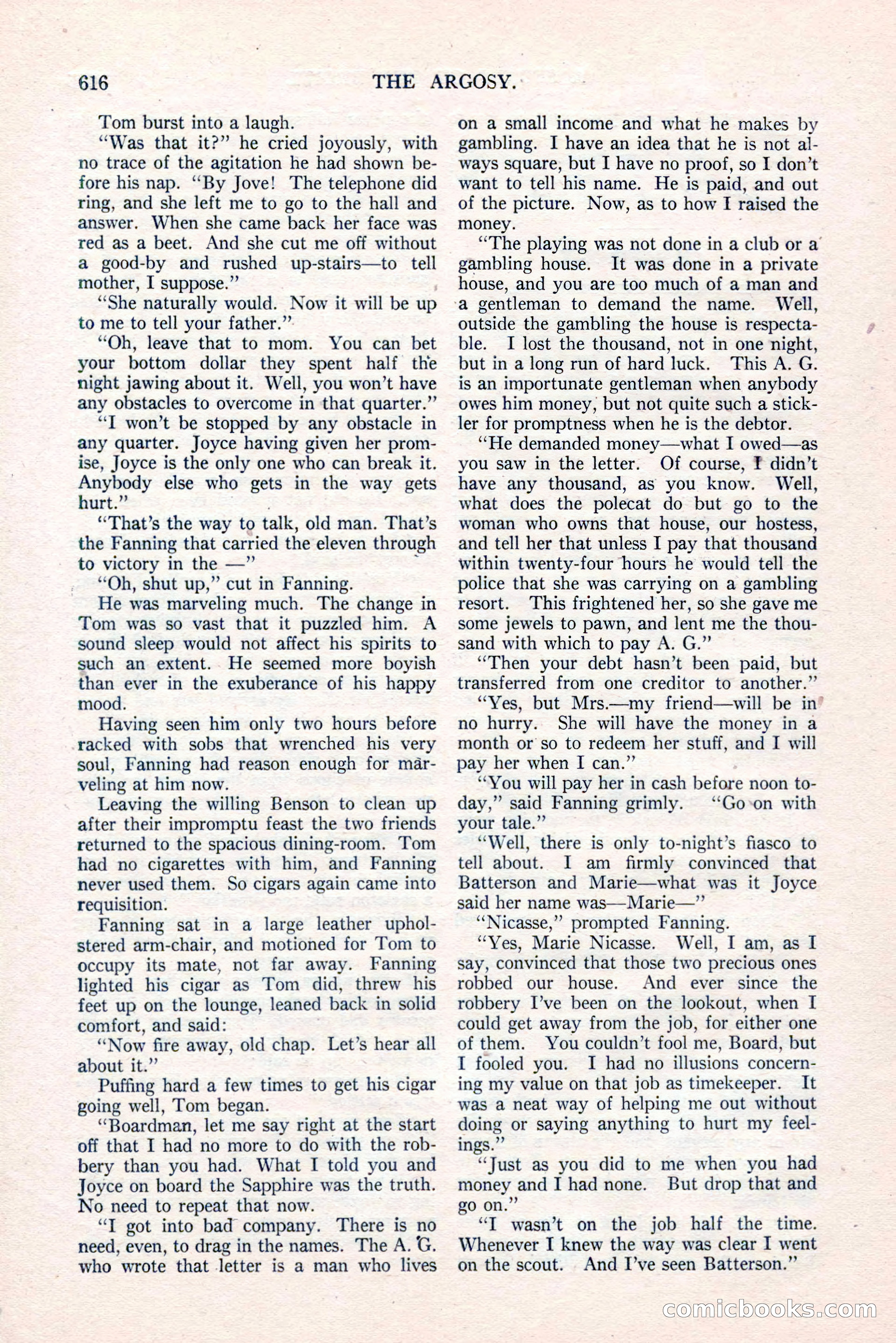
A restored page from Pulp Fiction, 1916. Page through the whole issue in the reader above.
📄 Transcribed text from this page (OCR, searchable)
Machine-transcribed from the original scan — historical spelling and the odd misread are preserved.
616 THE Tom burst into a laugh. “Was that it?” he cried joyously, with no trace of the agitation he had shown be- fore his nap. “By Jove! The telephone did ring, and she left me to go to the hall and answer. When she came back her face was red as a beet. And she cut me off without a good-by and rushed up-stairs—to tell mother, I suppose.” “She naturally would. Now it will be up to me to tell your father.’” “Oh, leave that to mom. You can bet your bottom dollar they spent half the night jawing about it. Well, you won’t have any obstacles to overcome in that quarter.” “T won’t be stopped by any obstacle in any quarter. Joyce having given her prom- ise, Joyce is the only one who can break it. Anybody else who gets in the way gets hurt.” ; “That’s the way to talk, old man. That’s the Fanning that carried the eleven through to victory in the —” : “Oh, shut up,” cut in Fanning. He was marveling much. The change in Tom was so vast that it puzzled him. A sound sleep would not affect his spirits to such an extent. He seemed more boyish than ever in the exuberance of his happy mood. Having seen him only two hours before racked with sobs that wrenched his very soul, Fanning had reason enough for mar- veling at him now. Leaving the willing Benson to clean up after their impromptu feast the two friends returned to the spacious dining-room. Tom had no cigarettes with him, and Fanning never used them. So cigars again came into requisition. Fanning sat in a large leather uphol- stered arm-chair, and motioned for Tom to occupy its mate, not far away. Fanning lighted his cigar as Tom did, threw his feet up on the lounge, leaned back in solid comfort, and said: “Now fire away, old chap. Let’s hear all about it.” Puffing hard a few times to get his cigar going well, Tom began. “Boardman, let me say right at the start off that I had no more to do with the rob- bery than you had. What I told you and Joyce on board the Sapphire was the truth. No need to repeat that now. “T got into bad company. There is no need, even, to drag in the names. The A. G. who wrote that letter is a man who lives ‘a gentleman to demand the name. ARGOSY. on a small income and what he makes by gambling. I have an idea that he is not al- ways square, but I have no proof, so I don’t want to tell his name. He is paid, and out of the picture. Now, as to how I raised the money. : “The playing was not done in a club or a gambling house. It was done in a private house, and you are too much of a man and Well, outside the gambling the house is respecta- ble. I lost the thousand, not in one night, but in a long run of hard luck. This A. G. is an importunate gentleman when anybody owes him money, but not quite such a stick- ler for promptness when he is the debtor. ‘““He demanded money—what I owed—as you saw in the letter. Of course, f didn’t have any thousand, as you know. Well, what does the polecat do but go to the woman who owns that house, our hostess, and tell her that unless I pay that thousand within twenty-four hours he would tell the police that she was carrying on a gambling resort. This frightened her, so she gave me some jewels to pawn, and lent me the thou- sand with which to pay A. G.” “Then your debt hasn’t been paid, but transferred from one creditor to another.” “Ves, but Mrs.—my friend—will be in’ no hurry. She will have the money in a month or’so to redeem her stuff, and I will pay her when I can.”’ “You will pay her in cash before noon to- day,” said Fanning grimly. ‘“Govon with your tale.” “Well, there is only to-night’s fiasco to tell about. I am firmly convinced that Batterson and Marie—what was it Joyce said her name was—Marie—”’ ‘“‘Nicasse,” prompted Fanning. “Ves, Marie Nicasse. Well, I am, as I say, convinced that those two precious ones robbed our house. And ever since the robbery I’ve been on the lookout, when [ could get away from the job, for either one of them. You couldn’t fool me, Board, but I fooled you. I had no illusions concern- ing my value on that job as timekeeper. It was a neat way of helping me out without doing or saying anything to hurt my feel- ings.” “Just as you did to me when you had money and I had none. But drop that and go on.” “T wasn’t on the job half the time. Whenever I knew the way was clear I went on the scout. And I’ve seen Batterson.” COMMICLOO® S (C@