
Pulp Fiction, 1916 · page 49 of 208
The Argosy, Vol. 82 No. 4 — page 49: what you’re looking at
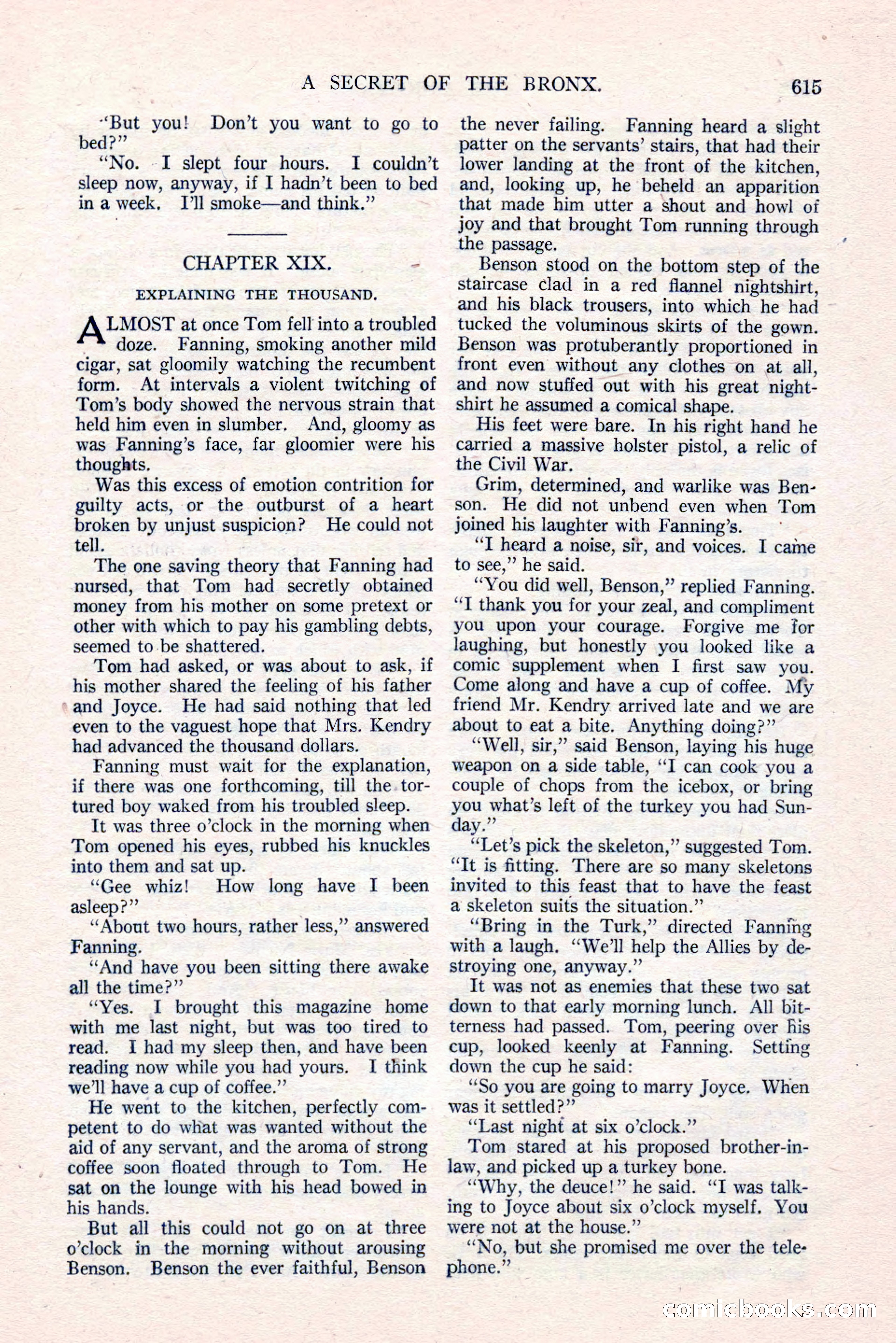
A restored page from Pulp Fiction, 1916. Page through the whole issue in the reader above.
📄 Transcribed text from this page (OCR, searchable)
Machine-transcribed from the original scan — historical spelling and the odd misread are preserved.
A SECRET OF THE BRONX. “But you! Don’t you want to go to bed?” “No. -I slept four hours. I couldn’t sleep now, anyway, if I hadn’t been to bed in a week, I’ll smoke—and think.” CHAPTER XIX. - EXPLAINING THE THOUSAND. LMOST at once Tom fell into a troubled ' * doze. Fanning, smoking another mild cigar, sat gloomily watching the recumbent form. At intervals a violent twitching of Tom’s body showed the nervous strain that held him even in slumber. And, gloomy as was Fanning’s face, far gloomier were his thoughts. Was this excess of emotion contrition for guilty acts, or the outburst of a heart broken by unjust suspicion? He could not tell. The one saving theory that Fanning had nursed, that Tom had secretly obtained money from his mother on some pretext or other with which to pay his gambling debts, seemed to-be shattered. Tom had asked, or was about to ask, if his mother shared the feeling of his father ‘and Joyce. He had said nothing that led even to the vaguest hope that Mrs. Kendry had advanced the thousand dollars. Fanning must wait for the explanation, if there was one forthcoming, till the. tor- tured boy waked from his troubled sleep. It was three o’clock in the morning when Tom opened his eyes, rubbed his knuckles into them and sat up. “Gee whiz! How long have I been asleep?” “About two hours, rather less,’’ answered Fanning. “And have you been sitting there awake all the time?” “Ves. I brought this magazine home with me last night, but was too tired to read. I had my sleep then, and have been reading now while you had yours. I think we'll have a cup of coffee.” He went to the kitchen, perfectly com- petent to do what was wanted without the aid of any servant, and the aroma of strong coffee soon floated through to Tom. He sat on the lounge with his head bowed in his hands. But all this could not go on at three o’clock in the morning without arousing Benson. Benson the ever faithful, Benson 615 the never failing. Fanning heard a slight patter on the servants’ stairs, that had their lower landing at the front of the kitchen, and, looking up, he beheld an apparition that made him utter a shout and howl of joy and that brought Tom running through the passage. Benson stood on the bottom step of the staircase clad in a red flannel nightshirt, and his black trousers, into which he had tucked the voluminous skirts of the gown. Benson was protuberantly proportioned in front even without any clothes on at all, and now stuffed out with his great night- shirt he assumed a comical shape. His feet were bare. In his right hand he carried a massive holster pistol, a relic of the Civil War. Grim, determined, and warlike was Ben- son. He did not unbend even when Tom joined his laughter with Fanning’s. “I heard a noise, sir, and voices. I came to see,” he said. “You did well, Benson,” replied Fanning. “I thank you for your zeal, and compliment you upon your courage. Forgive me for laughing, but honestly you looked like a comic supplement when I first saw you. Come along and have a cup of coffee. My friend Mr. Kendry arrived late and we are about to eat a bite. Anything doing?” ‘“Well, sir,” said Benson, laying his huge weapon on a side table, “I can cook you a couple of chops from the icebox, or bring = what's left of the turkey you had Sun- y.” “Let’s pick the skeleton,” suggested Tom. “It is fitting. There are so many skeletons invited to this feast that to have the feast a skeleton suits the situation.” “Bring in the Turk,” directed Fanning with a laugh. ‘We'll help the Allies by de- stroying one, anyway.”’ It was not as enemies that these two sat down to that early morning lunch. All bit- terness had passed. Tom, peering over his cup, looked keenly at Fanning. Setting down the cup he said: “So you are going to marry Joyce. When was it settled?” “Last night at six o’clock.” Tom stared at his proposed brother-in- law, and picked up a turkey bone. ‘““Why, the deuce!”’ he said. “I was talk- ing to Joyce about six o’clock myself. You were not at the house.” ‘““‘No, but she promised me over the tele- phone.” cS COMICOOO (C@