
Pulp Fiction, 1916 · page 194 of 208
The Argosy, Vol. 82 No. 4 — page 194: what you’re looking at
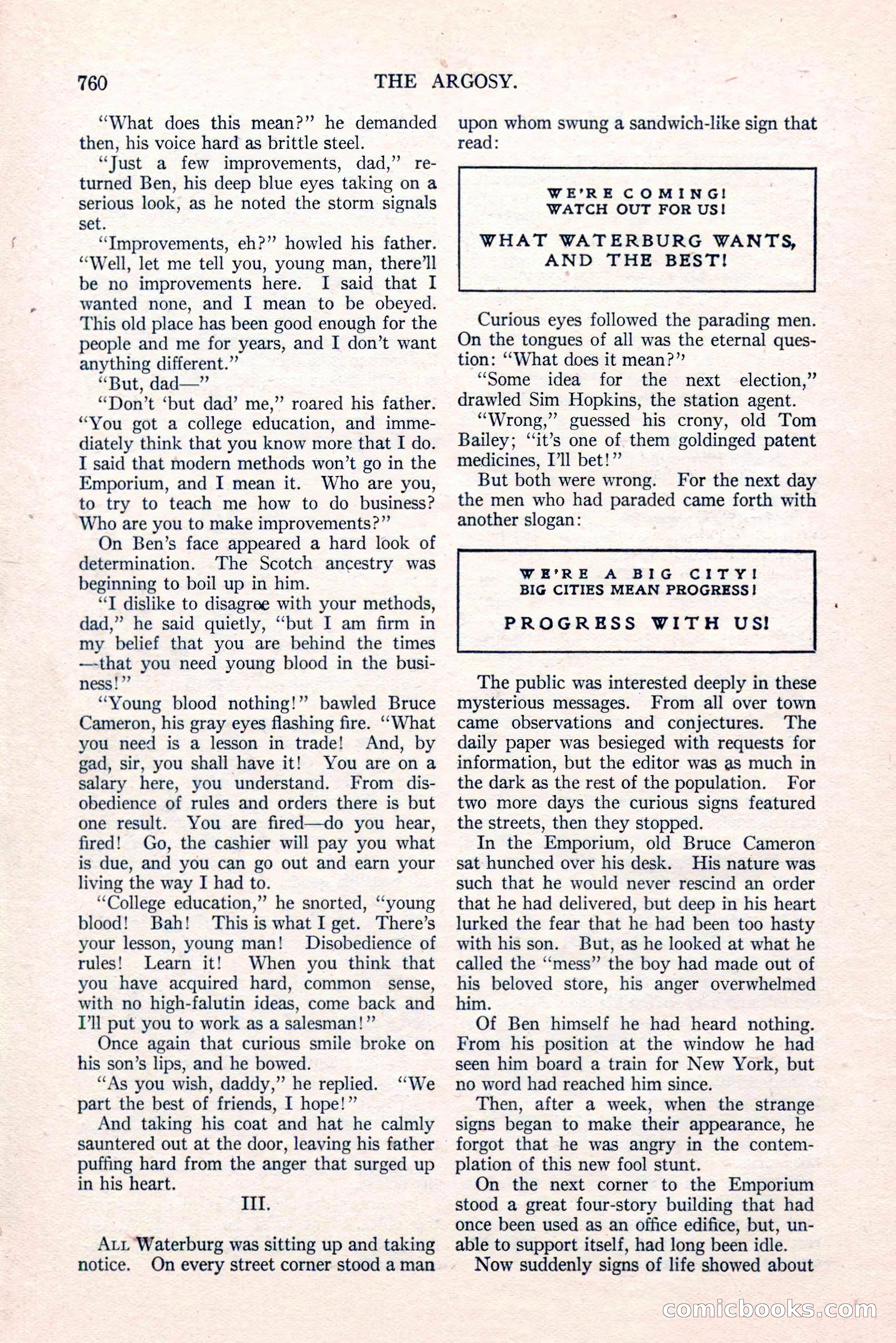
A restored page from Pulp Fiction, 1916. Page through the whole issue in the reader above.
📄 Transcribed text from this page (OCR, searchable)
Machine-transcribed from the original scan — historical spelling and the odd misread are preserved.
760 “What does this mean?” he demanded then, his voice hard as brittle steel. “Just a few improvements, dad,” re- turned Ben, his deep blue eyes taking on a serious look, as he noted the storm signals set. “Improvements, eh?” howled his father. “Well, let me tell you, young man, there’ll be no improvements here. I said that I wanted none, and I mean to be obeyed. This old place has been good enough for the people and me for years, and I don’t want anything different.” “But, dad—” “Don’t ‘but dad’ me,” roared his father. “You got a college education, and imme- diately think that you know more that I do. I said that modern methods won’t go in the Emporium, and I mean it. Who are you, to try to teach me how to do business? Who are you to make improvements?”’ On Ben’s face appeared a hard look of determination. The Scotch ancestry was beginning to boil up in him. “T dislike to disagree with your methods, dad,” he said quietly, “but I am firm in my belief that you are behind the times — that you need young blood in the busi- ness!”’ “Young blood nothing!” bawled Bruce Cameron, his gray eyes flashing fire. “What you need is a lesson in trade! And, by gad, sir, you shall have it! You are on a salary here, you understand. From dis- obedience of rules and orders there is but one result. You are fired—do you hear, fired! Go, the cashier will pay you what is due, and you can go out and earn your living the way I had to. “College education,” he snorted, “young blood! Bah! This is what I get. There’s your lesson, young man! Disobedience of rules! Learn it! When you think that you have acquired hard, common sense, with no high-falutin ideas, come back and I’ll put you to work as a salesman!” Once again that curious smile broke on his son’s lips, and he bowed. ‘““As you wish, daddy,” he replied. part the best of friends, I hope!” And taking his coat and hat he calmly sauntered out at the door, leaving his father puffing hard from the anger that surged up in his heart. “We IIT, Att Waterburg was sitting up and taking notice. On every street corner stood a man THE ARGOSY. upon whom swung a sandwich-like sign that read: WE’RE COMING! WATCH OUT FOR US! WHAT WATERBURG WANTS, AND THE BEST! Curious eyes followed the parading men. On the tongues of all was the eternal ques- tion: “‘What does it mean?” “Some idea for the next election,” drawled Sim Hopkins, the station agent. “Wrong,” guessed his crony, old Tom Bailey; “it’s one of them goldinged patent medicines, [ll bet!” But both were wrong. For the next day the men who had paraded came forth with another slogan: W.E’RE -A BG -OIT Y¥1 BIG CITIES MEAN PROGRESS! PROGRESS WITH US! The public was interested deeply in these mysterious messages. From all over town came observations and conjectures. The daily paper was besieged with requests for information, but the editor was as much in the dark as the rest of the population. For two more days the curious signs featured the streets, then they stopped. In the Emporium, old Bruce Cameron sat hunched over his desk. His nature was such that he would never rescind an order that he had delivered, but deep in his heart lurked the fear that he had been too hasty with his son. But, as he looked at what he called the ‘“‘mess” the boy had made out of his beloved store, his anger overwhelmed him. Of Ben himself he had heard nothing. From his position at the window he had seen him board a train for New York, but no word had reached him since. Then, after a week, when the strange signs began to make their appearance, he forgot that he was angry in the contem- plation of this new fool stunt. On the next corner to the Emporium stood a great four-story building that had once been used as an office edifice, but, un- able to support itself, had long been idle. Now suddenly signs of life showed about CORmMICLOOokKS (C@