
Pulp Fiction, 1916 · page 53 of 212
The Argosy, Vol. 82, No. 3 — page 53: what you’re looking at
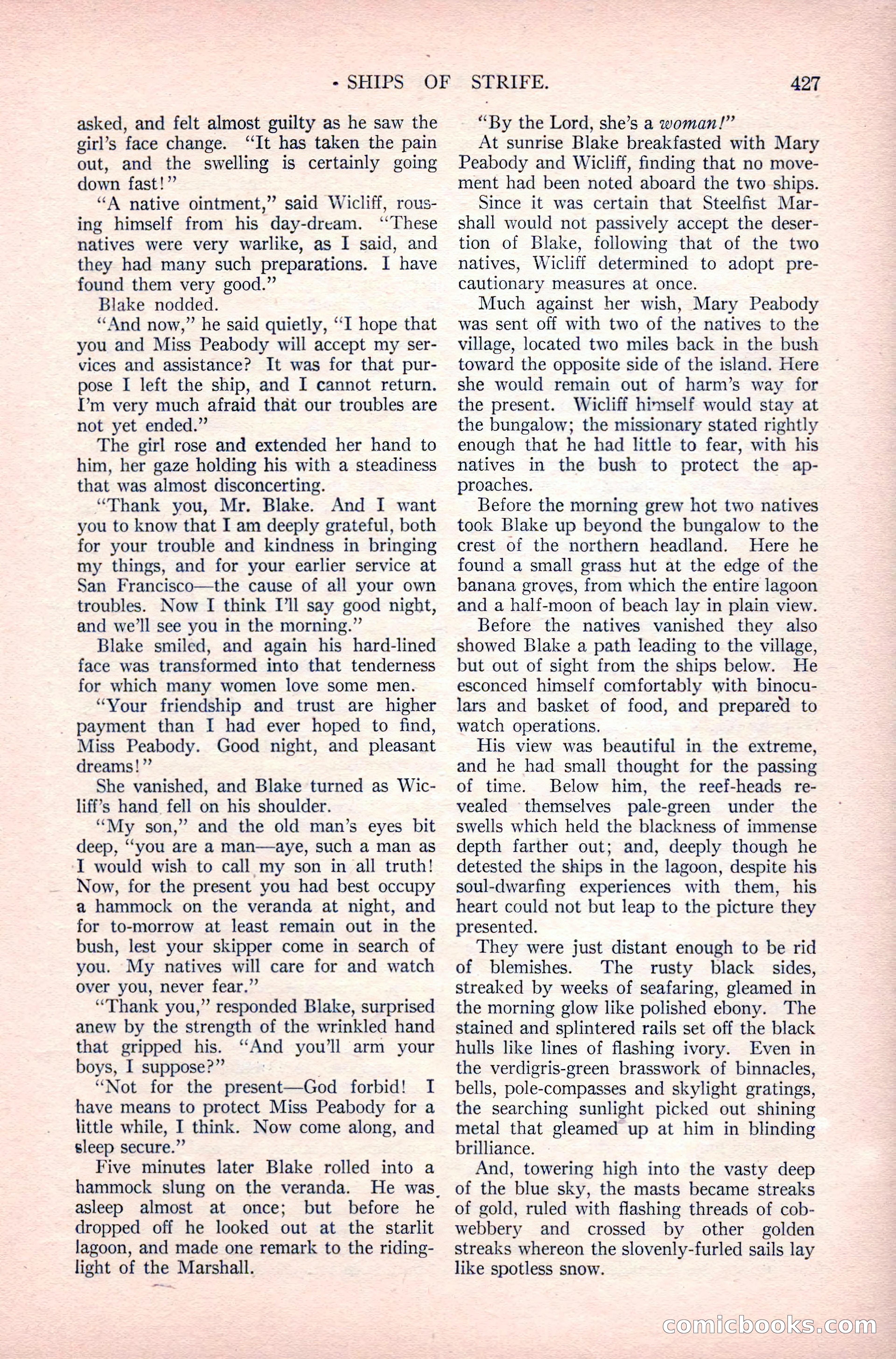
A restored page from Pulp Fiction, 1916. Page through the whole issue in the reader above.
📄 Transcribed text from this page (OCR, searchable)
Machine-transcribed from the original scan — historical spelling and the odd misread are preserved.
- SHIPS OF STRIFE. asked, and felt almost guilty as he saw the girl’s face change. “It has taken the pain out, and the swelling is certainly going down fast!” “A native ointment,” said Wicliff, rous- ing himself from his day-dream. ‘These natives were very warlike, as I said, and they had many such preparations. I have found them very good.” Blake nodded. “And now,” he said quietly, “I hope that you and Miss Peabody will accept my ser- vices and assistance? It was for that pur- pose I left the ship, and I cannot return. (’'m very much afraid that our troubles are not yet ended.” The girl rose and extended her hand to him, her gaze holding his with a steadiness that was almost disconcerting. “Thank you, Mr. Blake. And I want you to know that I am deeply grateful, both for your trouble and kindness in bringing my things, and for your earlier service at San Francisco—the cause of all your own troubles. Now I think I'll say good night, and we’ll see you in the morning.” Blake smiled, and again his hard-lined face was transformed into that tenderness for which many women love some men. “Your friendship and trust are higher - payment than I had ever hoped to find, Miss Peabody. Good night, and pleasant dreams!” She vanished, and Blake turned as Wic- liff’s hand fell on his shoulder. “My son,” and the old man’s eyes bit deep, “you are a man—aye, such a man as I would wish to call my son in all truth! Now, for the present you had best occupy a hammock on the veranda at night, and for to-morrow at least remain out in the bush, lest your skipper come in search of you. My natives will care for and watch over you, never fear.” “Thank you,” responded Blake, surprised anew by the strength of the wrinkled hand that gripped his. “And you’ll arm your boys, I suppose?” . “Not for the present—God forbid! I have means to protect Miss Peabody for a little while, I think. Now come along, and sleep secure.” Five minutes later Blake rolled into a hammock slung on the veranda. asleep almost at once; but before he dropped off he looked out at the starlit lagoon, and made one remark to the riding- light of the Marshall. He was. 427 “By the Lord, she’s a woman!” At sunrise Blake breakfasted with Mary Peabody and Wicliff, finding that no move- ment had been noted aboard the two ships. Since it was certain that Steelfist Mar- shall would not passively accept the deser- tion of Blake, following that of the two natives, Wicliff determined to adopt pre- cautionary measures at once. Much against her wish, Mary Peabody was sent off with two of the natives to the village, located two miles back in the bush toward the opposite side of the island. Here she would remain out of harm’s way for the present. Wicliff himself would stay at the bungalow; the missionary stated rightly enough that he had little to fear, with his natives in the bush to protect the ap- proaches. Before the morning grew hot two natives took Blake up beyond the bungalow to the crest of the northern headland. Here he found a small grass hut at the edge of the banana groves, from which the entire lagoon and a half-moon of beach lay in plain view. Before the natives vanished they also showed Blake a path leading to the village, but out of sight from the ships below. He esconced himself comfortably with binocu- lars and basket of food, and prepared to watch operations. His view was beautiful in the extreme, and he had small thought for the passing of time. Below him, the reef-heads re- vealed themselves pale-green under the swells which held the blackness of immense depth farther out; and, deeply though he detested the ships in the lagoon, despite his soul-dwarfing experiences with them, his heart could not but leap to the picture they presented. They were just distant enough to be rid of blemishes. The rusty black sides, streaked by weeks of seafaring, gleamed in the morning glow like polished ebony. The stained and splintered rails set off the black hulls like lines of flashing ivory. Even in the verdigris-green brasswork of binnacles, bells, pole-compasses and skylight gratings, the searching sunlight picked out shining metal that gleamed up at him in blinding brilliance. And, towering high into the vasty deep of the blue sky, the masts became streaks of gold, ruled with flashing threads of cob- webbery and crossed by other golden streaks whereon the slovenly-furled sails lay like spotless snow. CORMICLOOOKS (C@)