
Pulp Fiction, 1916 · page 52 of 212
The Argosy, Vol. 82, No. 3 — page 52: what you’re looking at
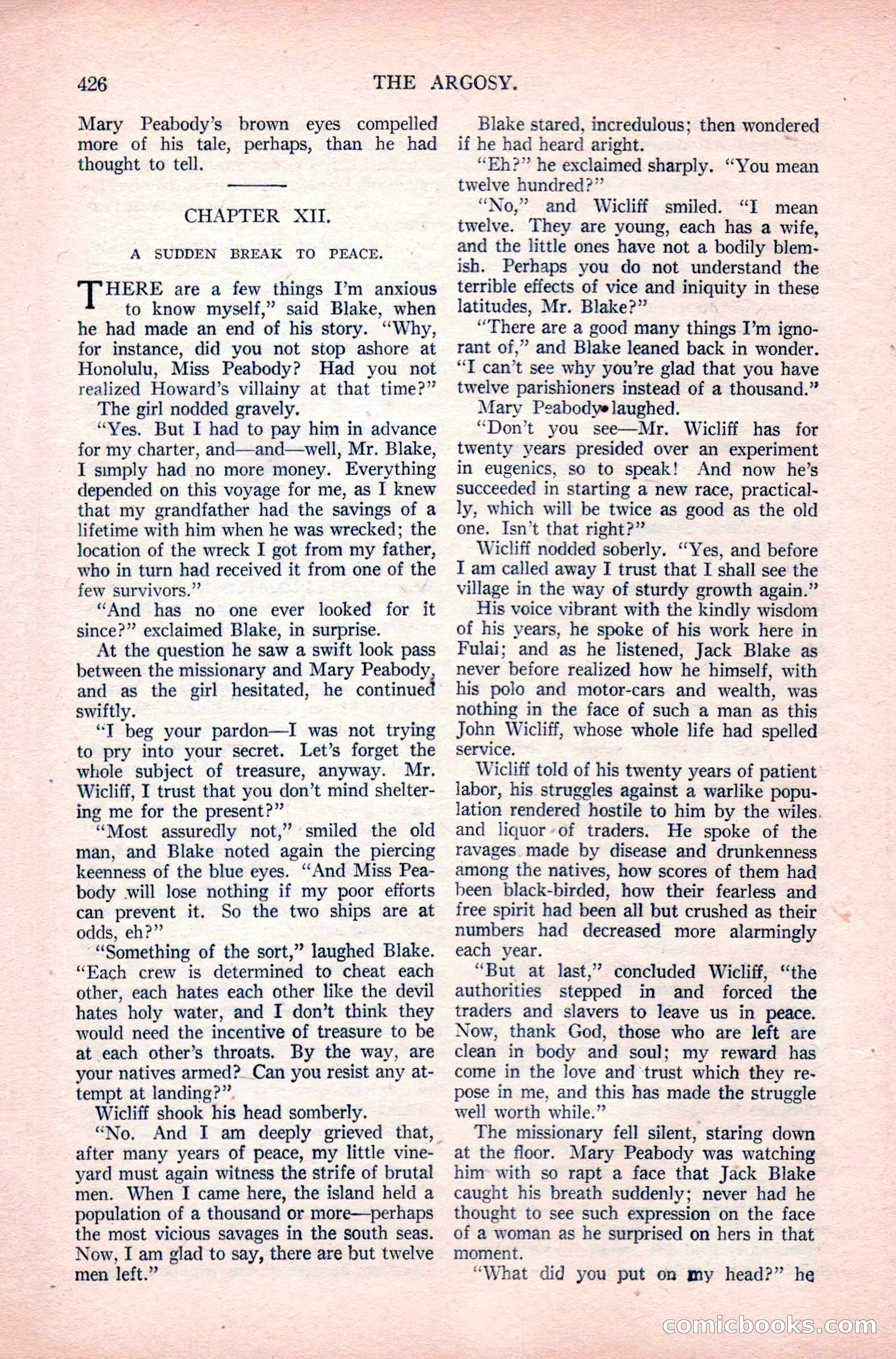
A restored page from Pulp Fiction, 1916. Page through the whole issue in the reader above.
📄 Transcribed text from this page (OCR, searchable)
Machine-transcribed from the original scan — historical spelling and the odd misread are preserved.
426 Mary Peabody’s brown eyes compelled more of his tale, perhaps, than he had thought to tell. CHAPTER XII. A SUDDEN BREAK TO PEACE. HERE are a few things I’m anxious to know myself,” said Blake, when he had made an end of his story. “Why, for instance, did you not stop ashore at Honolulu, Miss Peabody? Had you not realized Howard’s villainy at that time?” The girl nodded gravely. “Ves. But I had to pay him in advance for my charter, and—and—well, Mr. Blake, I simply had no more money. Everything depended on this voyage for me, as I knew that my grandfather had the savings of a lifetime with him when he was wrecked; the location of the wreck I got from my father, who in turn had received it from one of the few survivors.” “And has no one ever looked for it since?” exclaimed Blake, in surprise. At the question he saw a swift look pass between the missionary and Mary Peabody and as the girl hesitated, he continued swiftly. “T beg your pardon—I was not trying to pry into your secret. Let’s forget the whole subject of treasure, anyway. Mr. Wicliff, I trust that you don’t mind shelter- ing me for the present?” “Most assuredly not,” smiled the old man, and Blake noted again the piercing keenness of the blue eyes. ‘““And Miss Pea- body will lose nothing if my poor efforts can prevent it. So the two ships are at odds, eh?” “Something of the sort,” laughed Blake. “Each crew is determined to cheat each other, each hates each other like the devil hates holy water, and I don’t think they would need the incentive of treasure to be at each other’s throats. By the way, are your natives armed? Can you resist any at- tempt at landing?” Wicliff shook his head somberly. “No. And I am deeply grieved that, after many years of peace, my little vine- yard must again witness the strife of brutal men. When I came here, the island held a population of a thousand or more—perhaps the most vicious savages in the south seas. Now, I am glad to say, there are but twelve men left.” THE ARGOSY. Blake stared, incredulous; then wondered if he had heard aright. “Eh?” he exclaimed sharply. “You mean twelve hundred?” “No,” and Wicliff smiled. “I mean twelve. They are young, each has a wife, and the little ones have not a bodily blem- ish. Perhaps you do not understand the terrible effects of vice and iniquity in these latitudes, Mr. Blake?” ‘There are a good many things I’m igno- rant of,” and Blake leaned back in wonder. “T can’t see why you're glad that you have twelve parishioners instead of a thousand.” Mary Peabodye laughed. “Don’t you see—Mr. Wicliff has for twenty years presided over an experiment in eugenics, so to speak! And now he’s succeeded in starting a new race, practical- ly, which will be twice as good as the old one. Isn’t that right?” Wicliff nodded soberly. ‘Yes, and before I am called away I trust that I shall see the village in the way of sturdy growth again.” His voice vibrant with the kindly wisdom of his years, he spoke of his work here in Fulai; and as he listened, Jack Blake as never before realized how he himself, with his polo and motor-cars and wealth, was nothing in the face of such a man as this John Wicliff, whose whole life had spelled service. Wicliff told of his twenty years of patient labor, his struggles against a warlike popu- lation rendered hostile to him by the wiles. and liquor-of traders. He spoke of the ravages. made by disease and drunkenness among the natives, how scores of them had been black-birded, how their fearless and free spirit had been all but crushed as their numbers had decreased more alarmingly each year. “But at last,” concluded Wicliff, “the authorities stepped in and forced the traders and slavers to leave us in peace. Now, thank God, those who are left are clean in body and soul; my reward has come in the love and trust which they re- pose in me, and this has made the struggle well worth while.” The missionary fell silent, staring down at the floor. Mary Peabody was watching him with so rapt a face that Jack Blake caught his breath suddenly; never had he thought to see such expression on the face of a woman as he surprised on hers in that moment. “What did you put on my head?” he ECORMMICLOOOKS (C@)