
Pulp Fiction, 1916 · page 168 of 212
The Argosy, Vol. 82, No. 3 — page 168: what you’re looking at
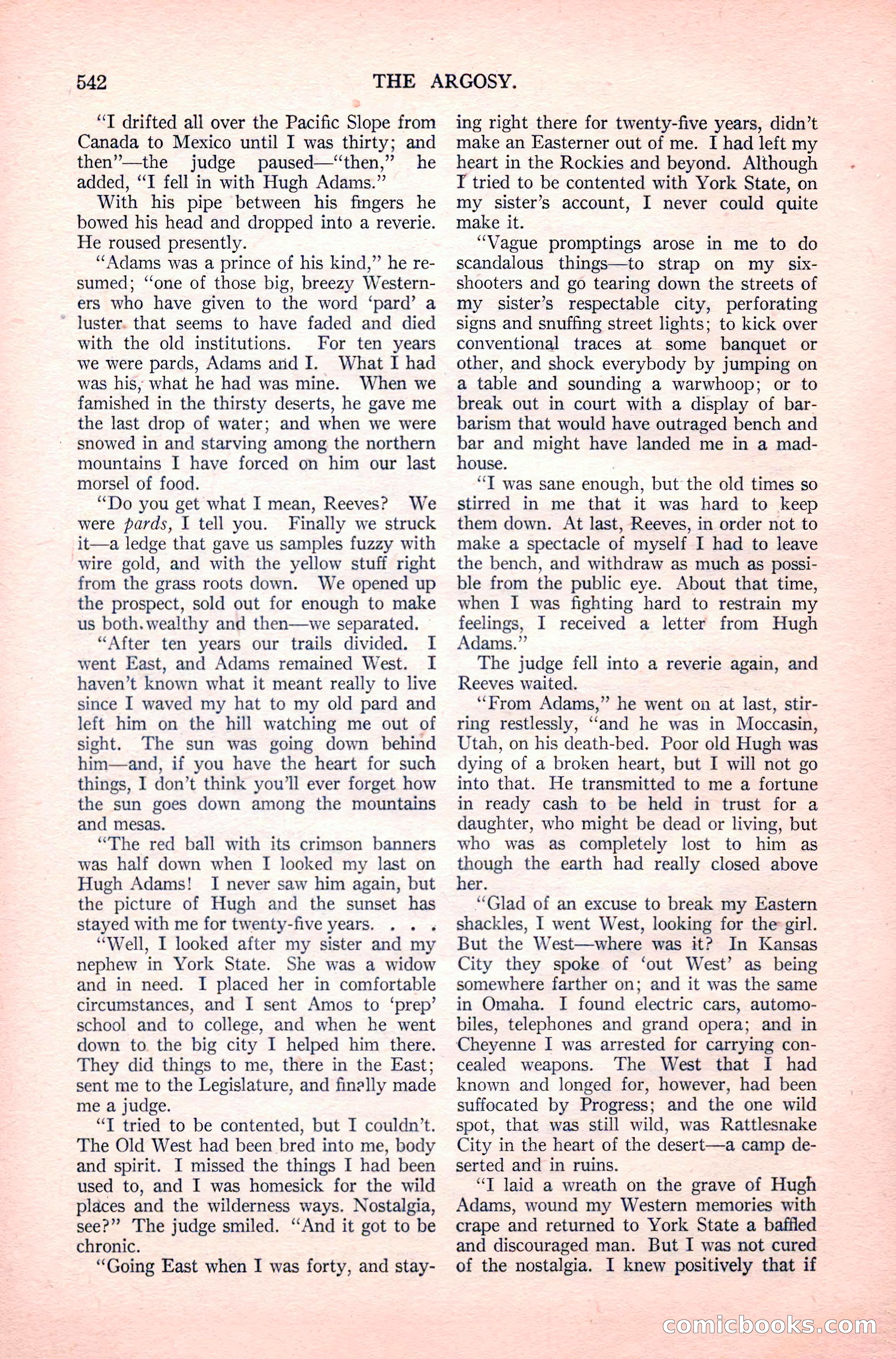
A restored page from Pulp Fiction, 1916. Page through the whole issue in the reader above.
📄 Transcribed text from this page (OCR, searchable)
Machine-transcribed from the original scan — historical spelling and the odd misread are preserved.
542 “T drifted all over the Pacific Slope from Canada to Mexico until I was thirty; and then”—the judge paused—‘“then,” he added, “I fell in with Hugh Adams.” With his pipe between his fingers he bowed his head and dropped into a reverie. He roused presently. ‘““Adams was a prince of his kind,” he re- sumed; “one of those big, breezy Western- ers who have given to the word ‘pard’ a luster. that seems to have faded and died with the old institutions. For ten years we were pards, Adams arid I. What I had was his, what he had was mine. When we famished in the thirsty deserts, he gave me the last drop of water; and when we were - snowed in and starving among the northern mountains I have forced on him our last morsel of food. “Do you get what I mean, Reeves? We were pards, J tell you. Finally we struck it—a ledge that gave us samples fuzzy with wire gold, and with the yellow stuff right from the grass roots down. We opened up the prospect, sold out for enough to make us both. wealthy and then—we separated. “After ten years our trails divided. I went East, and Adams remained West. I haven’t known what it meant really to live since I waved my hat to my old pard and left him on the hill watching me out of sight. The sun was going down behind him—and, if you have the heart for such things, I don’t think you'll ever forget how the sun goes down among the mountains and mesas. “The red ball with its crimson banners was half down when I looked my last on Hugh Adams! I never saw him again, but the picture of Hugh and the sunset has stayed with me for twenty-five years. ‘ “Well, I looked after my sister and my nephew in York State. She was a widow and in need. I placed her in comfortable circumstances, and I sent Amos to ‘prep’ school and to college, and when he went down to the big city I helped him there. They did things to me, there in the East; sent me to the Legislature, and finally made me a judge. “T tried to be contented, but I couldn’t. The Old West had been bred into me, body and spirit. I missed the things I had been used to, and I was homesick for the wild places and the wilderness ways. Nostalgia, see?” The judge smiled. ‘And it got to be chronic. “Going East when I was forty, and stay- THE ARGOSY. ing right there for twenty-five years, didn’t make an Easterner out of me. I had left my heart in the Rockies and beyond. Although T tried to be contented with York State, on my sister’s account, I never could quite make it. ‘Vague promptings arose in me to do scandalous things—to strap on my six- shooters and go tearing down the streets of my sister’s respectable city, perforating signs and snuffing street lights; to kick over conventional traces at some banquet or other, and shock everybody by jumping on a table and sounding a warwhoop; or to break out in court with a display of bar- barism that would have outraged bench and bar and might have landed me in a mad- house. 3 “T was sane enough, but the old times so stirred in me that it was hard to keep them down. At last, Reeves, in order not to make a spectacle of myself I had to leave the bench, and withdraw as much as possi- ble from the public eye. About that time, when I was fighting hard to restrain my feelings, I received a letter from Hugh Adams.” The judge fell into a reverie again, and Reeves waited. ‘From Adams,” he went on at last, stir- ring restlessly, ‘‘and he was in Moccasin, Utah, on his death-bed. Poor old Hugh was dying of a broken heart, but I will not go into that. He transmitted to me a fortune in ready cash to be held in trust for a daughter, who might be dead or living, but who was as completely lost to him as though the earth had really closed above her. “Glad of an excuse to break my Eastern shackles, I went West, looking for the girl. But the West—where was it? In Kansas City they spoke of ‘out West’ as being somewhere farther on; and it was the same in Omaha. I found electric cars, automo- biles, telephones and grand opera; and in Cheyenne I was arrested for carrying con- cealed weapons. The West that I had known and longed for, however, had been suffocated by Progress; and the one wild spot, that was still wild, was Rattlesnake City in the heart of the desert—a camp de- serted and in ruins. “T laid a wreath on the grave of Hugh Adams, wound my Western memories with crape and returned to York State a baffled and discouraged man. But I was not cured of the nostalgia. I knew positively that if COPMICLOOOKS (©)