
Pulp Fiction, 1916 · page 167 of 212
The Argosy, Vol. 82, No. 3 — page 167: what you’re looking at
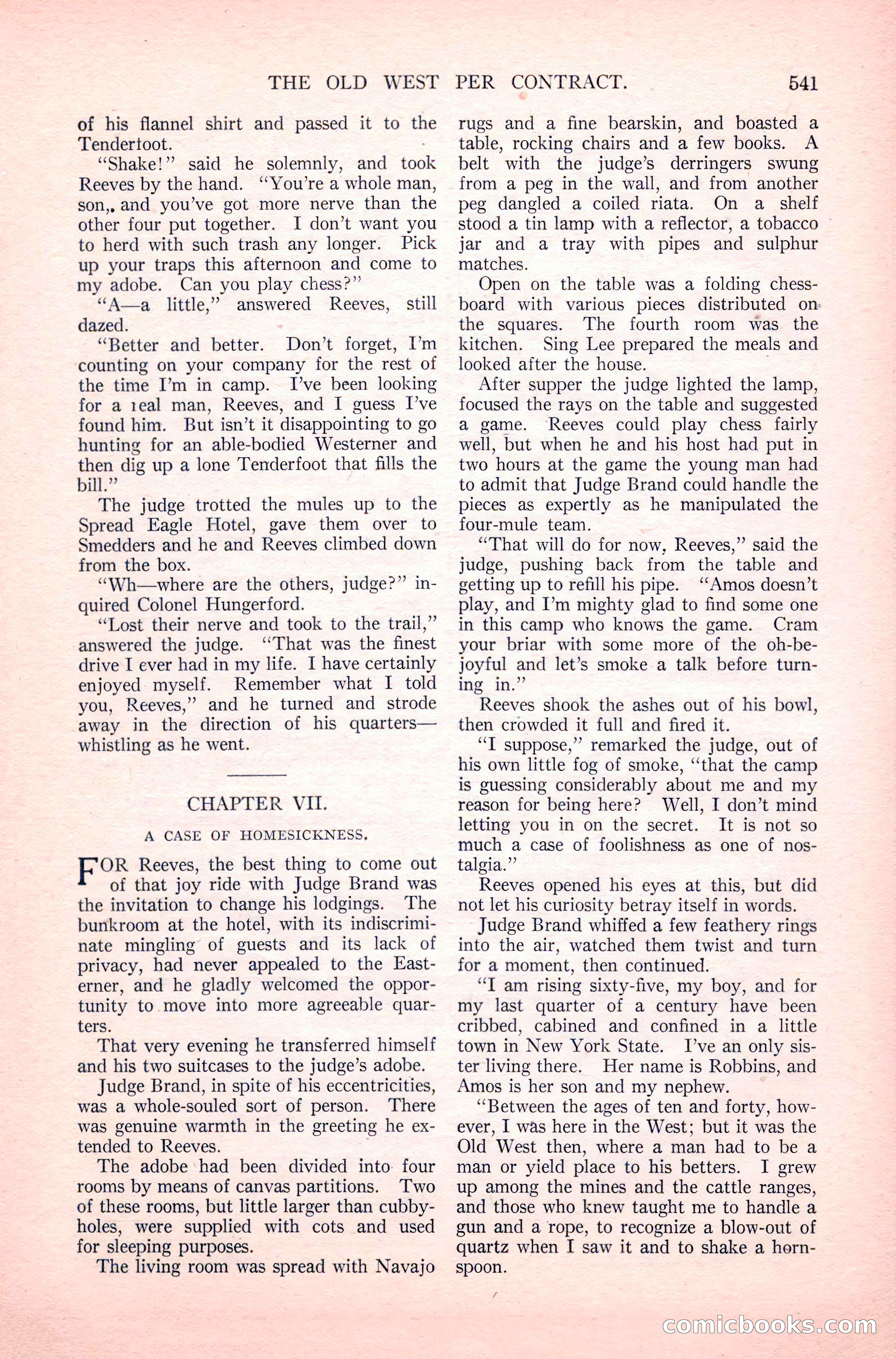
A restored page from Pulp Fiction, 1916. Page through the whole issue in the reader above.
📄 Transcribed text from this page (OCR, searchable)
Machine-transcribed from the original scan — historical spelling and the odd misread are preserved.
THE OLD WEST of his flannel shirt and passed it to the Tendertoot. “Shake!” said he solemnly, and took Reeves by the hand. “You’re a whole man, son, and you’ve got more nerve than the other four put together. I don’t want you to herd with such trash any longer. Pick up your traps this afternoon and come to my adobe. Can you play chess?” “Aa little,’ answered Reeves, still dazed. “Better and better. Don’t forget, I’m counting on your company for the rest of the time I’m in camp. I’ve been looking for a 1eal man, Reeves, and I guess I’ve found him. But isn’t it disappointing to go hunting for an able-bodied Westerner and then dig up a lone Tenderfoot that fills the bill.” The judge trotted the mules up to the Spread Eagle Hotel, gave them over to Smedders and he and Reeves climbed down from the box. ‘“‘Wh—where are the others, judge?” in- quired Colonel Hungerford. “Tost their nerve and took to the trail,” answered the judge. ‘That was the finest drive I ever had in my life. I have certainly enjoyed myself. Remember what I told you, Reeves,” and he turned and strode away in the direction of his quarters— whistling as he went. CHAPTER VII. A CASE OF HOMESICKNESS, FoR Reeves, the best thing to come out of that joy ride with Judge Brand was the invitation to change his lodgings. The bunkroom at the hotel, with its indiscrimi- nate mingling of guests and its lack of privacy, had never appealed to the East- erner, and he gladly welcomed the oppor- tunity to move into more agreeable quar- ters. That very evening he transferred himself and his two suitcases to the judge’s adobe. Judge Brand, in spite of his eccentricities, was a whole-souled sort of person. There was genuine warmth in the greeting he ex- tended to Reeves. ; The adobe had been divided into four rooms by means of canvas partitions. Two of these rooms, but little larger than cubby- holes, were supplied with cots and used for sleeping purposes. The living room was spread with Navajo PER CONTRACT. 541 rugs and a fine bearskin, and boasted a table, rocking chairs and a few books. A belt with the judge’s derringers swung from a peg in the wall, and from another peg dangled a coiled riata. On a shelf stood a tin lamp with a reflector, a tobacco ~ jar and a tray with pipes and sulphur matches. Open on the table was a folding chess- board with various pieces distributed on: the squares. The fourth room was the kitchen. Sing Lee prepared the meals and looked after the house. After supper the judge lighted the lamp, focused the rays on the table and suggested a game. Reeves could play chess fairly well, but when he and his host had put in two hours at the game the young man had to admit that Judge Brand could handle the pieces as expertly as he manipulated the four-mule team. “That will do for now, Reeves,” said the judge, pushing back from the table and getting up to refill his pipe. ‘‘Amos doesn’t play, and I’m mighty glad to find some one in this camp who knows the game. Cram your briar with some more of the oh-be- joyful and let’s smoke a talk before turn- ing in.” Reeves shook the ashes out of his bowl, then crowded it full and fired it. ‘“T suppose,” remarked the judge, out of his own little fog of smoke, ‘‘that the camp is guessing considerably about me and my reason for being here? Well, I don’t mind letting you in on the secret. It is not so much a case of foolishness as one of nos- talgia.”’ Reeves opened his eyes at this, but did not let his curiosity betray itself in words. Judge Brand whiffed a few feathery rings into the air, watched them twist and turn for a moment, then continued. “Tt am rising sixty-five, my boy, and for my last quarter of a century have been cribbed, cabined and confined in a little town in New York State. I’ve an only sis- ter living there. Her name is Robbins, and Amos is her son and my nephew. “Between the ages of ten and forty, how- ever, I was here in the West; but it was the Old West then, where a man had to be a man or yield place to his betters. I grew up among the mines and the cattle ranges, and those who knew taught me to handle a gun and a rope, to recognize a blow-out of quartz when I saw it and to shake a hern- spoon. / (EO) KOOKS (©)