
Pulp Fiction, 1916 · page 135 of 212
The Argosy, Vol. 82, No. 3 — page 135: what you’re looking at
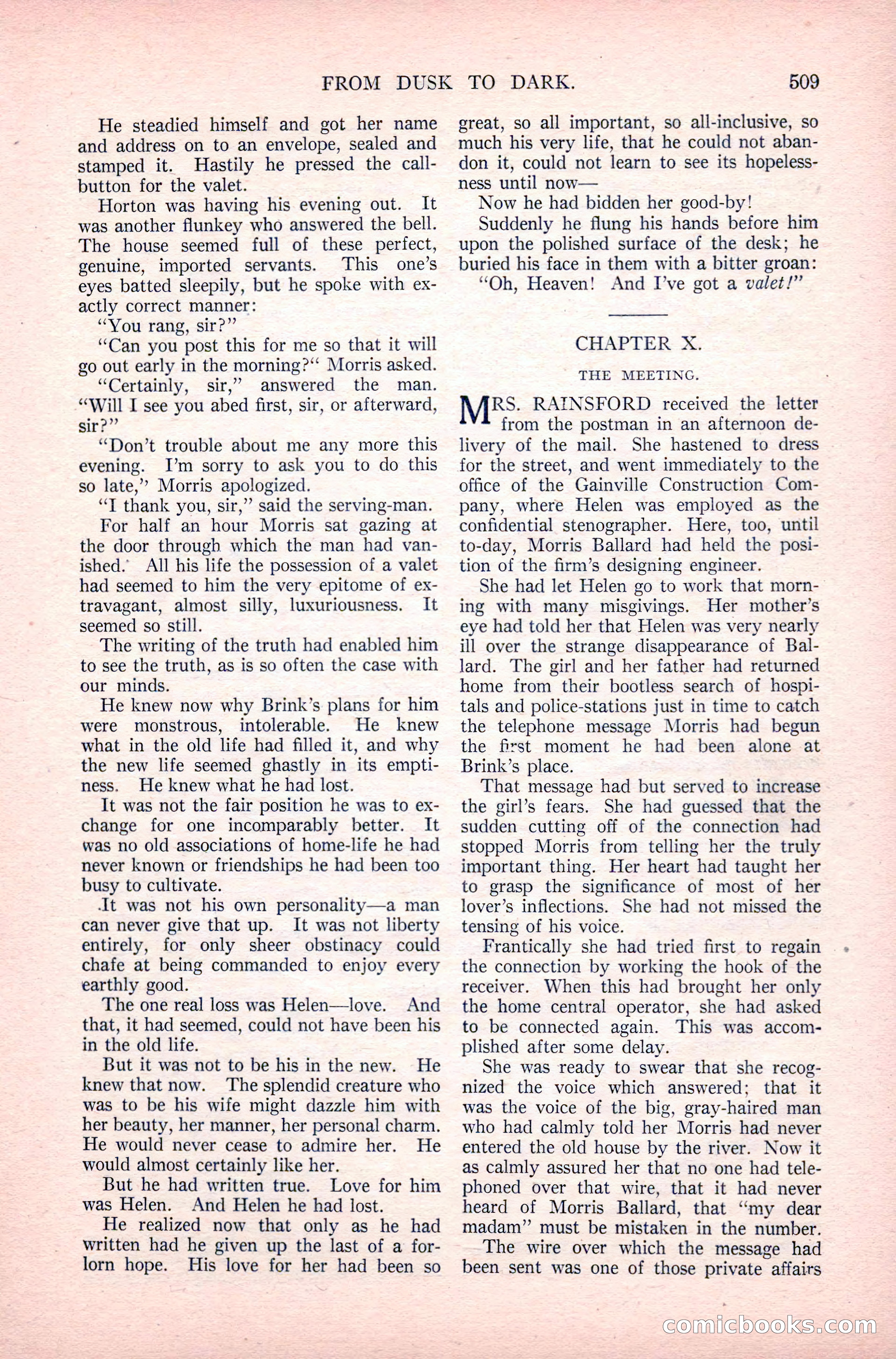
A restored page from Pulp Fiction, 1916. Page through the whole issue in the reader above.
📄 Transcribed text from this page (OCR, searchable)
Machine-transcribed from the original scan — historical spelling and the odd misread are preserved.
FROM DUSK TO DARK. He steadied himself and got her name and address on to an envelope, sealed and stamped it. Hastily he pressed the call- button for the valet. Horton was having his evening out. It was another flunkey who answered the bell. The house seemed full of these perfect, genuine, imported servants. This one’s eyes batted sleepily, but he spoke with ex- actly correct manner: “Vou rang, sir?” “Can you post this for me so that it will go out early in the morning?‘‘ Morris asked. “Certainly, sir,” answered the man. “Will I see you abed first, sir, or afterward, sir?” “Don’t trouble about me any more this evening. I’m sorry to ask you to do this so late,” Morris apologized. “T thank you, sir,” said the serving-man. For half an hour Morris sat gazing at the door through which the man had van- ished. All his life the possession of a valet had seemed to him the very epitome of ex- travagant, almost silly, luxuriousness. It seemed so still. The writing of the truth had enabled him to see the truth, as is so often the case with our minds. He knew now why Brink’s plans for him were monstrous, intolerable. He knew what in the old life had filled it, and why the new life seemed ghastly in its empti- ness. He knew what he had lost. It was not the fair position he was to ex- change for one incomparably better. It was no old associations of home-life he had never known or friendships he had been too busy to cultivate. It was not his own personality—a man can never give that up. It was not liberty entirely, for only sheer obstinacy could chafe at being commanded to enjoy every earthly good. The one real loss was Helen—love. And that, it had seemed, could not have been his in the old life. But it was not to be his in the new. He knew that now. The splendid creature who was to be his wife might dazzle him with her beauty, her manner, her personal charm. He would never cease to admire her. He would almost certainly like her. But he had written true. Love for him was Helen. And Helen he had lost. He realized now that only as he had written had he given up the last of a for- lorn hope. His love for her had been so 509 great, so all important, so all-inclusive, so much his very life, that he could not aban- don it, could not learn to see its hopeless- ness until now— Now he had bidden her good-by! Suddenly he flung his hands before him upon the polished surface of the desk; he buried his face in them with a bitter groan: “Oh, Heaven! And I’ve got a valet!” CHAPTER X. THE MEETING. RS. RAINSFORD received the letter from the postman in an afternoon de- livery of the mail. She hastened to dress for the street, and went immediately to the office of the Gainville Construction Com- pany, where Helen was employed as the confidential stenographer. Here, too, until to-day, Morris Ballard had held the posi- tion of the firm’s designing engineer. She had let Helen go to work that morn- ing with many misgivings. Her mother’s eye had told her that Helen was very nearly ill over the strange disappearance of Bal- lard. The girl and her father had returned home from their bootless search of hospi- tals and police-stations just in time to catch the telephone message Morris had begun the first moment he had been alone at Brink’s place. That message had but served to increase the girl’s fears. She had guessed that the sudden cutting off of the connection had stopped Morris from telling her the truly important thing. Her heart had taught her to grasp the significance of most of her lover’s inflections. She had not missed the tensing of his voice. Frantically she had tried first to regain the connection by working the hook of the receiver. When this had brought her only the home central operator, she had asked to be connected again. This was accom- plished after some delay. She was ready to swear that she recog- nized the voice which answered; that it was the voice of the big, gray-haired man who had calmly told her Morris had never entered the old house by the river. Now it as calmly assured her that no one had tele- phoned over that wire, that it had never heard of Morris Ballard, that “my dear madam” must be mistaken in the number. The wire over which the message had been sent was one of those private affairs ElN@O com S (C@