
Pulp Fiction, 1916 · page 134 of 212
The Argosy, Vol. 82, No. 3 — page 134: what you’re looking at
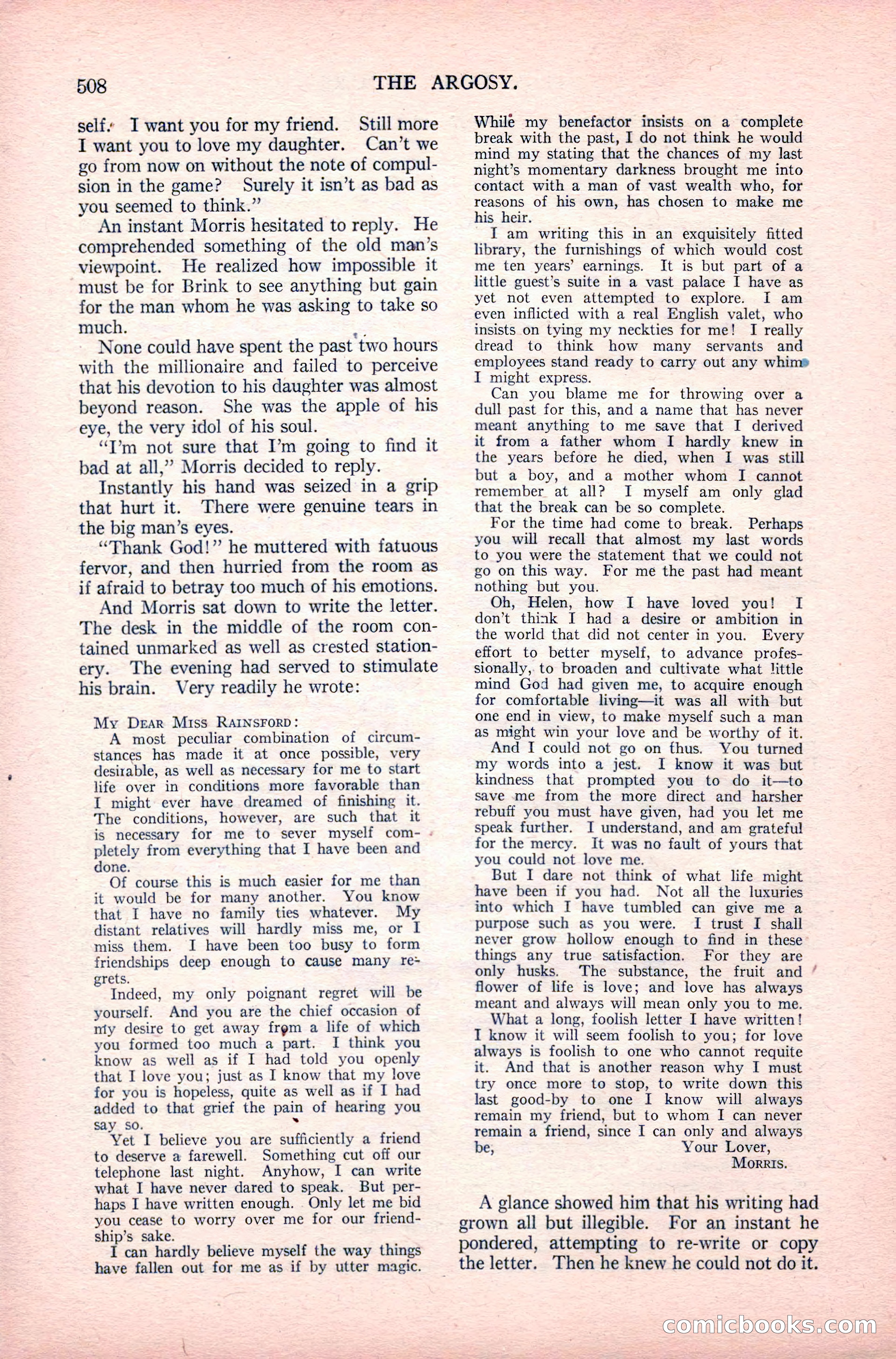
A restored page from Pulp Fiction, 1916. Page through the whole issue in the reader above.
📄 Transcribed text from this page (OCR, searchable)
Machine-transcribed from the original scan — historical spelling and the odd misread are preserved.
508 self’ I want you for my friend. Still more I want you to love my daughter. Can’t we go from now on without the note of compul- sion in the game? Surely it isn’t as bad as you seemed to think.” An instant Morris hesitated to reply. He comprehended something of the old man’s viewpoint. He realized how impossible it must be for Brink to see anything but gain for the man whom he was asking to take so much. = None could have spent the past two hours with the millionaire and failed to perceive that his devotion to his daughter was almost beyond reason. She was the apple of his eye, the very idol of his soul. “T’m not sure that I’m going to find it bad at all,” Morris decided to reply. Instantly his hand was seized in a grip that hurt it. There were genuine tears in the big man’s eyes. “Thank God!” he muttered with fatuous fervor, and then hurried from the room as if afraid to betray too much of his emotions. And Morris sat down to write the letter. The desk in the middle of the room con- tained unmarked as well as crested station- ery. The evening had served to stimulate his brain. Very readily he wrote: My Dear Miss RAINSFORD: A most peculiar combination of circum- stances has made it at once possible, very desirable, as well as necessary for me to start life over in conditions more favorable than I might ever have dreamed of finishing it. The conditions, however, are such that it is necessary for me to sever myself com- - pletely from everything that I have been and done. Of course this is much easier for me than it would be for many another. You know that I have no family ties whatever. My distant relatives will hardly miss me, or I miss them. I have been too busy to form friendships deep enough to cause many re= rets. : Indeed, my only poignant regret will be yourself. And you are the chief occasion of miy desire to get away frgm a life of which you formed too much a part. I think you know as well as if I had told you openly that I love you; just as I know that my love for you is hopeless, quite as well as if I had added to that grief the pain of hearing you so. Vet I believe you are sufficiently a friend to deserve a farewell. Something cut off our telephone last night. Anyhow, I can write what I have never dared to speak. But per- THE ARGOSY. While my benefactor insists on a complete break with the past, I do not think he would mind my stating that the chances of my last night’s momentary darkness brought me into contact with a man of vast wealth who, for reasons of his own, has chosen to make me his heir. I am writing this in an exquisitely fitted library, the furnishings of which would cost me ten years’ earnings. It is but part of a little guest’s suite in a vast palace I have as yet not even attempted to explore. i am even inflicted with a real English valet, who insists on tying my neckties for me! I really dread to think how many servants and employees stand ready to carry out any whims I might express. Can you blame me for throwing over a dull past for this, and a name that has never meant anything to me save that I derived it from a father whom I hardly knew in the years before he died, when I was still but a boy, and a mother whom I cannot remember at all? I myself am only glad that the break can be so complete. For the time had come to break. Perhaps you will recall that almost my last words to you were the statement that we could not go on this way. For me the past had meant nothing but you. Oh, Helen, how [I have loved you! I don’t think I had a desire or ambition in the world that did not center in you. Every effort to better myself, to advance profes- sionally,.to broaden and cultivate what little mind God had given me, to acquire enough for comfortable living—it was all with but one end in view, to make myself such a man as might win your love and be worthy of it. And I could not go on thus. You turned my words into a jest. I know it was but kindness that prompted you to do it—to save me from the more direct and harsher rebuff you must have given, had you let me speak further. I understand, and am grateful for the mercy. It was no fault of yours that you could not love me. But I dare not think of what life might have been if you had. Not all the luxuries into which I have tumbled can give me a purpose such as you were. I trust I shall never grow hollow enough to find in these things any true satisfaction. For they are only husks. The substance, the fruit and flower of life is love; and love has always meant and always will mean only you to me. What a long, foolish letter I have written! I know it will seem foolish to you; for love always is foolish to one who cannot requite it. And that is another reason why I must try once more to stop, to write down this last good-by to one I know will always remain my friend, but to whom I can never remain a friend, since I can only and always be, Your Lover, Morris. ‘~ haps I have written enough. Only let me bid you cease to worry over me for our friend- ship’s sake. I can hardly believe myself the way things have fallen out for me as if by utter magic. A glance showed him that his writing had grown all but illegible. For an instant he pondered, attempting to re-write or copy the letter. Then he knew he could not do it. Gomichoo cS) (E@)