
Pulp Fiction, 1916 · page 114 of 212
The Argosy, Vol. 82, No. 3 — page 114: what you’re looking at
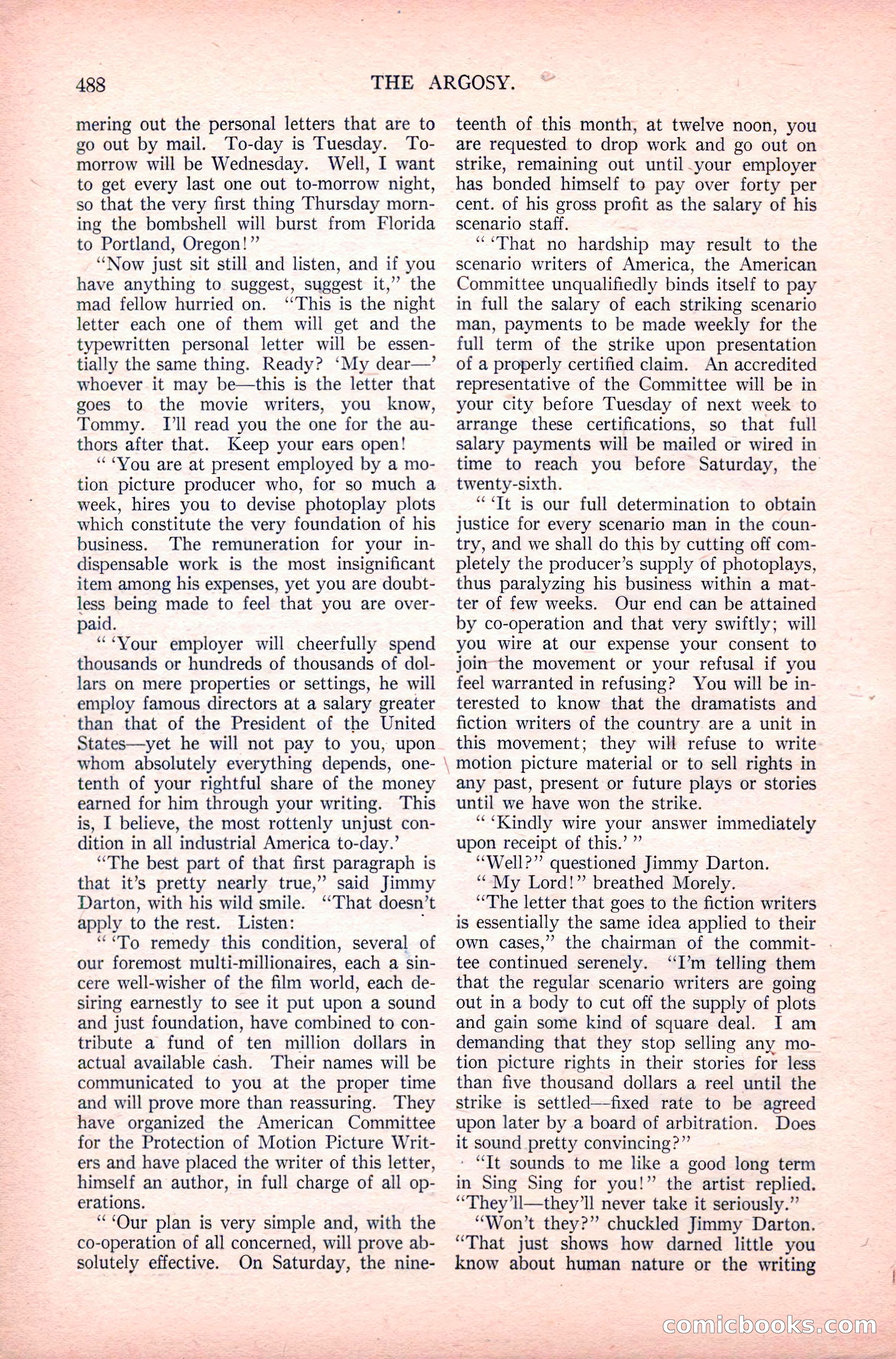
A restored page from Pulp Fiction, 1916. Page through the whole issue in the reader above.
📄 Transcribed text from this page (OCR, searchable)
Machine-transcribed from the original scan — historical spelling and the odd misread are preserved.
488 mering out the personal letters that are to go out by mail. To-day is Tuesday. To- morrow will be Wednesday. Well, I want to get every last one out to-morrow night, so that the very first thing Thursday morn- ing the bombshell will burst from Florida to Portland, Oregon!”’ “Now just sit still and listen, and if you have anything to suggest, suggest it,” the mad fellow hurried on. ‘This is the night letter each one of them will get and the typewritten personal letter will be essen- tially the same thing. Ready? ‘My dear—’ whoever it may be—this is the letter that goes to the movie writers, you know, Tommy. I'll read you the one for the au- thors after that. Keep your ears open! ‘““*Vou are at present employed by a mo- tion picture producer who, for so much a week, hires you to devise photoplay plots which constitute the very foundation of his business. ‘The remuneration for your in- dispensable work is the most insignificant item among his expenses, yet you are doubt- less being made to feel that you are over- paid. ““VYour employer will cheerfully spend thousands or hundreds of thousands of dol- lars on mere properties or settings, he will employ famous directors at a salary greater than that of the President of the United States—yet he will not pay to you, upon whom absolutely everything depends, one- | tenth of your rightful share of the money earned for him through your writing. This is, I believe, the most rottenly unjust con- dition in all industrial America to-day.’ “The best part of that first paragraph is that it’s pretty nearly true,” said Jimmy Darton, with his wild smile. “That doesn’t apply to the rest. Listen: “*To remedy this condition, several of our foremost multi-millionaires, each a sin- cere well-wisher of the film world, each de- siring earnestly to see it put upon a sound and just foundation, have combined to con- tribute a fund of ten million dollars in actual available cash. Their names will be communicated to you at the proper time and will prove more than reassuring. They have organized the American Committee for the Protection of Motion Picture Writ- ers and have placed the writer of this letter, himself an author, in full charge of all op- erations. “ “Our plan is very simple and, with the co-operation of all concerned, will prove ab- solutely effective. On Saturday, the nine- THE ARGOSY. teenth of this month, at twelve noon, you are requested to drop work and go out on strike, remaining out until.your employer has bonded himself to pay over forty per cent. of his gross profit as the salary of his scenario staff. “That no hardship may result to the scenario writers of America, the American Committee unqualifiedly binds itself to pay in full the salary of each striking scenario man, payments to be made weekly for the full term of the strike upon presentation of a properly certified claim. An accredited representative of the Committee will be in your city before Tuesday of next week to arrange these certifications, so that full salary payments will be mailed or wired in time to reach you before Saturday, the twenty-sixth. “Tt is our full determination to obtain justice for every scenario man in the coun- try, and we shall do this by cutting off com- pletely the producer’s supply of photoplays, thus paralyzing his business within a mat- ter of few weeks. Our end can be attained by co-operation and that very swiftly; will you wire at our expense your consent to join the movement or your refusal if you feel warranted in refusing? You will be in- terested to know that the dramatists and fiction writers of the country are a unit in this movement; they will refuse to write motion picture material or to sell rights in any past, present or future plays or stories until we have won the strike. “Kindly wire your answer immediately upon receipt of this.’ ”’ “Well?” questioned Jimmy Darton. “My Lord!” breathed Morely. “The letter that goes to the fiction writers is essentially the same idea applied to their own cases,” the chairman of the commit- . tee continued serenely. “I’m telling them that the regular scenario writers are going out in a body to cut off the supply of plots and gain some kind of square deal. I am demanding that they stop selling any mo- tion picture rights in their stories for less than five thousand dollars a reel until the strike is settled—fixed rate to be agreed upon later by a board of arbitration. Does it sound pretty convincing?” ' “It sounds to me like a good long term in Sing Sing for you!” the artist replied. ‘They’Il—they’ll never take it seriously.” ‘“Won’t they?” chuckled Jimmy Darton. “That just shows how darned little you know about human nature or the writing (E00) NOOLKS AAG (C@)